Pyeongye
Painters · 17th century
Rembrandt
1606–1669
A miller's son from Leiden who won fame in Amsterdam, lost nearly everything, and kept painting human faces caught in a single shaft of light until the end.
Scenes from a life
The life of Rembrandt,
scene by scene
- 1624Amsterdam
Rembrandt was born in Leiden on 15 July 1606, the son of a miller. The family mill stood by the Rhine, and van Rijn means "of the Rhine." He finished Latin school and briefly enrolled at the university, but he chose painting instead. After a few years of training in Leiden, at about eighteen he spent six more months in Amsterdam with the history painter Pieter Lastman.
- 1631Leiden
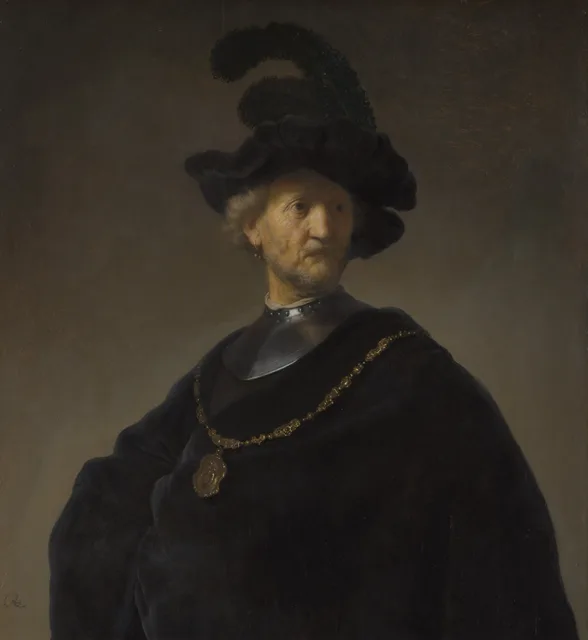
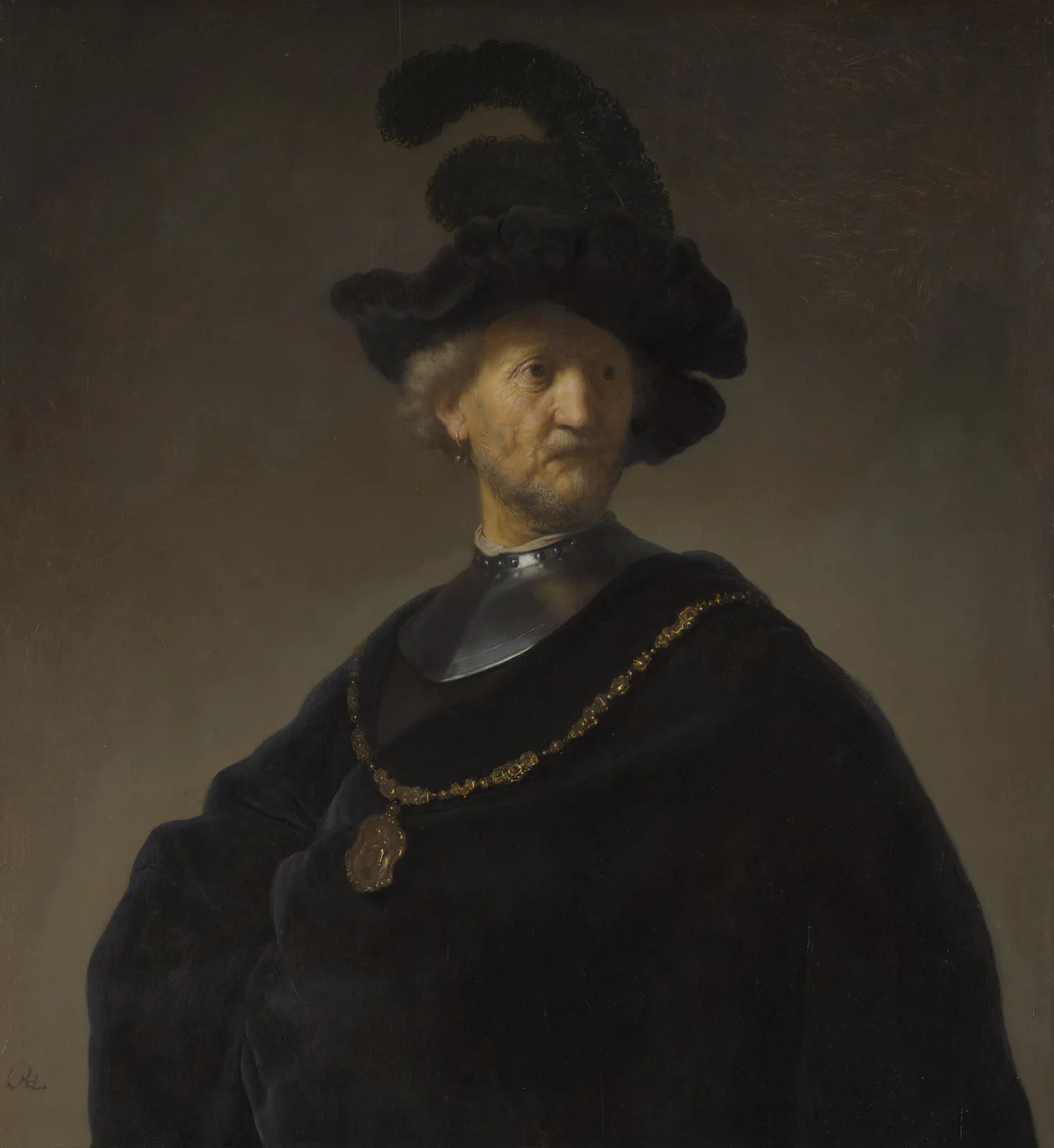
Back home, he worked side by side with Jan Lievens, a painter a year younger, the two pushing each other on. Constantijn Huygens, secretary to the stadtholder, visited and was impressed. He urged them to go to Italy to study. According to Huygens, they answered that they were too busy. Old Man with a Gold Chain comes from these years. Look at the plumed beret, the steel collar of armor at his throat, and the glinting chain. It was not a commissioned portrait but a character study, a chance to play with light and costume.
 Painted around this timeOld Man with a Gold Chain
- 1634Amsterdam
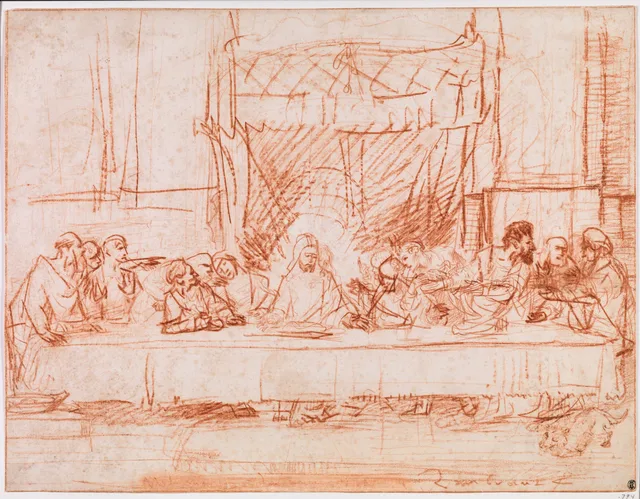
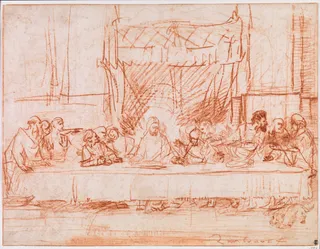
He moved to Amsterdam and teamed up with the art dealer Hendrick Uylenburgh. In 1632 The Anatomy Lesson of Dr. Nicolaes Tulp made his name almost overnight. In 1634 he married Saskia, Uylenburgh's cousin. Around then he copied Leonardo's Last Supper in red chalk. He never went to Italy, so he knew the mural through prints. His lines are fast and rough, and the disciples lean and murmur around the still figure of Christ in the middle.
 Painted around this timeThe Last Supper, after Leonardo da Vinci
- 1642Amsterdam
In 1639 he had bought an expensive house on a busy street, and in 1641 his son Titus was born. Three earlier children had died as babies. In 1642 Saskia died before she reached thirty. That same year he finished a huge group portrait of a civic militia company spilling out with drum and banner, the painting later nicknamed The Night Watch.
- 1653Amsterdam
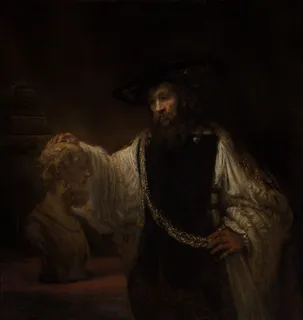
A Sicilian nobleman, Antonio Ruffo, ordered a painting from far away. Rembrandt gave him Aristotle, wearing a heavy gold chain, resting his hand on a bust of Homer, lost in thought. By then Hendrickje Stoffels was part of his household. Meanwhile, the debt on the house kept growing.
 Painted around this timeAristotle with a Bust of Homer
- 1656Amsterdam
In the end he went bankrupt. Everything in the house was written down in an inventory: paintings, sculpture, armor, even seashells. Then it was sold at auction. In 1658 the house itself was sold, and he moved to rented rooms on the Rozengracht, in a humbler part of town.
- 1660Amsterdam
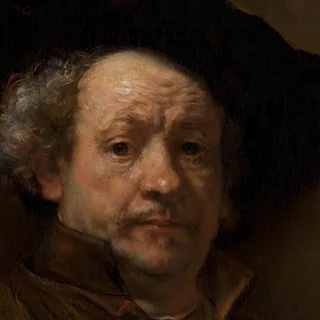
Hendrickje and Titus set up an art business and made Rembrandt their employee, so that creditors could not seize his new work. In the Self-Portrait from this year he wears a black beret over graying curls and shows every furrow in his forehead and every shadow under his eyes. Look at the right edge: in the darkness, his name and the date 1660 are faintly written.
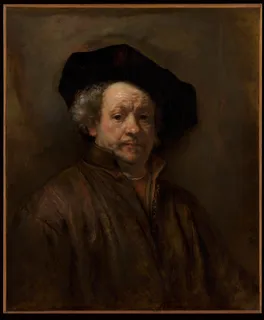 Painted around this timeSelf-Portrait
- 1669Amsterdam
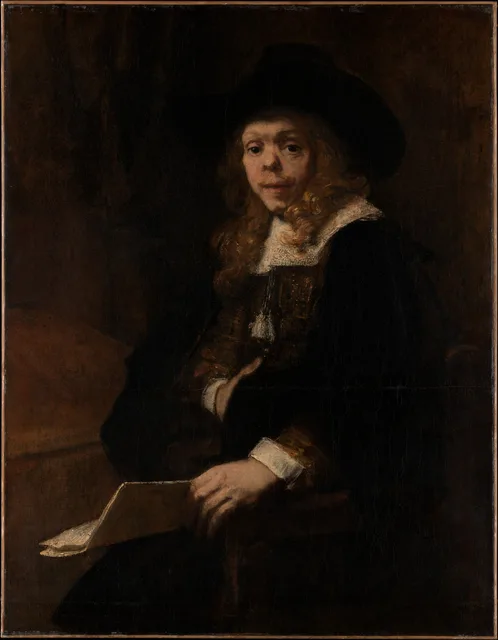
A few years earlier he had painted the young artist Gerard de Lairesse. Later, in a book on the art of painting, Lairesse criticized Rembrandt's dark manner as old-fashioned. Hendrickje died in 1663, and Titus in 1668. In October 1669 Rembrandt died in Amsterdam and was buried in the Westerkerk.
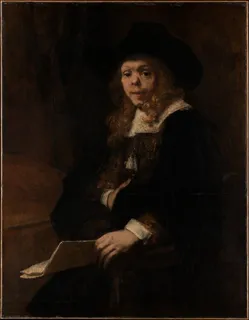 Painted around this timePortrait of Gerard de Lairesse
In their own words
die meeste ende die naetuereelste beweechgelickheijt
"The utmost and most natural movement." In a 1639 letter to Huygens, Rembrandt used these words for what he had tried to put into his paintings of Christ's Passion. Whether that last word means movement of the body or movement of the heart is still debated.
People around them
- Pieter Lastmanthe Amsterdam history painter who taught him for six months.
- Jan Lievensthe fellow painter he worked beside, and competed with, in Leiden.
- Constantijn Huygensthe stadtholder's secretary who spotted the young Rembrandt's talent and helped him find work.
- Saskia van Uylenburghhis wife from 1634, who died in 1642.
- Hendrickje Stoffelshis companion after Saskia's death, who ran the household and the art business.
- Titus van Rijnhis son, who died a year before his father.