Pyeongye
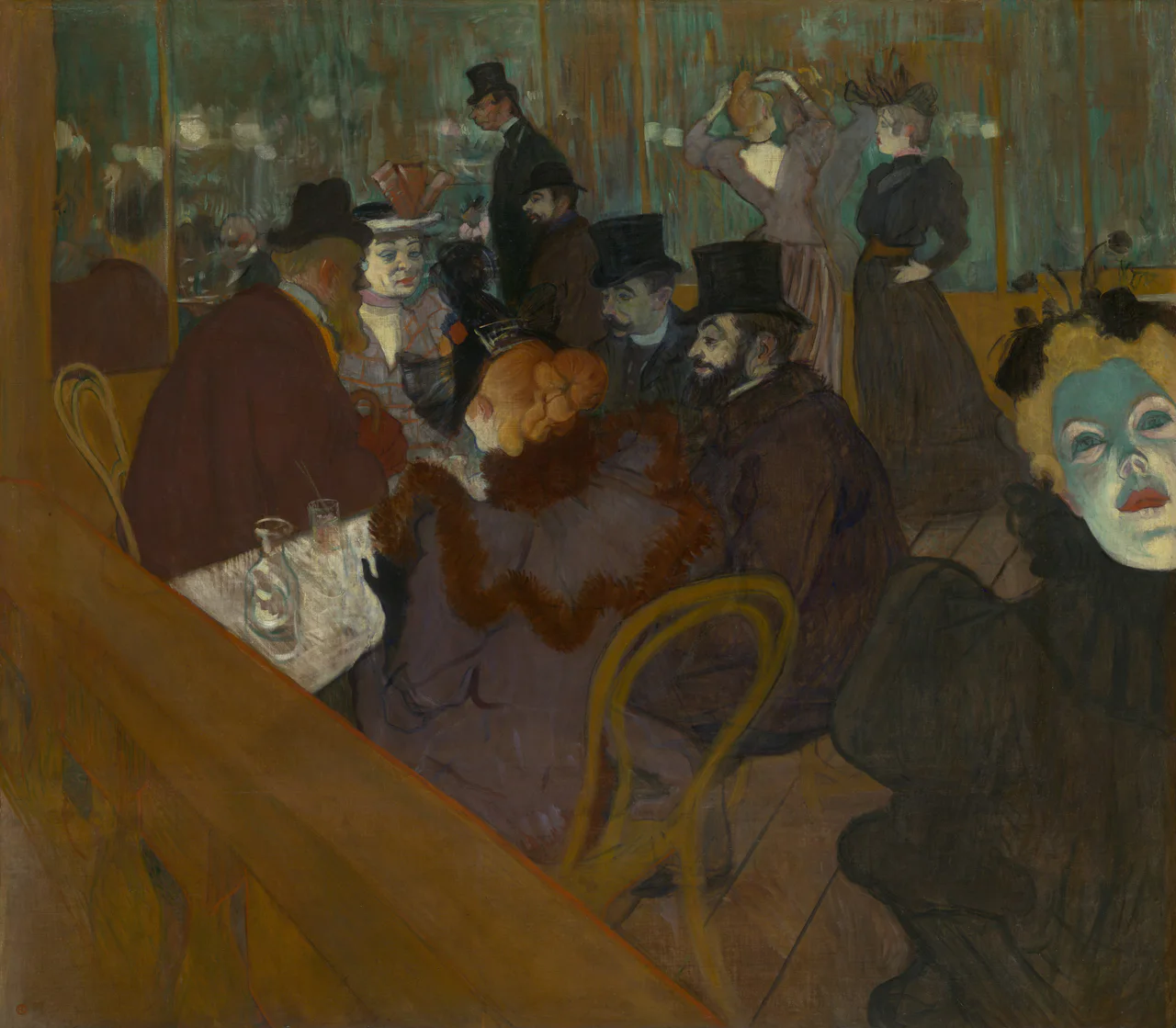
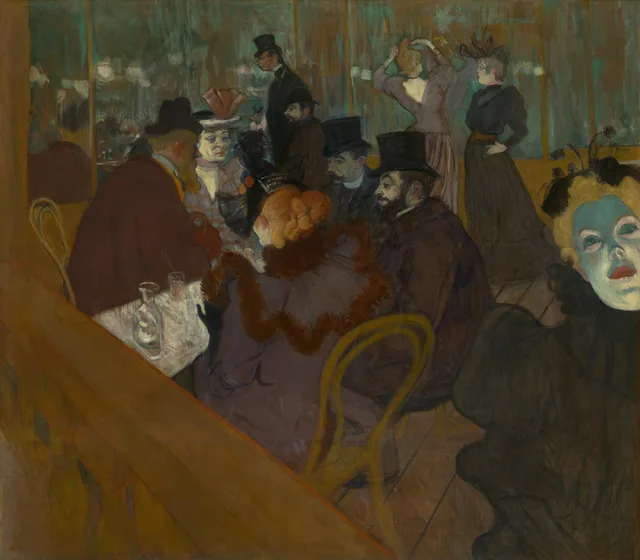
Stand in front of this painting and one thing grabs you first. A woman's face pushes in from the right edge. Half of her body is outside the canvas, and her face floats pale against the dark. And it is green.
Henri de Toulouse-Lautrec painted At the Moulin Rouge between 1892 and 1895. The Moulin Rouge opened in 1889 in Montmartre, in Paris. It was a café-concert, a place to drink and watch singers and dancers, and it became the most famous one of its kind. The Art Institute of Chicago notes that Toulouse-Lautrec was a regular there. He even had a table permanently reserved for him.
Look closely at the face.
The cheeks and forehead are a bluish green. Bright white sits on the eyelids and the tip of the nose, and only the lips are a hot red. A touch of lilac sits inside the nostrils. Even under the eyes, where you expect shadow, the skin glares white. The face looks almost like a mask.
The museum identifies her as the singer May Milton. It also explains that the green is not a random choice. The Moulin Rouge was designed with electric lighting, and Toulouse-Lautrec loved what that harsh artificial glare could do in a painting.
In daylight, nobody would paint a face like this. But at night, indoors, under a strange new light, a face really can stop looking like the skin color we expect. Instead of flattering his subject, the painter kept the color he actually saw.
Now move over to the table.
The woman in the hat has a face of yellowish white too. Red lips and bluish shadows around the eyes echo May Milton's face. The same light is falling on everyone in the hall. Even the back wall is streaked with long vertical strokes of green and orange.
According to the museum, the people at the table were real members of the artist's circle: the dancers Jane Avril and La Macarona, the photographer Paul Sescau, the poet Édouard Dujardin, and the wine merchant Maurice Guibert. The woman in the background with both arms raised, fixing her hair, is the dancer La Goulue.
So where is the painter who watched all this? Look at the center of the background.
Next to a tall man in a top hat stands a much shorter man in a bowler hat, shown in profile with a beard. That is Toulouse-Lautrec himself. The tall man beside him is his cousin, the physician Gabriel Tapié de Céleyran.
As a young teenager, Toulouse-Lautrec broke both of his legs, and afterward they stopped growing, so he was very short. He did not hide that here. He placed himself right next to his tall cousin, in the middle of the crowd, looking at the lit-up faces from inside the room rather than from outside it.