Pyeongye
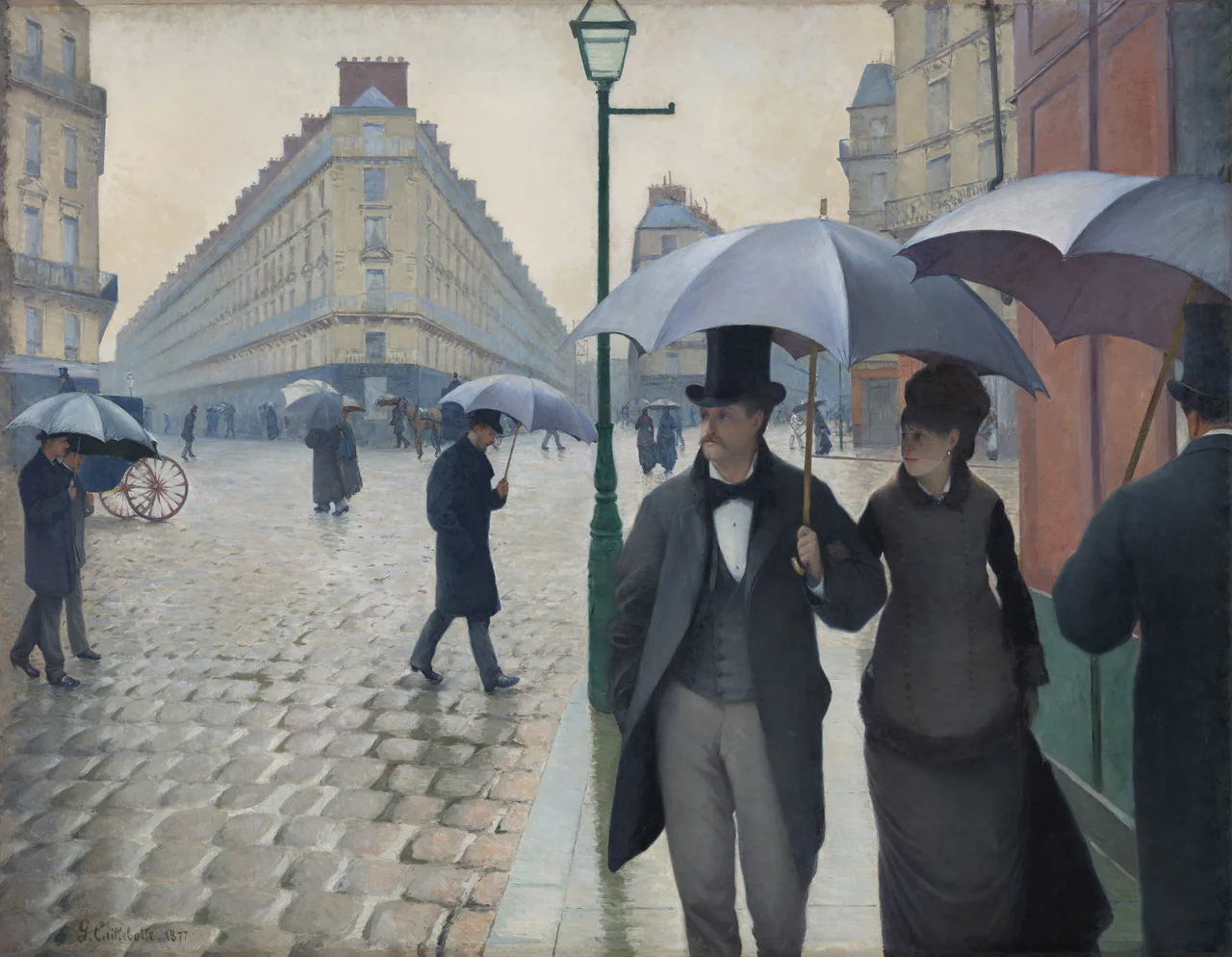
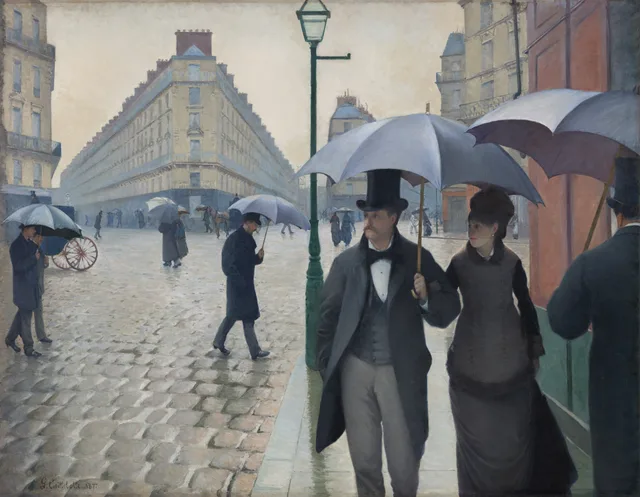
When we take a photo, most of us try to keep telephone poles out of the shot. A pole standing between people usually means the picture is ruined. Yet here, a dark green lamppost runs straight down the middle of the canvas, from top edge to pavement. Fold the painting in half from side to side, and the crease lands almost exactly on it.
Gustave Caillebotte painted Paris Street; Rainy Day in 1877. It is enormous, about 7 feet tall and more than 9 feet wide. The Art Institute of Chicago calls it his largest and most ambitious work. On a canvas that size, a pole in the dead center is hardly an accident.
Climb to the top of the post first.
A boxy glass lantern stands against the pale sky. Its little roof touches the top edge of the painting and is nearly cut off. A short crossbar sticks out to one side. It is all done with a few strokes of green on gray.
Now use the post to split the painting into two halves. The left half is wide open. A broad street of rounded paving stones runs back into the distance, ending at a building with a sharp corner like the prow of a ship. The people with umbrellas there are small and far away.
The right half is up close. A man in a top hat and a woman in a dark hat share one umbrella and walk toward us. One post lets the far distance and the near foreground sit side by side in a single picture.
This is a real intersection, a short walk from Caillebotte's home, near the Saint-Lazare train station. Today it is called the Place de Dublin. The wide, straight streets and the matching rows of cream-colored buildings were brand new then. Under Emperor Napoleon III, Baron Haussmann led a huge rebuilding of Paris that replaced narrow medieval lanes with grand boulevards like these.
Next, look down at the foot of the post.
The green pole stands on the wet sidewalk, and a soft green reflection runs down beneath it. Notice that there are no streaks of rain anywhere in the painting. Caillebotte shows the weather through shining stones and reflections like this one, and through the umbrellas. According to the museum, umbrellas that could fold up and open were a new thing at the time.
Finally, go to the far right edge.
A man in a black coat stands with his back to us. The right side of his body is sliced off by the edge of the canvas. His umbrella crowds close to the couple's umbrella beside him. Like a snapshot taken mid-step, the frame simply cuts him off. The museum suggests this bold cropping may owe something to photography, which was spreading quickly at the time.
Caillebotte showed this painting at the third Impressionist exhibition, in 1877. He came from a wealthy family and helped his fellow artists by buying their paintings and supporting their shows. But where many of them caught light with quick, loose brushwork, he painted the new city with smooth, careful strokes.