Pyeongye

Painters · 19th century
Henri de Toulouse-Lautrec
1864–1901
The eldest son of an old noble family from southern France, he carried the dancers, singers and late-night crowds of the Moulin Rouge out onto the streets of Paris in his paintings and posters.
Scenes from a life
The life of Henri de Toulouse-Lautrec,
scene by scene
- 1878Albi
In 1878, thirteen-year-old Henri got up from a low chair at home in Albi, slipped, and fell. His left thighbone broke. The next August, staying at the spa town of Barèges, he fell again and broke his right thighbone.
The bones did not heal well, and his legs never grew much after that. His parents were first cousins. During the long weeks in bed he drew and painted more and more. His first teacher was René Princeteau, a painter of horses and a friend of his father.
- 1887Paris
Young painters crowded into the Paris studio of Fernand Cormon to learn their trade. Toulouse-Lautrec was one of them. In 1886 a new student arrived: the Dutchman Vincent van Gogh, then thirty-three.
The next year Toulouse-Lautrec drew Van Gogh in pastel. Vincent sits turned to the side at a café table, a glass of absinthe in front of him. The brothers Vincent and Theo kept the portrait, and today it is in the Van Gogh Museum in Amsterdam.
- 1890Brussels
January 1890, Brussels. The artists' group Les XX is holding the opening dinner of its yearly show, and Van Gogh's sunflower paintings are on the walls. The Belgian painter Henry de Groux runs them down.
Toulouse-Lautrec challenges him to a duel. The painter Paul Signac sides with Van Gogh too. The duel never took place, and de Groux had to leave the group that year. Van Gogh died that July.
- 1891Montmartre
In 1891 Charles Zidler, who ran the Moulin Rouge, asked Toulouse-Lautrec for a poster to launch the new season. The artist was already a regular. His painting of a circus horsewoman had been bought by the owner to hang in the dance hall's lobby.
Moulin Rouge, La Goulue was his first poster. The dancer La Goulue kicks up her leg in the middle, while a dark, shadowy man in profile looms in front. The poster made his name known across Paris.
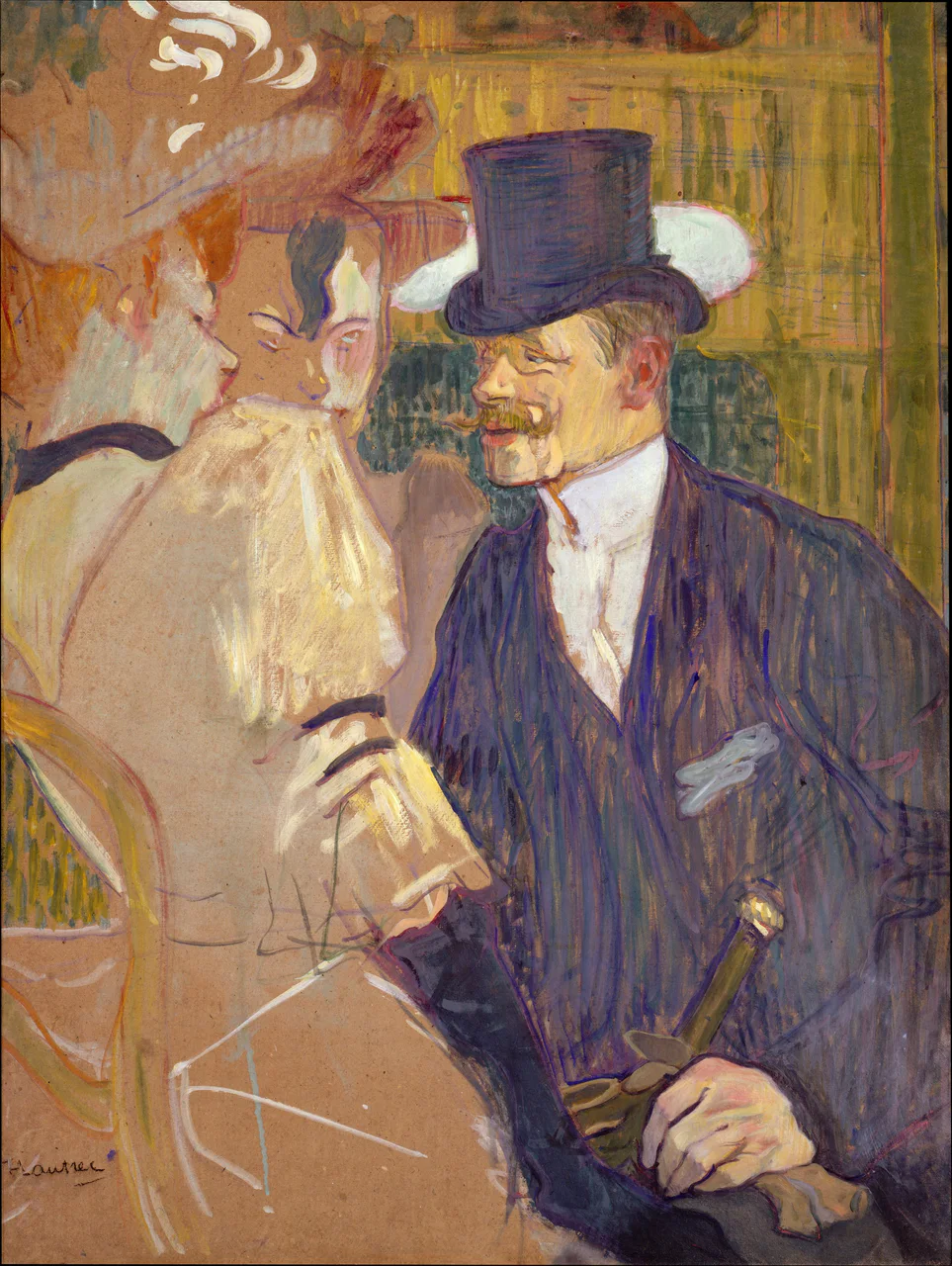
The next year he painted his friend, the English painter William Tom Warrener, at the Moulin Rouge. Warrener, in a tall silk hat, leans toward two women. That same year Toulouse-Lautrec turned the scene into a color lithograph.
 Painted around this timeThe Englishman (William Tom Warrener, 1861–1934) at the Moulin Rouge
- 1892–95The Moulin Rouge
At the Moulin Rouge, a table was always kept for Toulouse-Lautrec. He gathered the regulars, dancers and friends of the place into one large canvas, At the Moulin Rouge.
Look at the back, near the middle. A very tall man in a top hat walks beside a small one. The tall man is his cousin, the doctor Gabriel Tapié de Céleyran. The small one is the artist himself. At the right edge, the face of May Milton glows an acid green.
For a while the painting was in two pieces. The artist or his dealer cut away the strip with May Milton, but by 1914 it had been joined back on.
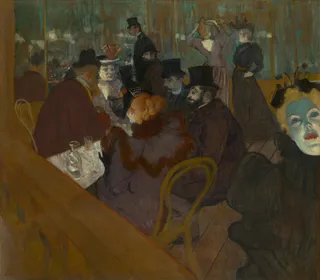 Painted around this timeAt the Moulin Rouge
- 1899Neuilly
In late February 1899, after a collapse brought on by drink, his mother Adèle had him admitted to a private mental clinic in Neuilly, just outside Paris. There, with colored pencils and pastels, he began drawing the Cirque Fernando of Montmartre from memory.
Horses, riders, acrobats and clowns piled up, sheet by sheet, until there were thirty-nine. Doctors then saw memory loss as a sign of his illness, so these drawings helped show he was well. He left the clinic on May 17.
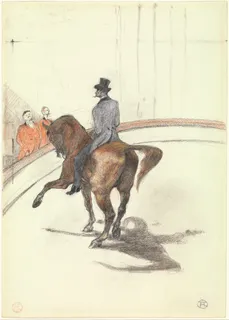 Painted around this timeAt the Circus: The Spanish Walk (Au Cirque: Le Pas espagnol)
- 1901Malromé
On September 9, 1901, Toulouse-Lautrec died at Château de Malromé, his mother's country house near Bordeaux. He was thirty-six.
His mother Adèle, together with his friend and dealer Maurice Joyant and his cousin Gabriel, then gave his work to his hometown of Albi. The deed of gift was signed in July 1922, and that same year the Musée Toulouse-Lautrec opened in the old bishops' palace, the Palais de la Berbie. The three pictures on this site took other roads. Today they hang in New York and Chicago.
People around them
- Adèle de Toulouse-Lautrechis mother, who placed him in the clinic in 1899 and later gave his work to Albi.
- René Princeteaua horse painter and family friend who was his first teacher.
- Vincent van Gogha fellow student at Cormon's studio, whom he drew in pastel in 1887.
- Gabriel Tapié de Céleyranhis cousin, a doctor, painted beside him in At the Moulin Rouge.
- Maurice Joyanthis friend and dealer, who looked after his work and helped found the Albi museum.
- William Tom Warreneran English painter friend, the model for The Englishman at the Moulin Rouge.
Works
Paintings by
Henri de Toulouse-Lautrec on Pyeongye
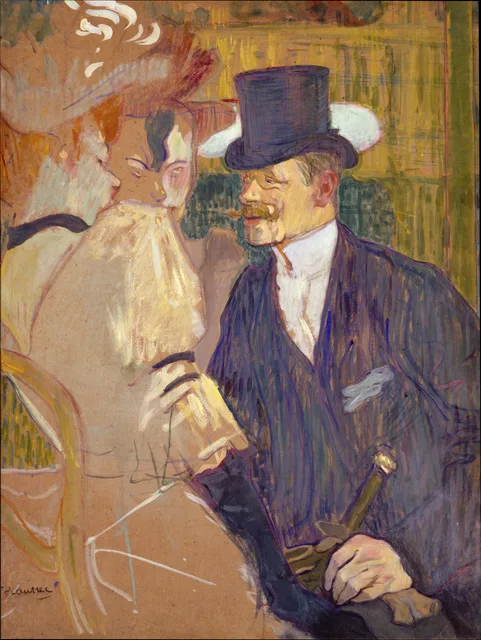 The Englishman (William Tom Warrener, 1861–1934) at the Moulin Rouge1892
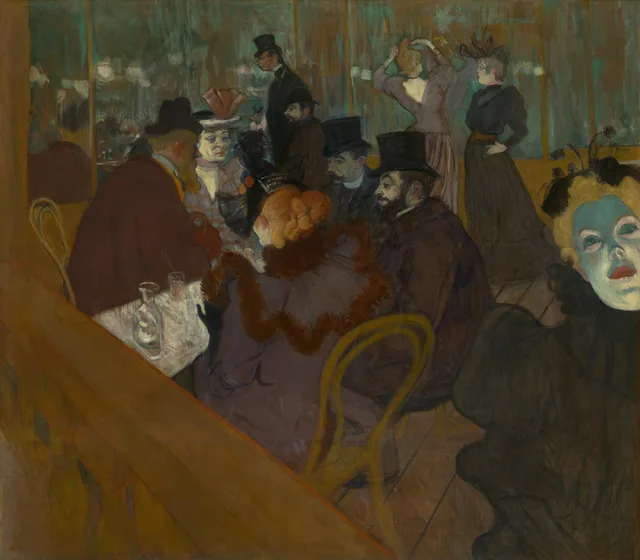 At the Moulin Rouge1892–95At the Circus: The Spanish Walk (Au Cirque: Le Pas espagnol)1899
Hidden stories in Henri de Toulouse-Lautrec's paintings
Contemporaries