Pyeongye
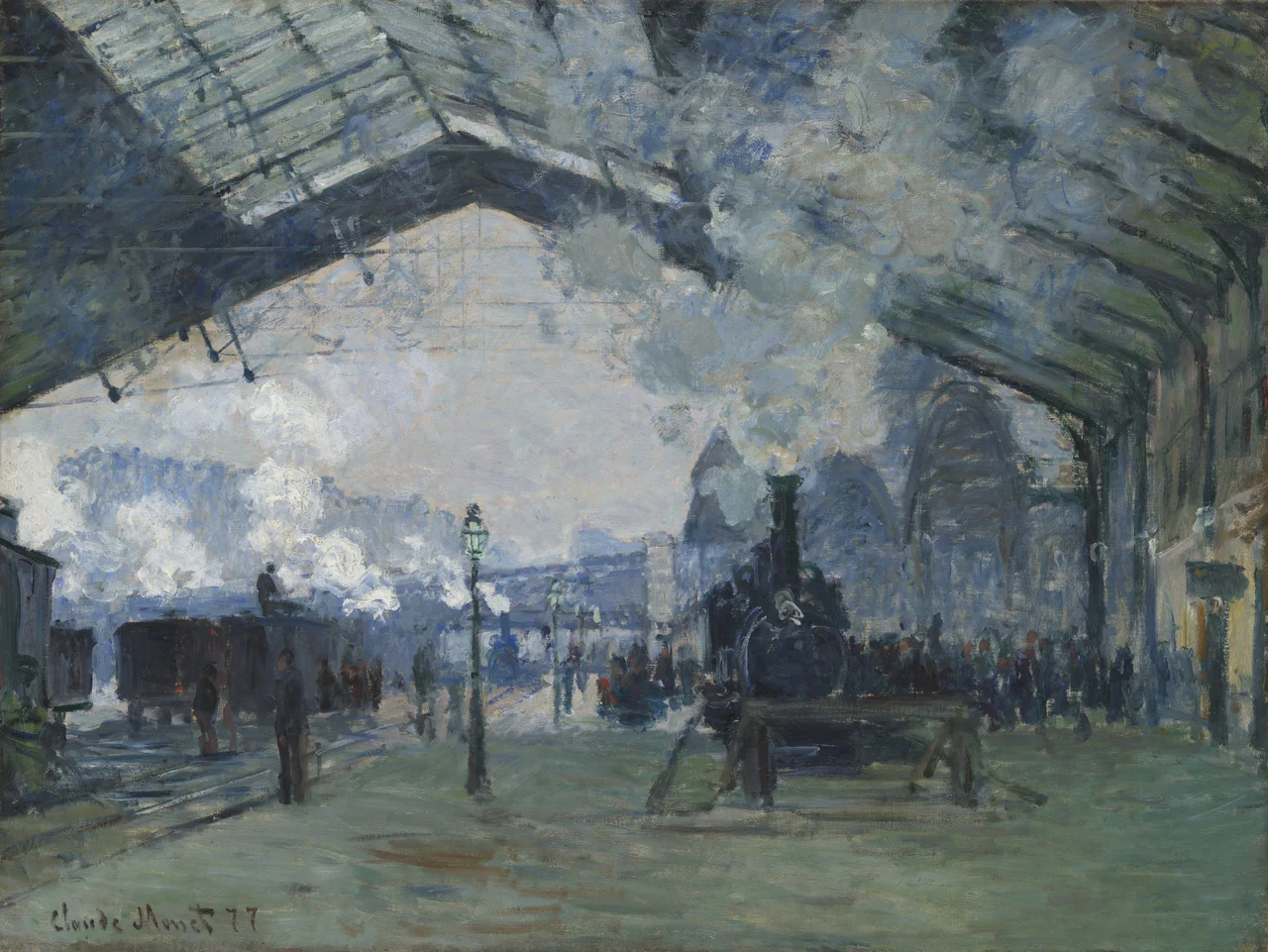
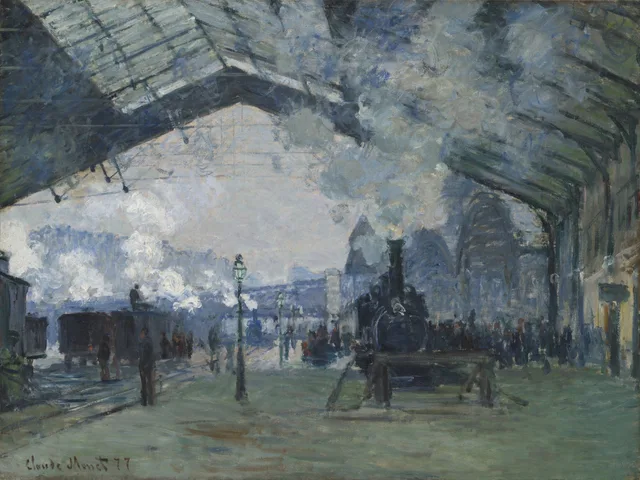
There are clouds in this picture, but they are not in the sky. They are trapped under a roof. White and blue masses press against the iron beams, and beneath them a black locomotive rolls toward us. Where did those clouds come from?
Claude Monet painted Arrival of the Normandy Train, Gare Saint-Lazare in 1877. The Gare Saint-Lazare was the Paris station for trains to and from Normandy. Normandy mattered to Monet. It was where, in the 1860s, he learned to paint outdoors, in front of his subject.
The same station was also the starting point for the towns and villages west and north of Paris that Monet and his friends liked to visit. For him, this was a familiar doorway out of the city.
Look first at the space under the roof.
White, gray, and blue paint swirl over one another. You can still see where the brush turned in circles. Dark lines of the iron roof show through the haze. This is steam from the locomotives, caught under the glass-and-iron shed with nowhere to go.
The Art Institute of Chicago explains what drew Monet here. Two things met under this roof: steam made by machines, and daylight pouring through the large glass sections overhead. In the upper left, you can see the glass panes glowing pale gray.
Now find the locomotive.
It is almost a single dark shape. There are no crisp wheels and no clear smokestack. A few strokes of deep blue-black make the body, and one dab of white sits on top, like a small puff of steam.
Monet did not paint the engine like a mechanical drawing. He painted how that mass of iron looked through steam and light. So it comes at us like a shadow.
Move your eyes to the train on the left.
Here the steam is whiter and much thicker. The paint is laid on heavily, and the brushstrokes stand up from the surface. In front of it, a tiny figure stands on top of a train car. The cloud of steam is many times taller than the man.
Monet did not paint this station just once. Twelve paintings of the Gare Saint-Lazare are known. He finished eight of them in time for the third Impressionist exhibition in 1877. The museum thinks he probably hung them together in the same room.
Painting one place again and again, to catch how the air changes with the hour and the weather, became a habit for Monet. His later series of stacks of wheat grew out of the same idea.
These station pictures were also his last attempt to paint city life. After them, Monet mostly turned to landscapes. Down in the lower left corner, he signed the canvas in dark brown: "Claude Monet 77."