Pyeongye
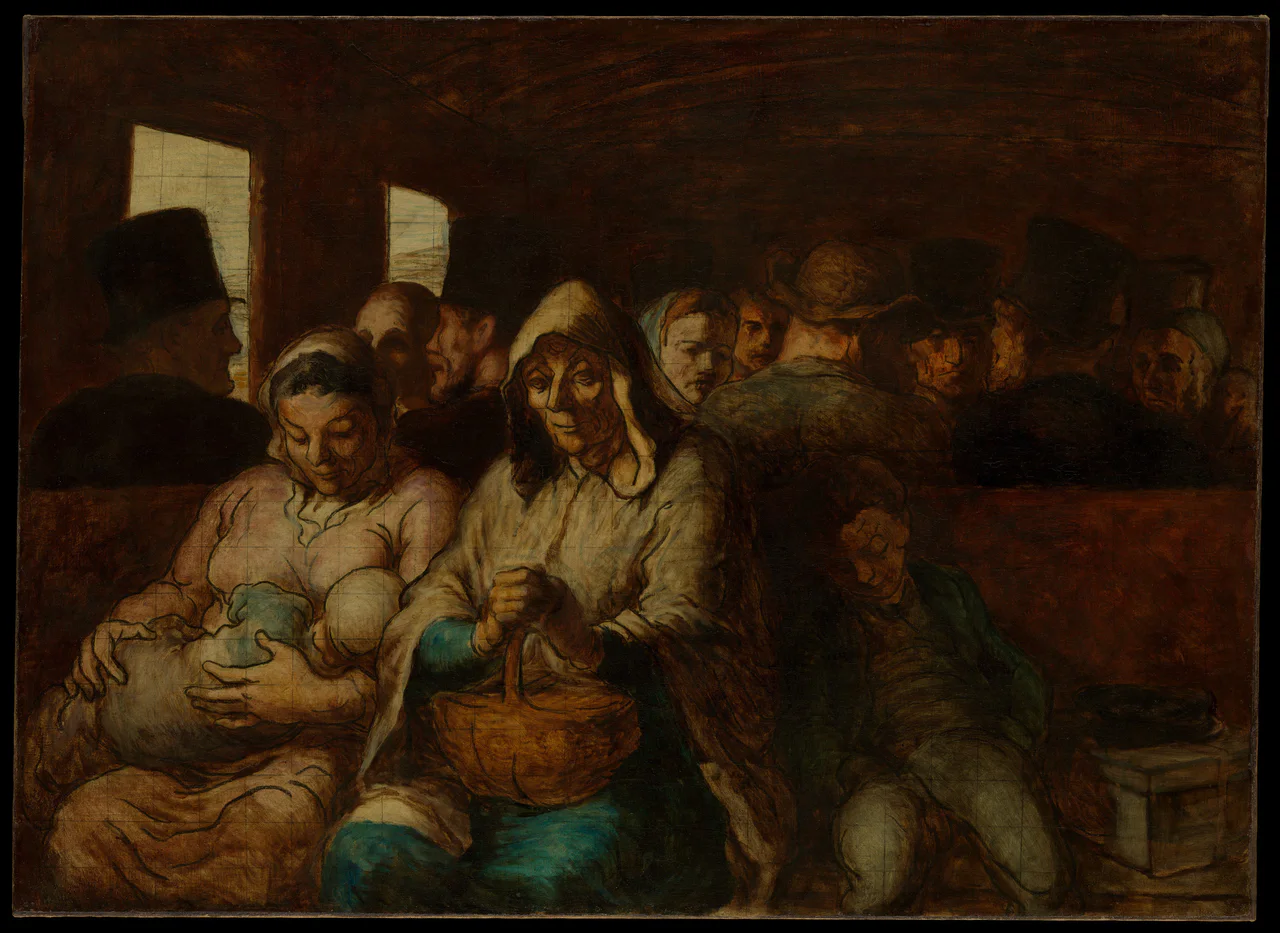
The train rattles on. Passengers are packed onto wooden benches. In the front row sit an old woman hugging a basket, a young mother holding her baby, and a boy slumped asleep. Behind them, row after row of hats and heads. Nobody is talking.
Look closely, though, and something odd appears. Thin, straight lines cross the faces and the clothes, running up and down and side to side. Were there wires strung across the carriage?
Start with the window at the upper left. The light outside makes it the easiest place to see.
Over the pale glass runs a faint checkerboard. The lines are evenly spaced and perfectly straight, far too regular to be anything in the landscape outside. In front of the window, the tall black hat of a passenger cuts into the light.
This is a transfer grid. An artist draws a grid over a sketch, draws the same number of squares on a new surface, and then copies the image one square at a time. That way, figures stay in the right places even when the picture changes size.
And this canvas was never finished. Honoré Daumier painted this scene more than once. A completed oil version is in the National Gallery of Canada in Ottawa. The one at The Metropolitan Museum of Art in New York still carries its grid, left unfinished.
For us, that is a gift. It lets us watch the artist at work. Let's look at the old woman's face.
She wears a hood and keeps her eyes lowered. Her mouth is set, and deep creases cut into her cheeks. The grid shows straight through her face. Her brows, nose, and chin are dashed in with thick, dark lines. This is the stage before paint smooths everything over.
Those dark lines came naturally to Daumier. He made his name drawing lithographs for the Paris newspaper Le Charivari, and he produced thousands of them over his life. Politicians, judges, ordinary city people: his job was to catch them in a few strokes. In 1832 he was even sent to prison over a caricature mocking King Louis-Philippe.
Now look to the right of the old woman, at the sleeping boy.
He sits hunched, his head dropped to one side. His closed eyes are just a few short marks. Most of his body sinks into shadow, and only his face catches the light. It must have been a long day, if he can sleep like that on a jolting train.
Railways spread quickly across France in the middle of the 1800s. Trains were divided into first, second, and third class, and third class was the cheapest. Many people crowded together on hard wooden seats. Daumier came back to these third-class passengers again and again, in prints and in paintings.
The passengers in the back rows each have their own clothes and their own expressions. Yet the three in front do not speak or look at one another. Each is lost in private thought. Even in a packed carriage, each of them seems alone.