 Pyeongye
Artwork · 19th century · Honoré Daumier
LeoTurn on Magnifier at the lower right and move slowly across the painting.
Full screen opens it edge to edge.Tap the painting to fill the screen.
Spread two fingers to look closer.
At a glance
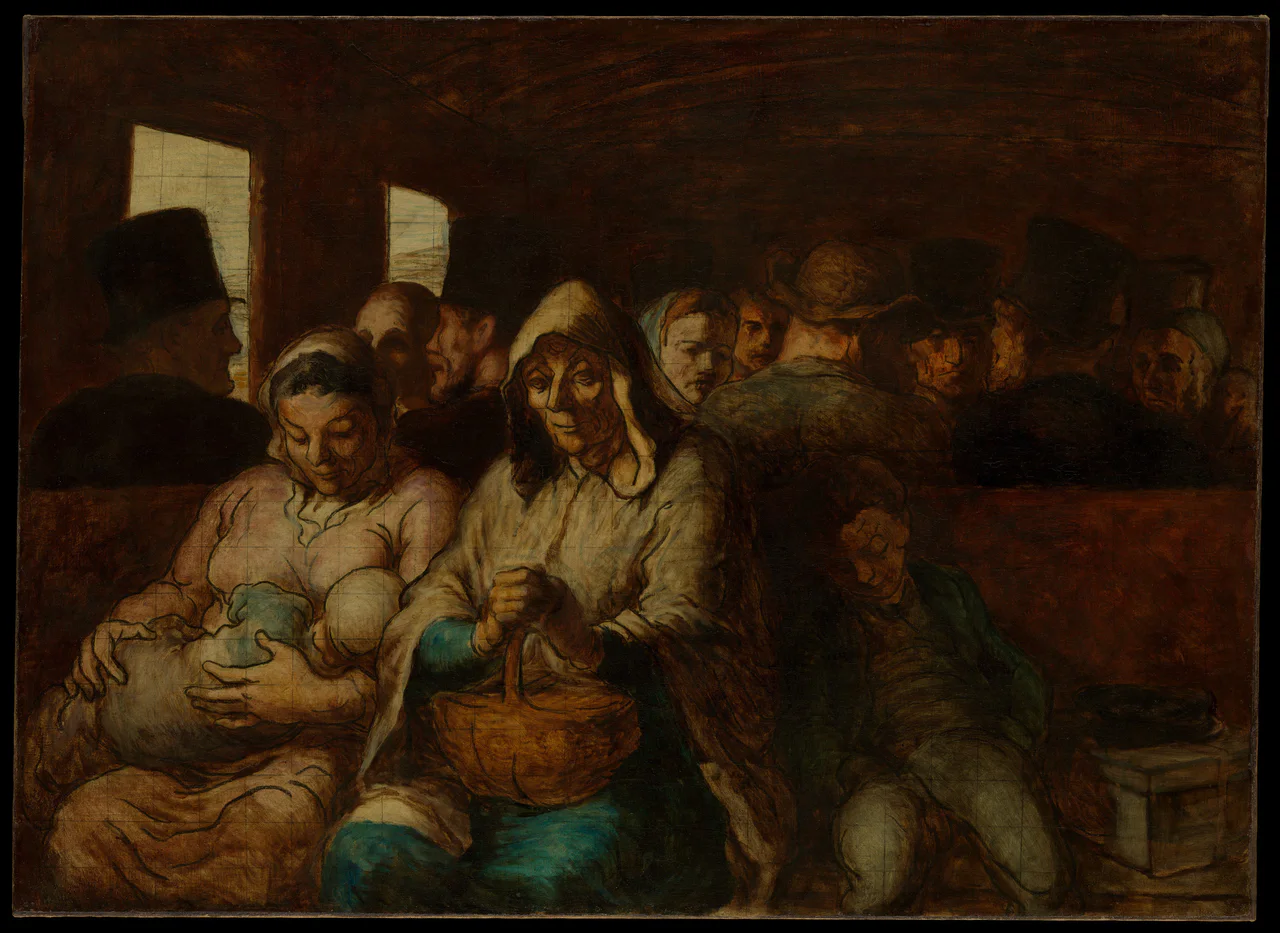
- In the cheapest car on the train, a young mother nursing her baby, an old woman clutching a basket, and a sleeping boy sit side by side on a wooden bench.
- The French artist Honoré Daumier painted it in oil on canvas in 1864.
- The painting was never finished, so you can still see the grid of lines he drew to transfer his design.
Reading the picture
5 places to look closer
Tap a number on the painting to jump to its note, or a close-up to see that spot in the whole picture.
Start with the old woman in the middle. A white hood frames her face, and her eyelids are half closed. Daumier drew her wrinkles and the line of her nose with quick, heavy black strokes. She says nothing, but you can feel the tiredness of a long working life.
Her hands grip the handle of the basket in her lap. The knuckles bulge. The woven basket is just a few sweeps of brown paint. What is inside? Nobody knows, and the picture doesn't tell.
On the left, the young mother is feeding her baby. She cradles the child with big, strong hands and bends her head. Zoom in and you will notice faint square lines running across her skin. That is a transfer grid, used to copy a smaller design onto a larger canvas.
Off to the right, in the shadows, a boy has dropped his head to one side and closed his eyes. He has fallen asleep to the rocking of the train. Only his face catches a little brown light. The rest of him melts into the dark.
Now look at the window in the upper left. Beyond the back of a man in a tall hat, the window glows pale. The grid lines show here too, plain as day. It is a rare look at a painting caught halfway through being made.
When it was painted
In 1860, when Daumier was just past fifty, he lost his steady job. For years he had drawn lithographs for Le Charivari, a satirical Paris paper. That year the paper let him go, and it was a few years before it took him back. This painting comes from that stretch of years.
Daumier had been famous for his cartoons since he was a young man. In 1832 a print mocking King Louis-Philippe even sent him to prison. Over his life he made thousands of lithographs. He painted steadily too, yet his paintings stayed little known while he lived.
In 1864 a Paris art agent, George A. Lucas, ordered three watercolors from him. They showed the first-class, second-class, and third-class carriages of a train. Lucas bought art for the Baltimore collector William Walters. The third-class watercolor is now in the Walters Art Museum, and its design is very close to this oil.
This canvas was never finished. The squares you can see on it are guidelines he drew to copy the design over. A completed oil of the same scene is in the National Gallery of Canada.
In old age Daumier's eyesight failed, and work grew hard. His friend, the painter Corot, bought the house Daumier lived in at Valmondois and gave it to him. In 1878 friends organized a show of his work at the Durand-Ruel gallery in Paris, and he died the next year. This painting came to the Met in 1929 as a bequest from the collector Mrs. H. O. Havemeyer.
Look at the picture once more. Behind the four people in front, more faces crowd together in the dark beyond the bench back. The hand that mocked the powerful in the papers is holding on, quietly, to nameless people riding along together.
The painter
Honoré Daumier
1808–1879
When painting this, the artist was about 56 years old
All paintings by Honoré Daumier →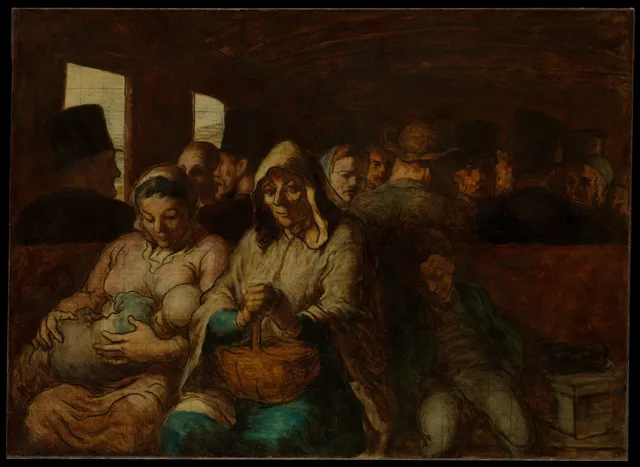
Hidden stories in this painting
Questions to think about
- Look for itIs anyone in this car actually talking to anyone else?
- Why?Why might Daumier have used heavy lines and deep shadow instead of sharp, detailed faces?
- What about you?Buses, trains, and planes today still sort people by what they pay. Do you think that kind of division is fair?
Same period
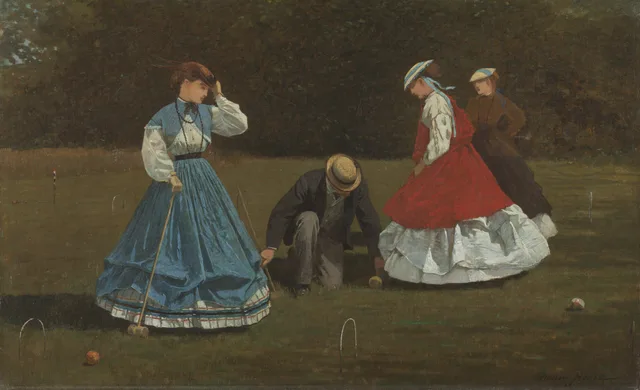
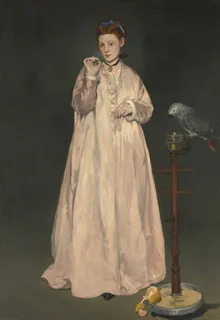
Painted around the same time,
somewhere else

Too good to keep to yourself
This painting,
for someone who comes to mind
They open it at full size
and see every brushstroke.
About this work
- Artist
- Honoré Daumier · 1808–1879
- Date
- 1864
- Medium
- Oil on canvas
- Size
- 65.4 × 90.2 cm
- Collection
- The Metropolitan Museum of Art
- Image
- Original long edge 4000px · shown at 2560px
- Original
- View on the museum's website ↗