Pyeongye
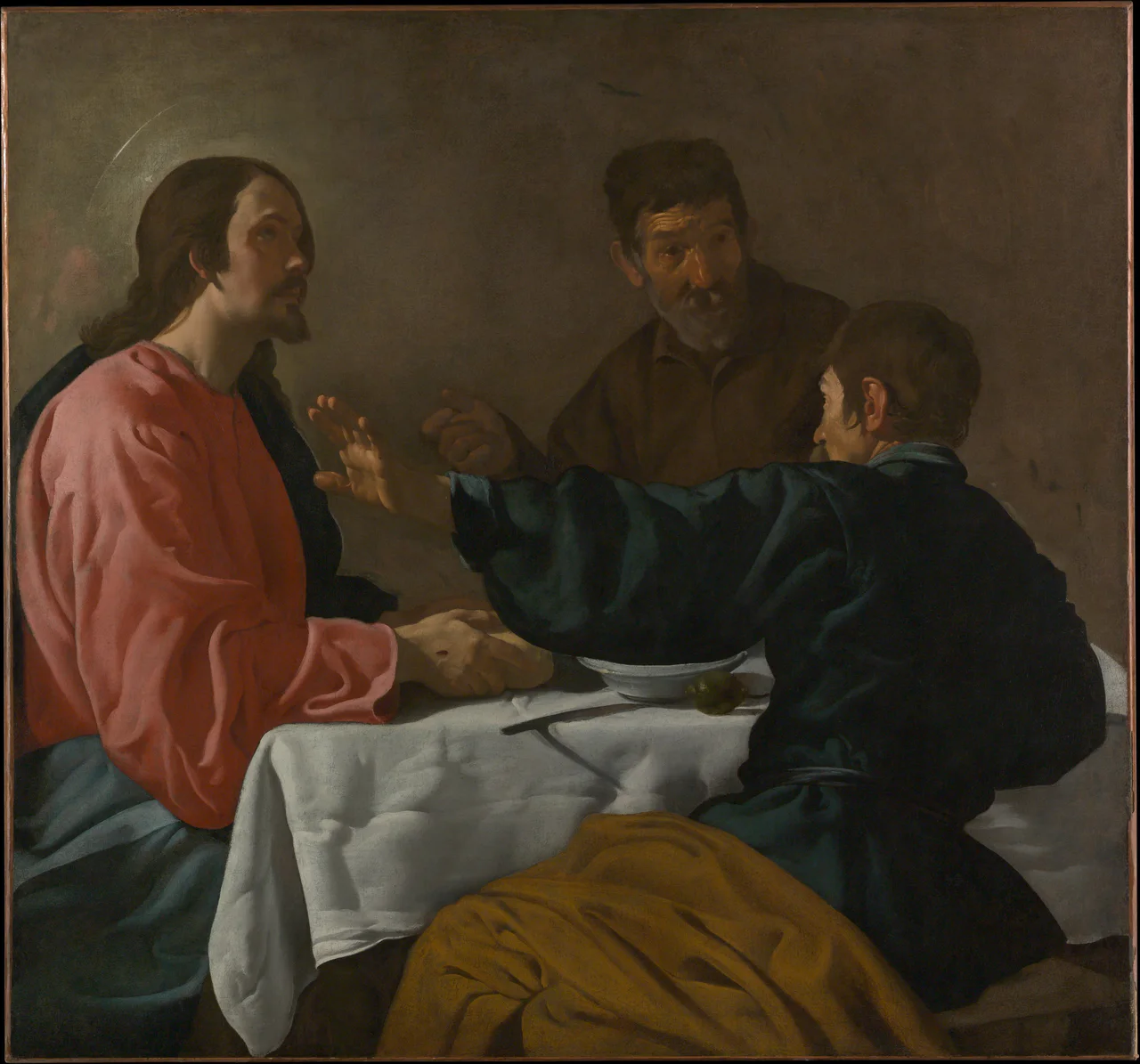
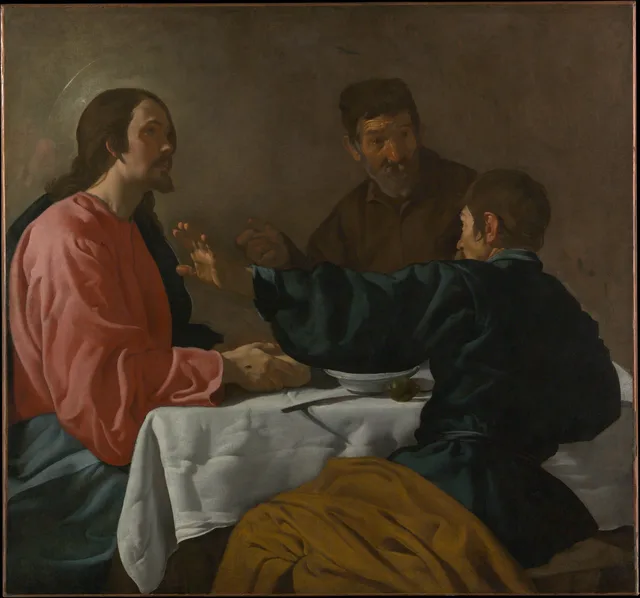
Three men sit at a supper table. The young man on the right suddenly throws out his arm, palm open. The older man behind him stares, wide-eyed, and leans forward. Yet the man on the left simply sits still and gazes upward. What just happened?
This is The Supper at Emmaus, painted by Diego Velázquez in 1622 to 1623. Velázquez was born in 1599, so he was only about twenty-three when he made it. The canvas is nearly square, about 48 1/2 by 52 1/4 inches, and the three figures fill it edge to edge.
The story comes from the Gospel of Luke. On the third day after Jesus died on the cross, two of his followers were walking to a village called Emmaus. A stranger fell into step with them. When evening came they invited him to eat. As he took the bread, blessed it, and broke it, they suddenly recognized him as the risen Jesus.
So what opened their eyes? Look at the hands on the table.
The man on the left has folded his hands on the white cloth. In the middle of the upper hand sits a small red mark. It is no bigger than a fingernail, but it is darker than everything around it, and once you see it, you can't stop seeing it. It is where a nail went through.
Velázquez never shouts who this is. There are no shining robes, no beams of heavenly light. He painted an ordinary young man in a pink tunic and gave him one small red wound.
Now look above the man's head.
A very thin white line curves around the upper left of his head. It is a halo, the sign painters used for holy figures. But instead of a golden disk, it is as fine as a single hair. From a few steps back, it almost disappears.
Telling a sacred story through ordinary people was something Velázquez learned in his hometown of Seville. He trained there with the painter Francisco Pacheco, and as a young man he loved painting kitchens and tables, pots and food. In his Kitchen Maid with the Supper at Emmaus, now in the National Gallery of Ireland, this same story appears tiny, glimpsed through an opening behind a kitchen worker.
That kitchen painter's eye is all over this table, too.
There is a white bowl, a round green fruit beside it, and a knife lying at an angle on the cloth. Light catches the rim of the bowl and makes it glow. The fruit casts a small shadow on the tablecloth. Even the white cloth is not one white. Its folds split cleanly into lit ridges and shaded hollows.
A strong light falls from one side against a dark background, making people and objects stand out almost like sculpture. That approach started with the Italian painter Caravaggio and spread across Europe in these years.
In 1623 Velázquez moved to Madrid and became a court painter to King Philip IV. This picture comes from right around that turning point, when the young painter of Seville kitchens was about to become the painter of a king.