 Pyeongye
Artwork · 18th century · Adélaïde Labille-Guiard
LeoTurn on Magnifier at the lower right and move slowly across the painting.
Full screen opens it edge to edge.Tap the painting to fill the screen.
Spread two fingers to look closer.
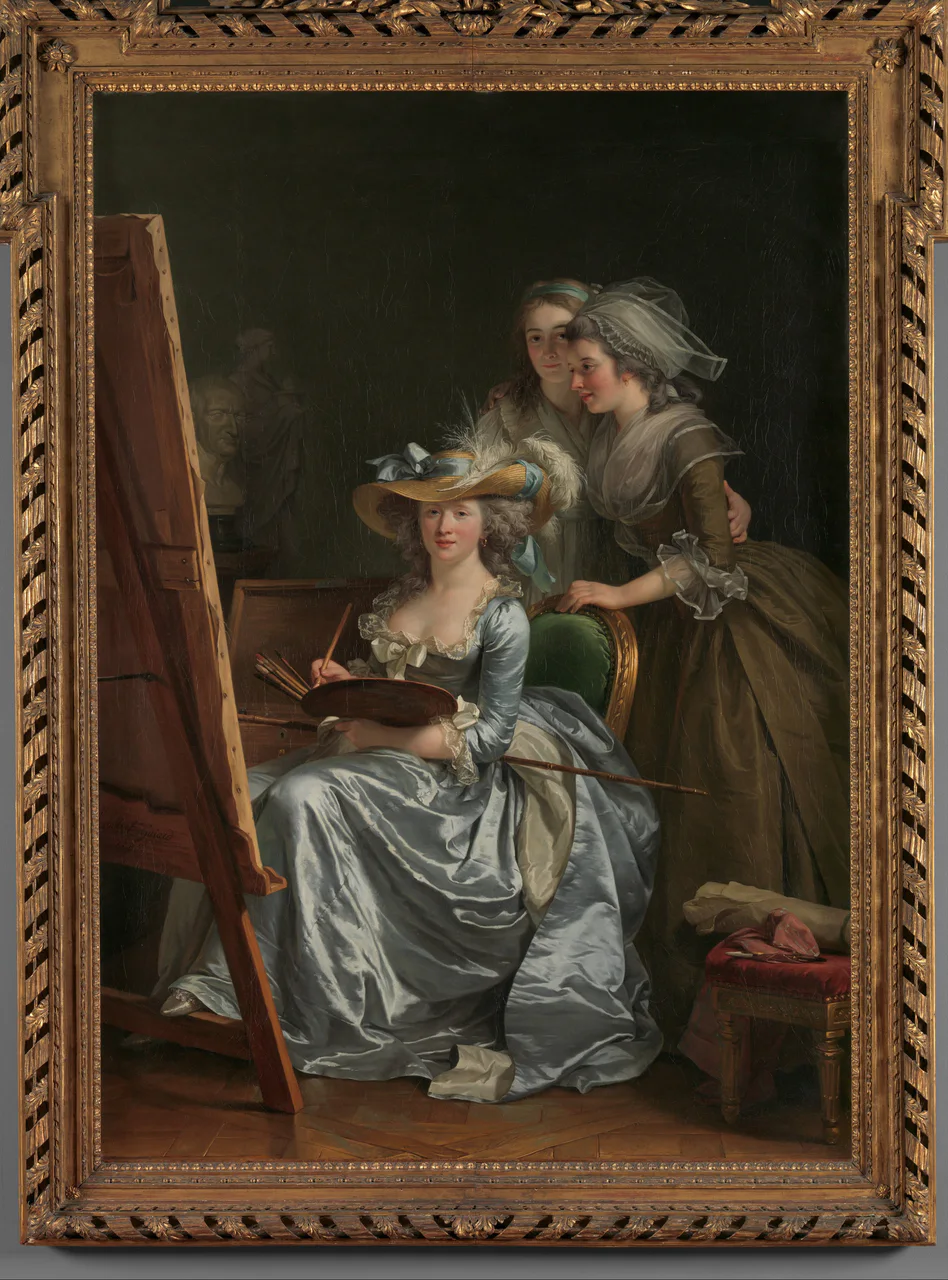
Self-Portrait with Two Pupils, Marie Gabrielle Capet (1761–1818) and Marie Marguerite Carraux de Rosemond (1765–1788)
Adélaïde Labille-Guiard1785Oil on canvas210.8 × 151.1 cm
At a glance
- A painter in a shimmering silver-blue silk dress sits at her easel with a palette, while two of her students stand close behind her.
- Adélaïde Labille-Guiard, a painter in Paris, made this self-portrait in 1785. Her two students are Marie Gabrielle Capet and Marie Marguerite Carraux de Rosemond.
- On a canvas more than six and a half feet tall, she shows a studio where a woman artist trains women artists, and she shows it proudly.
Reading the picture
5 places to look closer
Tap a number on the painting to jump to its note, or a close-up to see that spot in the whole picture.
Zoom in on the painter's face. She wears a straw hat trimmed with feathers and pale blue ribbons, and she looks right at us with a brush in her hand. A faint smile plays on her lips. It looks as if she has just glanced up from her work.
Look at the two students behind her. The one with a ribbon in her hair looks straight at us. The one in a sheer gauzy cap leans in to study her teacher's canvas. One has her arm wrapped around the other.
Zoom in on the hand holding the palette. Below it, a glossy blue silk sleeve and frills of lace spill down. The long stick reaching off to the right is a mahlstick, a rest that steadies the painting hand. Every gleaming fold of the silk is a small showcase of her skill.
Zoom in on the shadows at the back left. You can just make out a bust of an older man, and beside it a statue wrapped in drapery. A studio like this kept sculptures around for artists to study and draw.
Zoom in on the lower wooden board of the easel at the left. A signature in flowing script and the year 1785 are written there. She left her name and the date on a piece of studio equipment.
When it was painted
In 1785 Labille-Guiard was thirty-six, and she hung this huge self-portrait at the Salon, the great public art show in Paris. According to the Met, it was a big success.
Two years earlier she had been admitted to France's Royal Academy of Painting and Sculpture on the same day as Élisabeth Vigée Le Brun. From then on the two women were constantly compared as rivals. Right after they got in, the Academy decided to cap the number of women members at four.
That is why many people read this painting as a confident argument on behalf of women artists. Labille-Guiard taught young women in her own studio, and the two standing behind her are her students.
In 1787 she was named painter to the aunts of King Louis XVI. Then the Revolution changed everything. In 1793 she was ordered to give up an enormous group portrait commissioned by the king's brother so that it could be destroyed, because it glorified the monarchy.
Rosemond died in 1788, barely in her twenties. Capet stayed with her teacher for good, living in her household, and in 1808 she painted a picture of her teacher's studio. In 1800 Labille-Guiard married her former teacher, the painter François-André Vincent, and she died in 1803. This canvas was given to the Metropolitan Museum by Julia A. Berwind in 1953.
Look again at the two faces pressed close behind her shoulder. One of these young women would be gone in three years. The other would stay at her teacher's side for the rest of her teacher's life.
The painter
Adélaïde Labille-Guiard
1749–1803
When painting this, the artist was about 36 years old
All paintings by Adélaïde Labille-Guiard →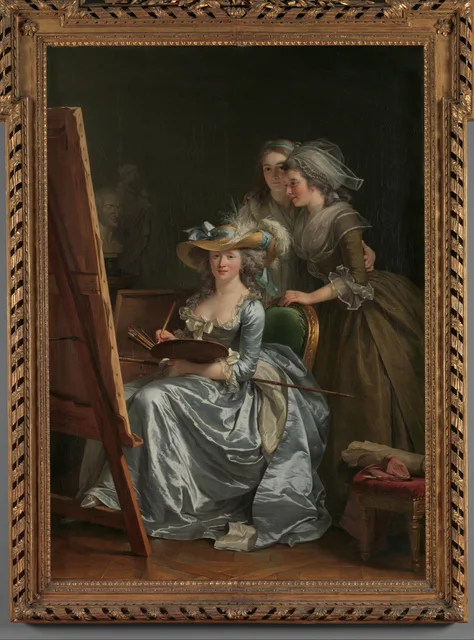
Hidden stories in this painting
Questions to think about
- Look for itAt the lower right, can you find the things lying on the red stool?
- Why?Why do you think Labille-Guiard turned the back of her canvas toward us, so we can't see what she is painting?
- What about you?The Academy capped the number of women members at four. Have you ever felt that some workplace or field today still has an unspoken limit on who gets in?
Same period
Painted around the same time,
somewhere else
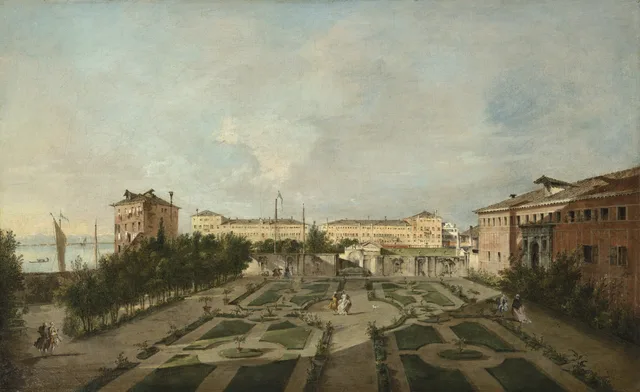 The Garden of Palazzo Contarini dal ZaffoFrancesco GuardiLate 1770s
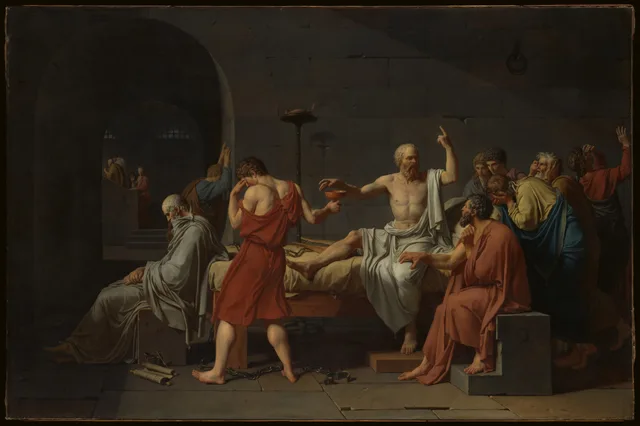 The Death of SocratesJacques Louis David1787
 Cottage Children (The Wood Gatherers)Thomas Gainsborough1787
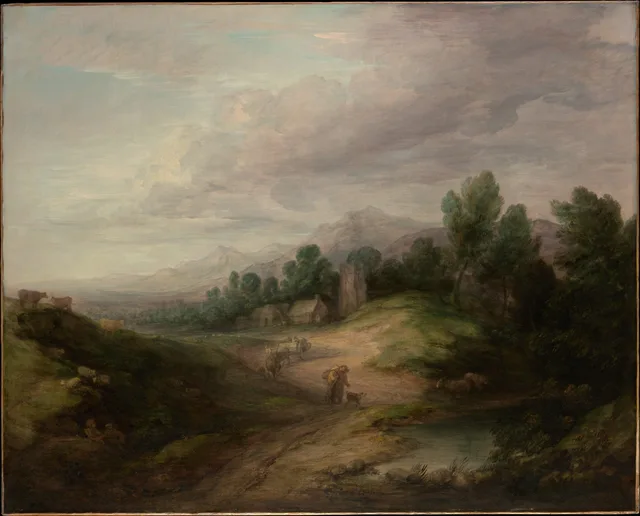 Wooded Upland LandscapeThomas Gainsboroughprobably 1783
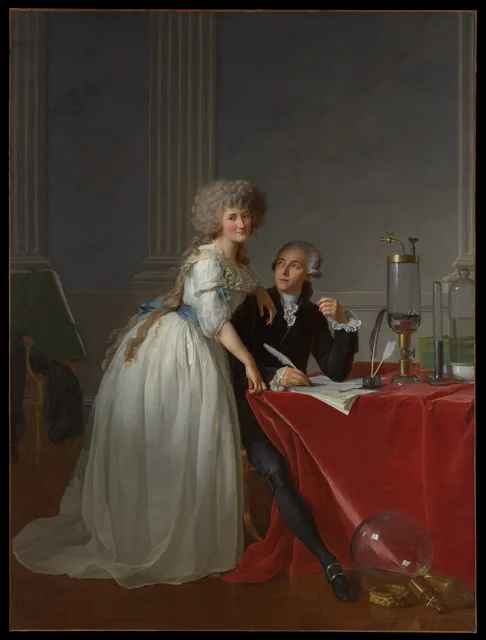 Antoine Laurent Lavoisier (1743–1794) and Marie Anne Lavoisier (Marie Anne Pierrette Paulze, 1758–1836)Jacques Louis David1788
 Queen CharlotteThomas Gainsborough1788
Too good to keep to yourself
This painting,
for someone who comes to mind
They open it at full size
and see every brushstroke.
About this work
- Artist
- Adélaïde Labille-Guiard · 1749–1803
- Date
- 1785
- Medium
- Oil on canvas
- Size
- 210.8 × 151.1 cm
- Collection
- The Metropolitan Museum of Art
- Image
- Original long edge 3894px · shown at 2560px
- Original
- View on the museum's website ↗