 Pyeongye
Artwork · 19th century · Paul Cézanne
LeoTurn on Magnifier at the lower right and move slowly across the painting.
Full screen opens it edge to edge.Tap the painting to fill the screen.
Spread two fingers to look closer.
At a glance
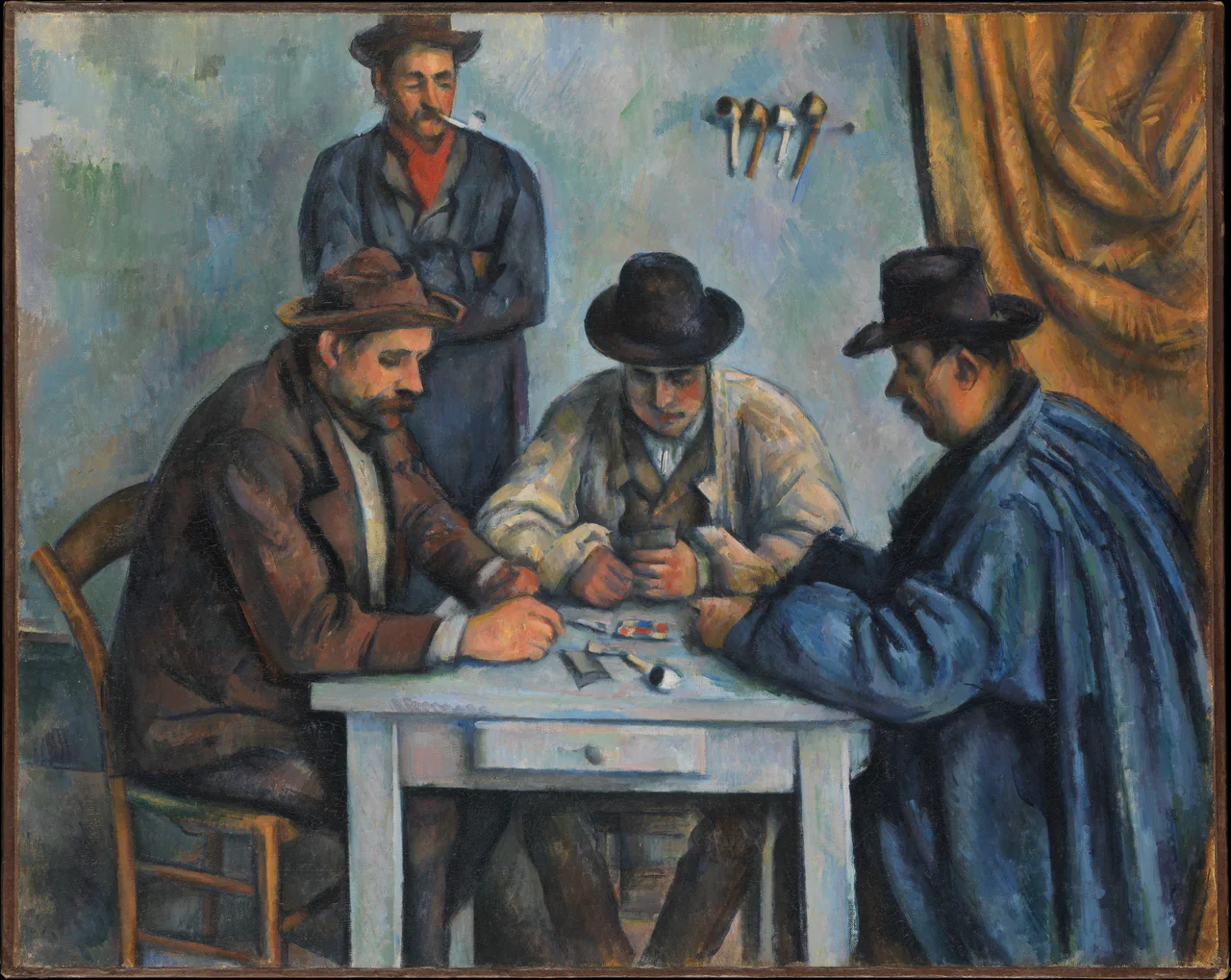
- Three men sit at a small table, staring at their cards in silence, while a fourth stands behind them and watches.
- Paul Cézanne painted it in oil on canvas around 1890–92.
- It is one of five paintings Cézanne made of card players, and it turns a moment where nothing happens into something you can look at for a long time.
Reading the picture
5 places to look closer
Tap a number on the painting to jump to its note, or a close-up to see that spot in the whole picture.
Start with the young man in the middle. Under his round black hat, his eyes are lowered to the cards in his hands. The shadows on his face are not black at all. They are browns and greenish grays, with just a touch of red on the cheek and lips.
Zoom in on the tabletop. Hands from three players meet near the center. In front of them lie a card patterned in red and blue and a white clay pipe. There are no coins and no glasses. The painting never tells us what, if anything, is being played for.
Now look at the man standing at the back. A white pipe hangs from his mouth as he looks down at the game. The red scarf at his neck is the brightest red in the whole picture. He is the only one not seated, yet his face is just as quiet as the others.
Look at the wall to his right. Four pipes hang in a row. Each is only a few strokes of paint, but they look as if each belongs to someone in particular.
At the far right, compare the man in the blue coat with the orange curtain behind him. The folds of the curtain are built from short, slanting strokes laid side by side. His profile and hat brim are built up the same firm way. Orange and blue press against each other, and each makes the other look stronger.
When it was painted
In 1890 Paul Cézanne was fifty-one and painting at the Jas de Bouffan, a country estate just outside his hometown of Aix-en-Provence. His father, a banker, had bought the property years before. When his father died in 1886, Cézanne inherited a fortune. From then on he never had to sell a picture to pay the bills.
That same year he drifted apart from Émile Zola, his friend since boyhood. Zola had just published a novel about a painter who fails to achieve his vision, and the two men never grew close again. In Paris, his work was rarely on view.
So he painted the people around him. The models for this picture were local farm workers. Cézanne posed them one at a time for separate studies, then brought them together at a single table on canvas.
In 1895 a young dealer, Ambroise Vollard, gave Cézanne his first solo exhibition in Paris. Fellow painters were among the first to notice. Pissarro and Degas both bought works from the show.
This canvas later belonged to the American collector Stephen C. Clark, who left it to the Metropolitan Museum in 1960. In 2011 the Met joined with the Courtauld Gallery in London to bring the card players and their studies together in one exhibition. Look again at the middle of the table. The hands are almost touching, yet no one looks anyone else in the eye.
Questions to think about
- Look for itIf you zoom in on each of the four faces, can you find anyone smiling or talking?
- Why?Why might Cézanne have picked a silent moment instead of a loud, lively card game?
- What about you?How often do you sit at a table with a few people, phones away, focused on one shared game, and do you think we have less of that today?
Same period
Painted around the same time,
somewhere else
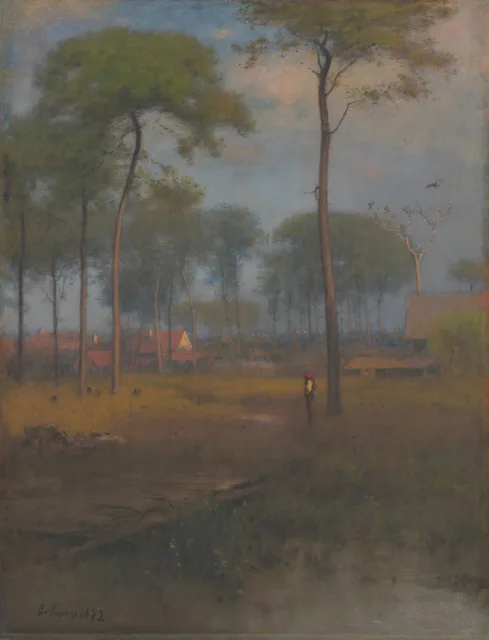 Early Morning, Tarpon SpringsGeorge Inness1892
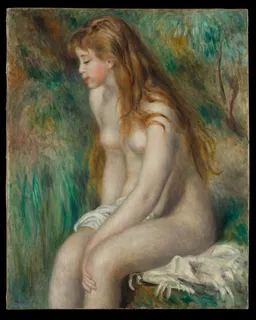 Young Girl BathingAuguste Renoir1892
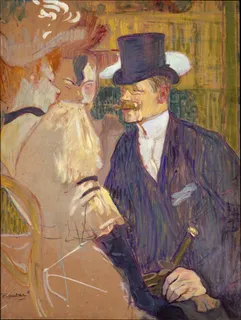 The Englishman (William Tom Warrener, 1861–1934) at the Moulin RougeHenri de Toulouse-Lautrec1892
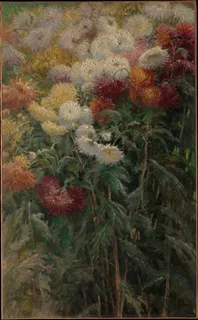 Chrysanthemums in the Garden at Petit-GennevilliersGustave Caillebotte1893
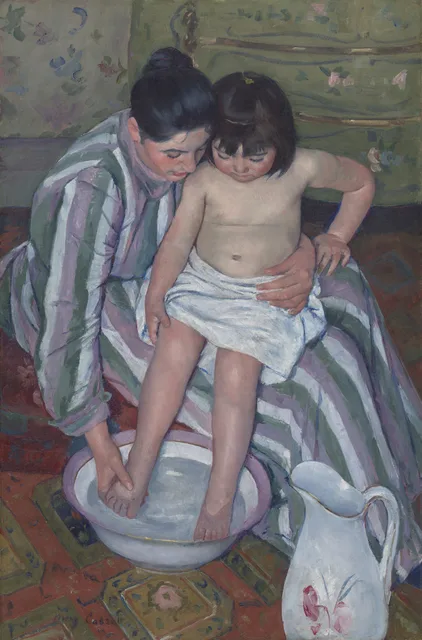 The Child's BathMary Cassatt1893
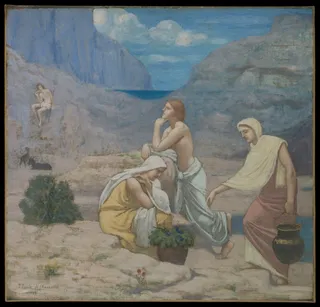 The Shepherd's SongPierre Puvis de Chavannes1891
Too good to keep to yourself
This painting,
for someone who comes to mind
They open it at full size
and see every brushstroke.
About this work
- Artist
- Paul Cézanne · 1839–1906
- Date
- 1890–92
- Medium
- Oil on canvas
- Size
- 65.4 × 81.9 cm
- Collection
- The Metropolitan Museum of Art
- Image
- Original long edge 3909px · shown at 2560px
- Original
- View on the museum's website ↗