 Pyeongye
Artwork · 18th century · Jacques Louis David
LeoTurn on Magnifier at the lower right and move slowly across the painting.
Full screen opens it edge to edge.Tap the painting to fill the screen.
Spread two fingers to look closer.
At a glance
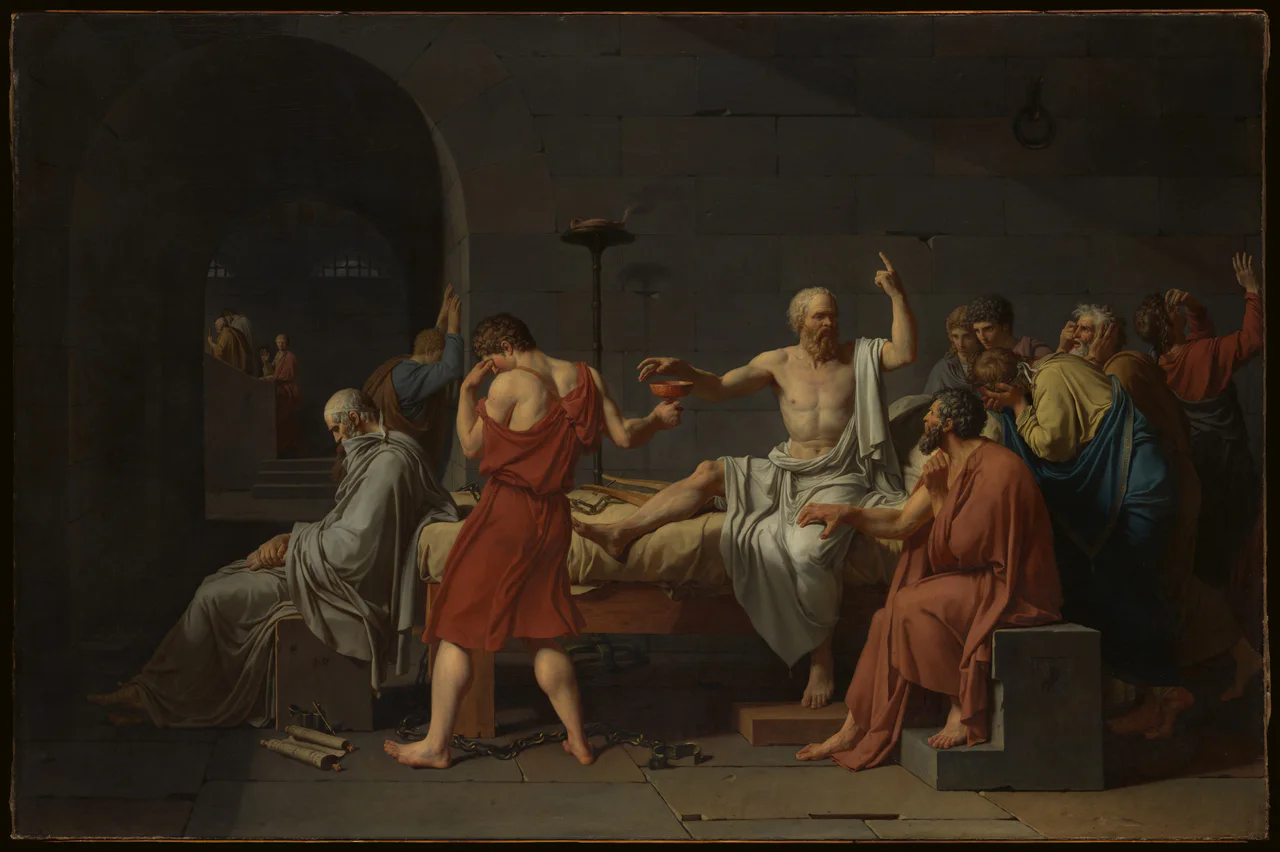
- The Athenian philosopher Socrates, condemned to death, reaches for the cup of poison.
- Painted by Jacques Louis David in Paris in 1787.
- One hand reaches for the cup while the other points upward: two hands, one man, two different messages.
Reading the picture
5 places to look closer
Tap a number on the painting to jump to its note, or a close-up to see that spot in the whole picture.
Look at Socrates sitting up on the bed in the center. His right hand reaches toward the cup, but his eyes are not on it. His left forefinger points up, and his mouth is open in mid-sentence. Even now, at the edge of death, he is still talking with his students.
Zoom in on the young man passing the cup. He holds it out with one hand and covers his eyes with the other. His back is turned to Socrates and his head hangs low. The person who has to hand over the poison looks like the one who suffers most.
At the foot of the bed sits an old man with his back to everyone. His head is bowed and his eyes are closed. Unlike the others, he does not cry out. He is identified as Plato, Socrates' student. A scroll lies on the floor near his feet, and a little to the right, loose chains trail across the stones.
Zoom into the stairway beyond the arch at the back left. A few people climb away up the steps, and one turns back with a raised hand. This is often read as Socrates' wife, Xanthippe, being led out of the prison. Compared with the drama in front, this corner is tiny and dim.
At the lower right, look at the side of the stone bench where the student in red sits. Inside a carved frame there is an owl. The owl was the bird of the goddess Athena and a symbol of the city of Athens. The city that sentenced Socrates is quietly carved right beside him.
When it was painted
Picture Paris in the summer of 1787. Jacques Louis David was about to turn thirty-nine. Two years earlier he had brought The Oath of the Horatii back from Rome, and it had caused a stir at the Salon of 1785.
This time the client was not the state. The painting was a private commission from the Trudaines, a wealthy Paris family. David built the scene from Plato's Phaedo, the dialogue that tells of Socrates' last day. But he did not follow the book to the letter.
The Phaedo says Plato was ill that day and stayed away. David put him at the foot of the bed anyway. And when Socrates died, Plato was still a young man under thirty. In the painting he is white haired and old.
David was not the only one to paint this subject that year. Pierre Peyron also showed a Death of Socrates at the Salon of 1787. Peyron had won the Prix de Rome in 1773, and David had only won it the year after. Visitors could compare the two rivals' versions of the same story at one show.
Thomas Jefferson, then the American minister in Paris, saw David's picture at that Salon and praised it warmly. Two years later, in 1789, the Revolution began. David later became a deputy in the National Convention and voted for the execution of Louis XVI. The painting itself came to The Metropolitan Museum of Art in New York in 1931.
Now zoom in on the side of the stone block where Plato sits. Two faint letters are carved there: L D. In the seat of the man who was not in the room that day, the painter left his own initials.
The painter
Jacques Louis David
1748–1825
When painting this, the artist was about 39 years old
All paintings by Jacques Louis David →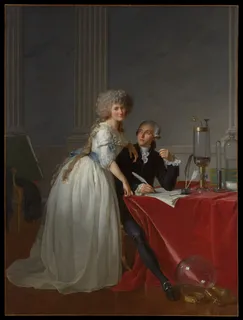
Questions to think about
- Look for itHow many people in the painting are hiding their faces with their hands?
- Why?Why might David have chosen the moment just before Socrates' fingers touch the cup?
- What about you?Socrates refused to escape and accepted the verdict; when what I believe is right clashes with what my community has decided, what would I do?
Same period
Painted around the same time,
somewhere else
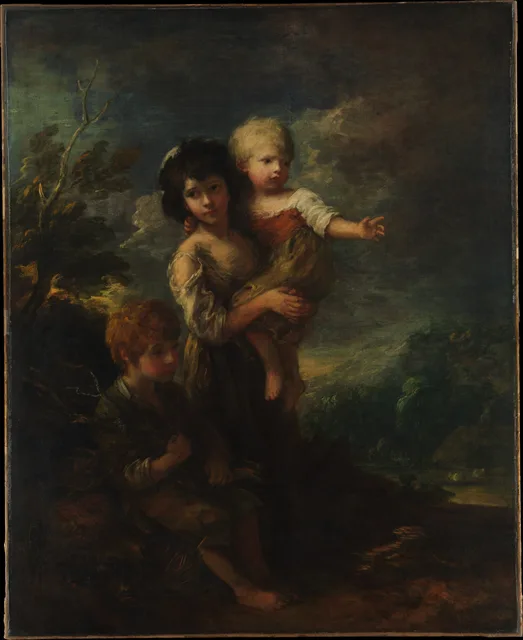 Cottage Children (The Wood Gatherers)Thomas Gainsborough1787
 Queen CharlotteThomas Gainsborough1788
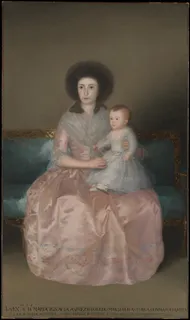 Condesa de Altamira and Her Daughter, María AgustinaGoya1787–88
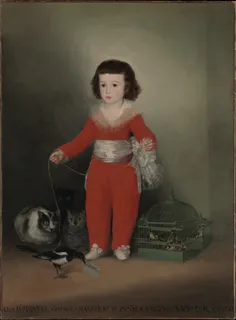 Manuel Osorio Manrique de Zuñiga (1784–1792)Goya1787–88
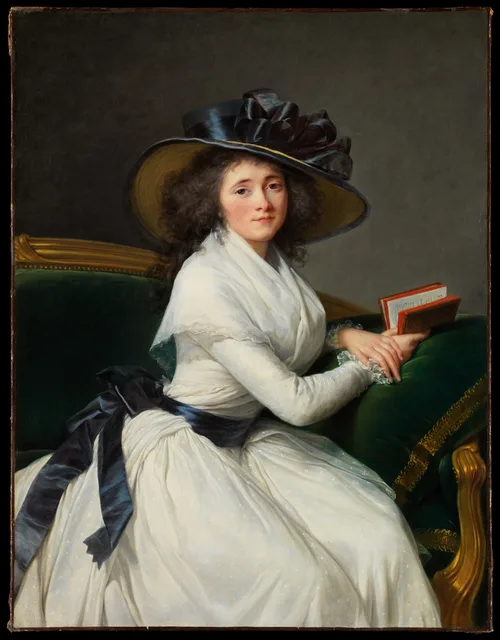 Comtesse de la Châtre (Marie Charlotte Louise Perrette Aglaé Bontemps, 1762–1848)Elisabeth Louise Vigée Le Brun1789
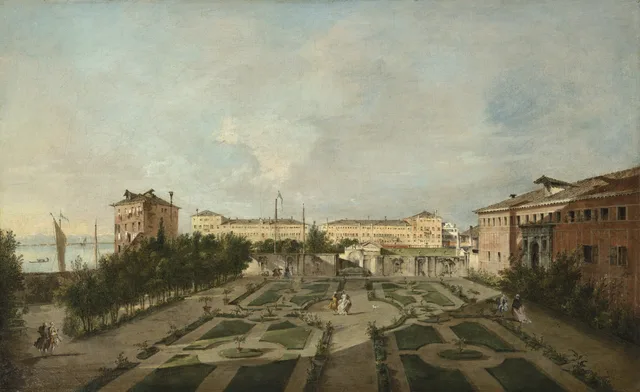 The Garden of Palazzo Contarini dal ZaffoFrancesco GuardiLate 1770s
Too good to keep to yourself
This painting,
for someone who comes to mind
They open it at full size
and see every brushstroke.
About this work
- Artist
- Jacques Louis David · 1748–1825
- Date
- 1787
- Medium
- Oil on canvas
- Size
- 129.5 × 196.2 cm
- Collection
- The Metropolitan Museum of Art
- Image
- Original long edge 4000px · shown at 2560px
- Original
- View on the museum's website ↗