 Pyeongye
Artwork · 14th century
LeoTurn on Magnifier at the lower right and move slowly across the painting.
Full screen opens it edge to edge.Tap the painting to fill the screen.
Spread two fingers to look closer.
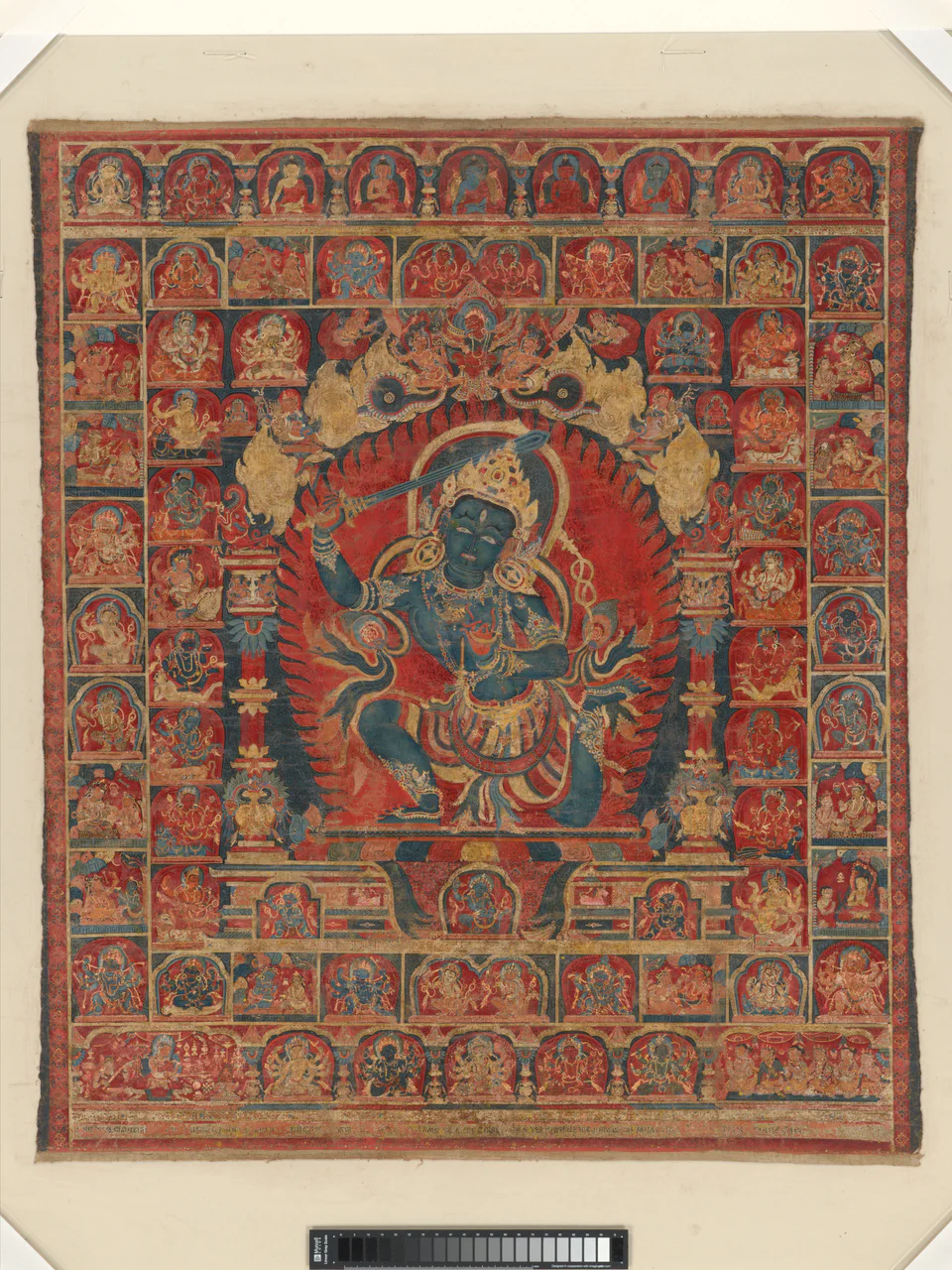
Acala, The Buddhist Protector
Unknown artist · Nepal, Kathmandu Valleyequivalent to February / March 1322Distemper and gold on cloth81.3 × 67.3 cm
At a glance
- Acala, a blue-bodied Buddhist protector, kneels on one knee inside a ring of flames, raising a sword over his head.
- An unnamed painter in Nepal's Kathmandu Valley made it in distemper and gold on cloth, dated to around February or March 1322.
- This cloth painting is more than 700 years old, and one large central figure is surrounded by dozens of small gods in their own little frames.
Reading the picture
5 places to look closer
Tap a number on the painting to jump to its note, or a close-up to see that spot in the whole picture.
Start by zooming into the face. In the middle of his blue forehead is a third eye, set upright, so he has three eyes in all. He wears a gold crown studded with red and white jewels and big round earrings. His right hand swings a sword up and across above his head.
Now look over to his other hand. A golden cord loops twice, like a figure eight. It is a noose. The sword and the noose are Acala's constant tools: the sword is understood to cut through ignorance, and the noose to catch and bind what is harmful.
Move down to the legs. One knee is pressed to the ground and the other leg is raised, so his body is low and coiled. Around his waist he wears a cloth striped red, yellow and blue, its ends spilling to the floor. It is a pose that looks ready to spring up at any moment.
Zoom into the border at the upper left. Inside each small arched niche sits a single deity. Some have many arms, one has a white face, another is red, and each holds different objects. Dozens of these little frames run all the way around the painting.
Look at the lower right corner. A row of people sits side by side, and below them a band carries a single line of small writing. Much of the color here has faded or flaked away. You can see at a glance that this cloth has survived a very long time.
When it was painted
Near the end of winter in 1322, a family in Nepal's Kathmandu Valley dedicated this painting. It carries a date, which the Met reads as the year 443 of the Nepal era, likely in the month of Phalguna. The Nepal era begins in 879, so that works out to February or March 1322. Seven hundred years on, we can still name the season it was made.
In Sanskrit, Acala means the immovable one, and in East Asia he goes by names that mean the same thing, such as Fudo in Japan. The Met describes this Acala as a wrathful form of Manjushri, the bodhisattva of wisdom. Think of it as wisdom with an angry face, swinging a sword at ignorance.
Paintings on cloth like this one are called paubha by the Newar people of the valley. Newar families had images of Buddhist and Hindu gods painted for their household rituals, and commissioning one was a way of earning religious merit. Newar artists were famous well beyond the valley. About sixty years before this painting, a Newar artist named Anige traveled to Tibet and on to the court of the Mongol ruler Kublai Khan.
The people who paid for this painting are inside it. At the lower left sits a Vajracharya, a Newar Buddhist priest, with ritual objects laid out before him. The Met explains that he is performing rites for the donor family seated across from him. Centuries later the cloth came to the Metropolitan Museum as a gift from Perry J. Lewis in 1994.
Now look at the painting again. At the top of Acala's flaming halo, the winged Garuda grips two nagas, beings with human bodies and snake tails. And at the lower right, the family who gave this painting seven hundred years ago is still sitting in a row.
Questions to think about
- Look for itCan you find the sword, the noose and the third eye on the central figure?
- Why?Why would a protector be painted with such a frightening face and flames, rather than a gentle smile?
- What about you?If Acala's sword is meant to cut through ignorance, what is one thing you would like to cut out of your own thinking today?
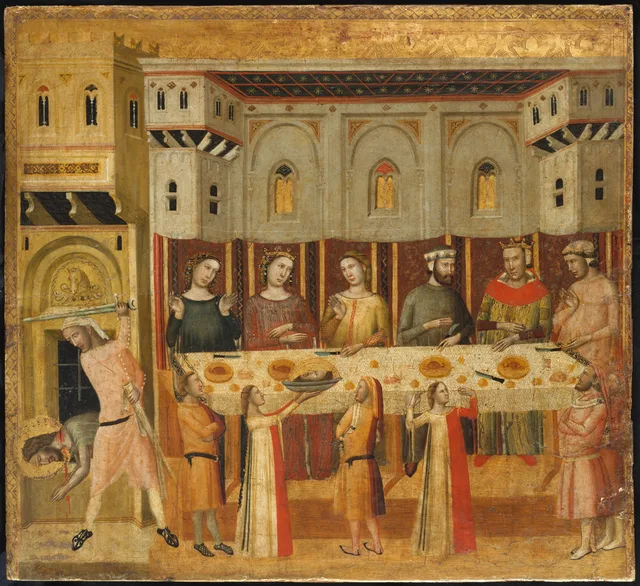
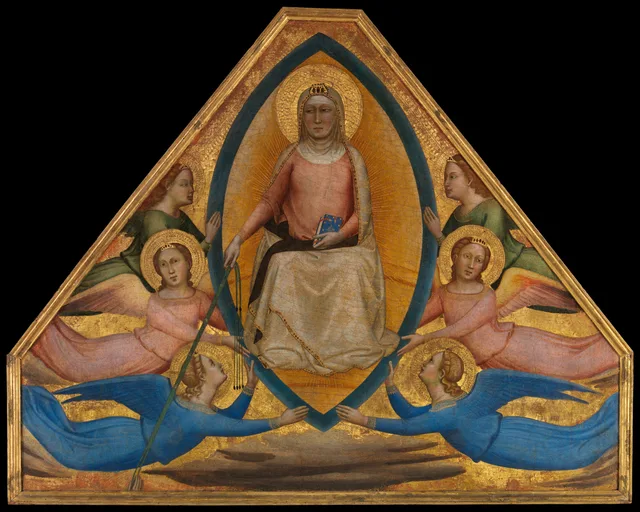
Same period
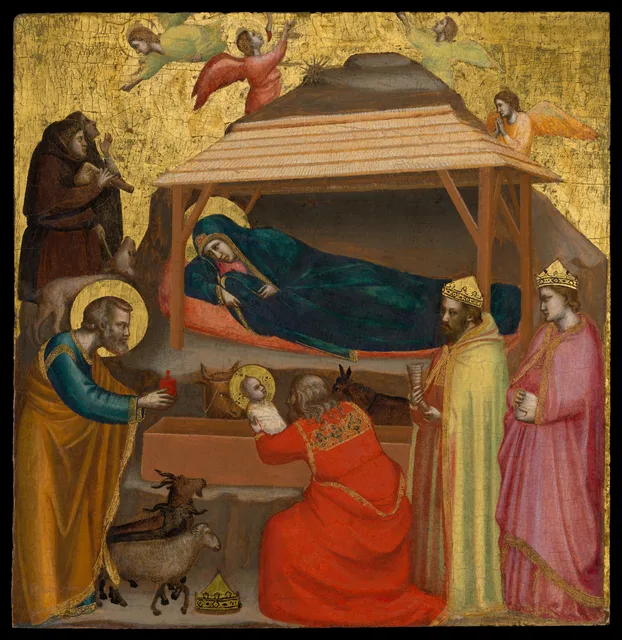
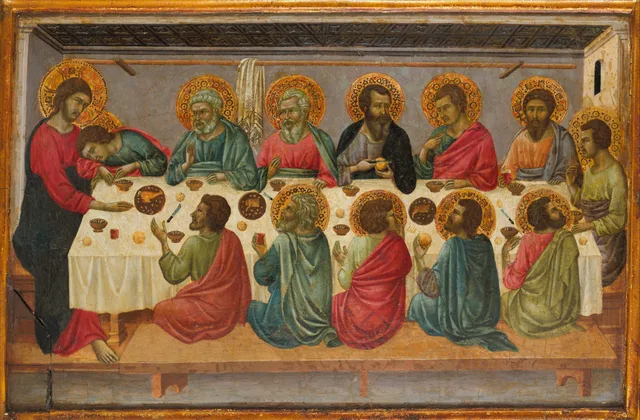
Painted around the same time,
somewhere else
Too good to keep to yourself
This painting,
for someone who comes to mind
They open it at full size
and see every brushstroke.
About this work
- Artist
- Unknown artist · Nepal, Kathmandu Valley
- Date
- equivalent to February / March 1322
- Medium
- Distemper and gold on cloth
- Size
- 81.3 × 67.3 cm
- Culture
- Nepal, Kathmandu Valley
- Collection
- The Metropolitan Museum of Art
- Image
- Original long edge 4000px · shown at 2560px
- Original
- View on the museum's website ↗