 Pyeongye
Artwork · 17th century
LeoTurn on Magnifier at the lower right and move slowly across the painting.
Full screen opens it edge to edge.Tap the painting to fill the screen.
Spread two fingers to look closer.
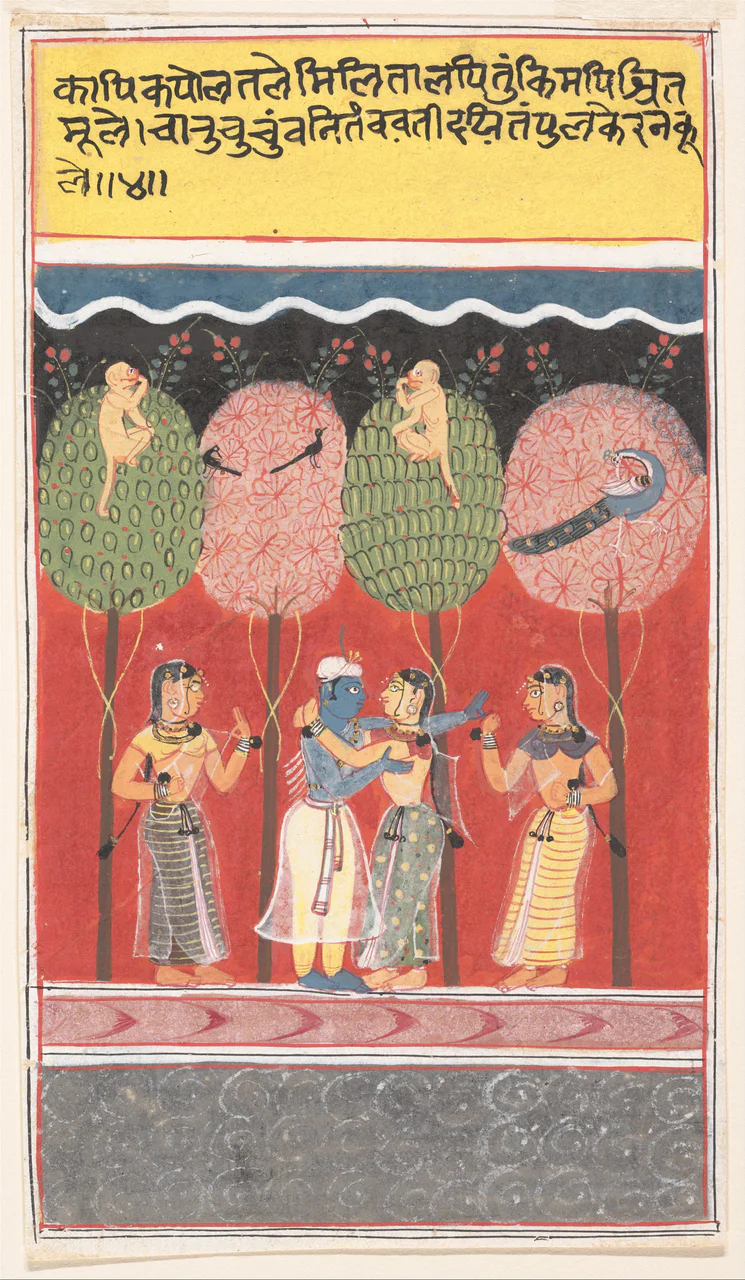
Krishna Revels with the Gopis: Page from a Dispersed Gita Govinda (Song of the Cowherds)
Unknown artist · India (Madhya Pradesh, Malwa)ca. 1630–40Opaque watercolor and silver on paper11.4 × 20.3 cm
At a glance
- In a red grove, the blue-skinned god Krishna embraces one of the gopis, the cowherd women, while two more stand nearby.
- An unnamed painter in Malwa, in central India, made it around 1630–40 with opaque watercolor and silver on paper.
- On one small sheet, about 11.4 by 20.3 centimeters, a line of poetry sits right above the picture it describes.
Reading the picture
5 places to look closer
Tap a number on the painting to jump to its note, or a close-up to see that spot in the whole picture.
Begin with the yellow panel at the top. The black writing is Sanskrit verse from the Gita Govinda, a poem by Jayadeva. This line sings of a woman pressing her cheek to Krishna's as if to whisper something in his ear. The mark at the end, with the Devanagari numeral 4, tells you it is the fourth verse of the song.
Zoom into the couple in the middle. Krishna has blue skin and a white turban topped with a little yellow ornament. The gopi wraps an arm around his neck. Their eyes meet only inches apart.
Now look up into the trees. Green trees and pink trees alternate, and on top of each green tree a monkey crouches, lifting something to its mouth. In a pink tree, two black birds with long tails have settled. Above the people, the animals of the grove are busy too.
Zoom into the pink tree at the right. A peacock curls its body and turns its head back. Its long tail is lined with eye spots dotted in yellow. The gray-blue bird sits on the patterned pink tree like a pattern laid on top of a pattern.
Look at the gopi on the right. Stacks of black and white striped bangles circle her wrists, and a gold necklace hangs at her throat. The thin cloth over her body is drawn with only a few white lines, so it reads as see-through. Black tassels dangle from her waist.
When it was painted
About five hundred years before this page was painted, in the 12th century, a poet named Jayadeva in eastern India wrote a song-poem in Sanskrit. He called it the Gita Govinda, the Song of the Cowherd. It follows Krishna and Radha through a spring forest as they love, drift apart, and find each other again. At the Jagannath temple in Puri, in Odisha, the poem is still sung today.
This scene comes from near the start of the poem. Spring has arrived, and Radha's friend describes to her what Krishna is up to: playing and flirting with the other cowherd women. The verse in the yellow panel is one line from that song. Krishna is honored as a form of the Hindu god Vishnu, and painters often give him blue skin, as here.
When this page was made, around 1630 to 1640, Malwa was a province of the Mughal Empire. Up north in Agra, the emperor Shah Jahan had begun building the Taj Mahal in memory of his late wife. Meanwhile, on this small sheet to the south, a very different kind of picture took shape. The color is laid on flat, with no shadows. The scene is stacked in bands, and the verse is written right above it.
This sheet once belonged to a set that illustrated the poem verse by verse. No record tells us who ordered the set or whose hand painted it. At some point the set was broken up and scattered, and this page entered the Metropolitan Museum's collection in 2003.
Now look at the picture again. Between the wavy blue band at the top and the gray band at the bottom, the background is solid red. In the middle of that red grove, blue Krishna locks eyes with a gopi. The restless heat of the poet's spring forest lives in that red.
Questions to think about
- Look for itHow many monkeys, birds and peacocks can you find in this small picture?
- Why?Why do you think the painter wrote the line of poetry right above the scene?
- What about you?When a set of paintings has been split up among museums in different countries, should it be brought back together, or is it fine for people in many places to see parts of it?
Same period
Painted around the same time,
somewhere else
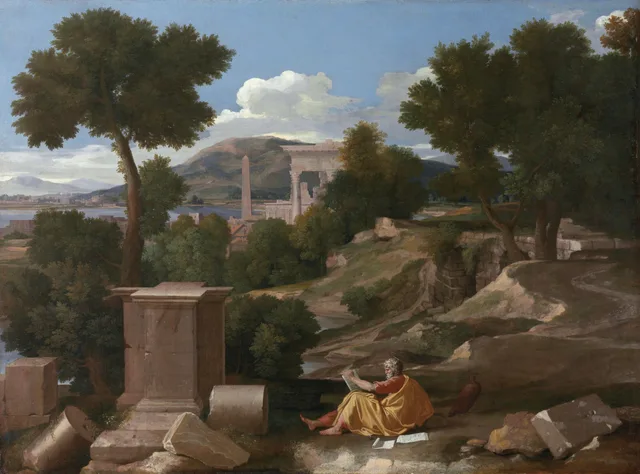 Landscape with Saint John on PatmosNicolas Poussin1640
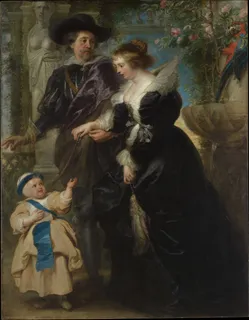 Rubens, Helena Fourment (1614–1673), and Their Son Frans (1633–1678)Peter Paul Rubensca. 1635
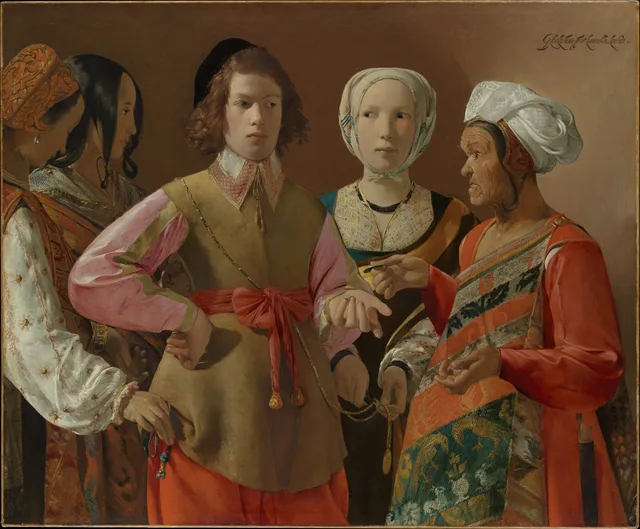 The Fortune-TellerGeorges de La Tourprobably 1630s
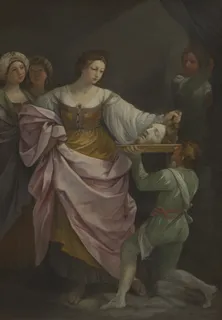 Salome with the Head of Saint John the BaptistGuido Renic. 1639–42
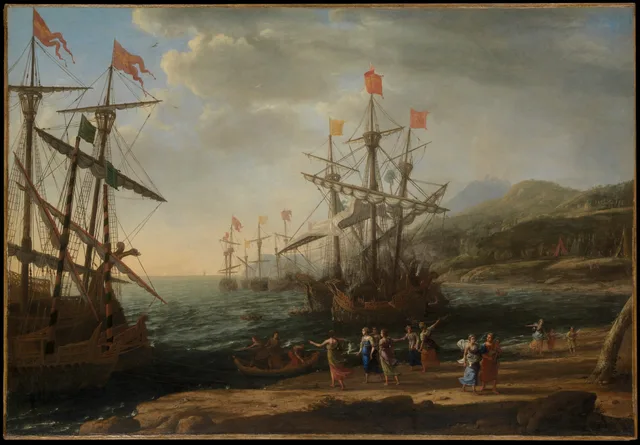 The Trojan Women Setting Fire to Their FleetClaude Lorrainca. 1643
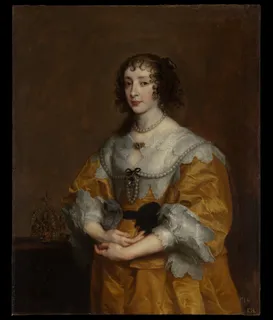 Queen Henrietta MariaAnthony van Dyck1636
Too good to keep to yourself
This painting,
for someone who comes to mind
They open it at full size
and see every brushstroke.
About this work
- Artist
- Unknown artist · India (Madhya Pradesh, Malwa)
- Date
- ca. 1630–40
- Medium
- Opaque watercolor and silver on paper
- Size
- 11.4 × 20.3 cm
- Culture
- India (Madhya Pradesh, Malwa)
- Collection
- The Metropolitan Museum of Art
- Image
- Original long edge 3726px · shown at 2560px
- Original
- View on the museum's website ↗