 Pyeongye
Artwork · 17th century · Anthony van Dyck
LeoTurn on Magnifier at the lower right and move slowly across the painting.
Full screen opens it edge to edge.Tap the painting to fill the screen.
Spread two fingers to look closer.
At a glance
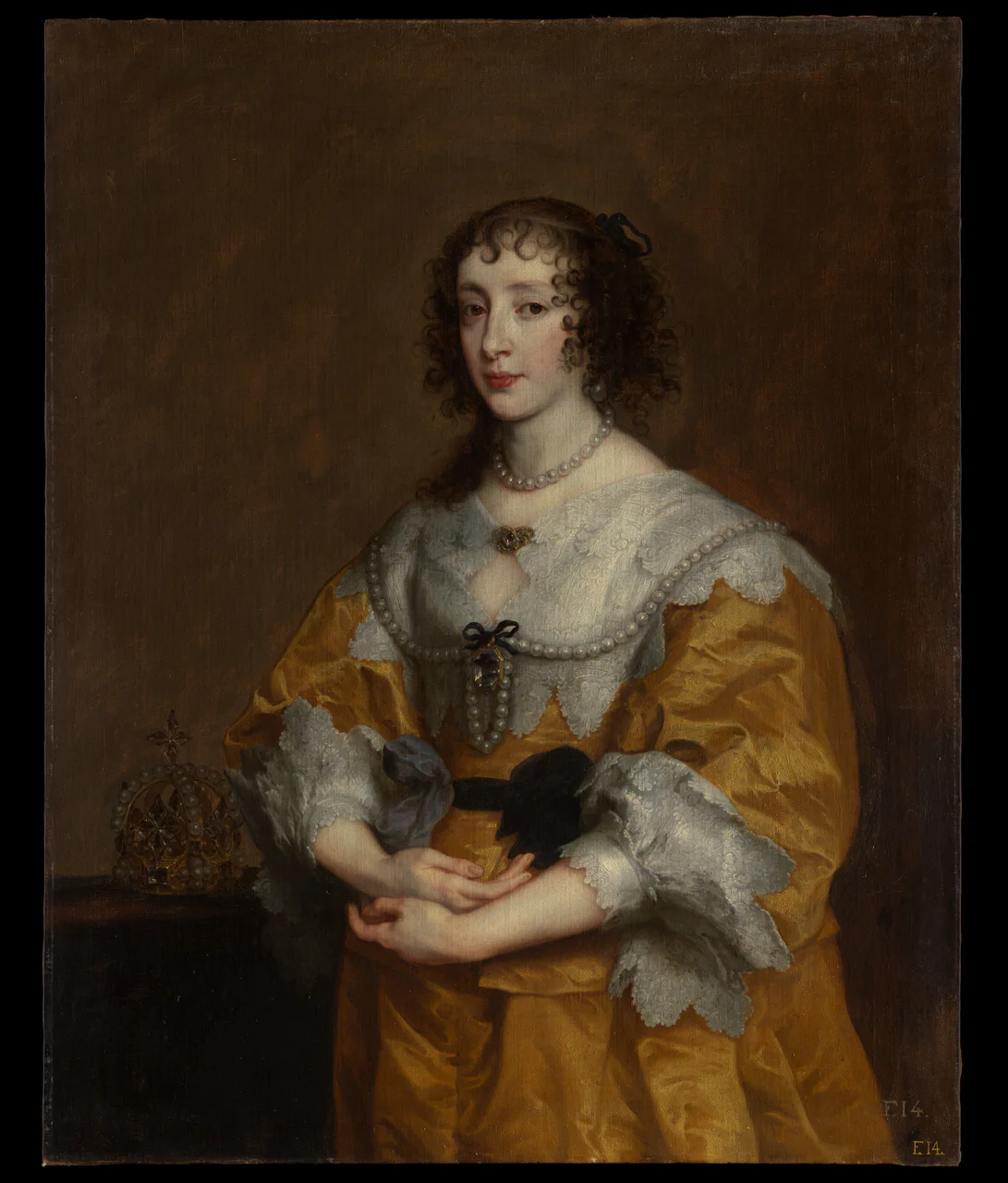
- Henrietta Maria, queen of England, stands beside a crown in a yellow silk gown hung with pearls, her hands folded in front of her.
- Anthony van Dyck, court painter to King Charles I, painted it in 1636.
- Crown, pearls, and lace are all here, yet the picture is quiet and soft. It shows Van Dyck's way of presenting royalty through grace rather than grandeur.
Reading the picture
5 places to look closer
Tap a number on the painting to jump to its note, or a close-up to see that spot in the whole picture.
Zoom in on her face and hair. Short curls bob across her forehead, and a black ribbon is tied in the hair on the right. Her mouth hovers on the edge of a smile. Only her cheeks and lips are touched with pink, so the pale face seems to glow.
Look at the front of her bodice. A gold brooch sits in the middle of the lace collar, and below it a large jewel hangs from a black bow. Each pearl gets a single dot of white for its highlight. That one dot is what makes it look round.
Zoom in on the crown on the table at the left. It is a gold crown edged with pearls, with a small cross-shaped ornament on top. But it sits on a table, half lost in shadow, not on her head. The painting tells you she is queen without pushing the point.
Look at the lace cuff on the right sleeve. Broad lace with a flower pattern falls in jagged points over the yellow silk. Van Dyck only hinted at the pattern with gray and white strokes, yet from a step back you seem to see every stitch.
Zoom in on her folded hands. Long, slender fingers rest lightly over one another. The people in Van Dyck's portraits very often have hands like these, long and elegant.
When it was painted
In 1636 Van Dyck was about thirty-seven. Born in Antwerp, he had worked alongside Rubens as a young man, and in 1632 he crossed to London to become principal painter to Charles I. The king knighted him and gave him a house at Blackfriars on the Thames. He painted the king, the queen, and their children many times.
The queen in this picture was in her late twenties. A daughter of King Henry IV of France, she had married Charles I in 1625 and become queen of England, a Catholic queen in a Protestant country.
This portrait was meant for Rome from the start. Henrietta Maria ordered it for Cardinal Francesco Barberini, the pope's nephew. The cardinal hoped England might return to the Catholic Church, and he saw the queen as a key ally. The painting was one of many diplomatic gifts that passed between the two courts.
The Metropolitan Museum reads the queen here as pregnant, with her arms cradled over her abdomen. In March of the following year, 1637, she gave birth to a daughter, Princess Anne.
The picture passed through other hands and in time reached the American collectors Charles and Jayne Wrightsman. It came to the Met as a bequest in 2019. Van Dyck himself died in London in 1641. The next year civil war broke out between king and Parliament, and Charles I was executed in 1649.
Look again at the queen's arms, folded softly over the yellow silk. If the museum is right, this painting carried someone else to Rome too: a child not yet born.
The painter
Anthony van Dyck
1599–1641
When painting this, the artist was about 37 years old
All paintings by Anthony van Dyck →More by the same painter
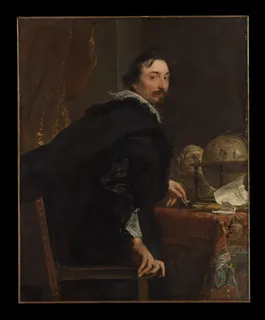
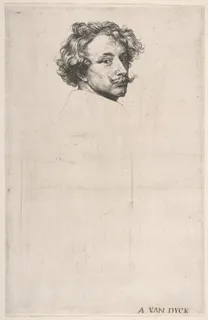
Questions to think about
- Look for itCan you find the small letters written in the lower right corner?
- Why?Why do you think Van Dyck put the crown on a side table instead of on the queen's head?
- What about you?A court painter had to show the queen at her very best. How is that like choosing and editing the photos we post today, and where would you draw the line?
Same period
Painted around the same time,
somewhere else
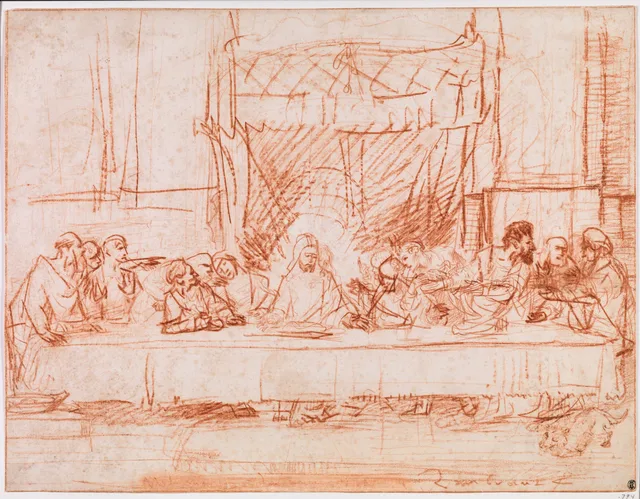 The Last Supper, after Leonardo da VinciRembrandt1634–35
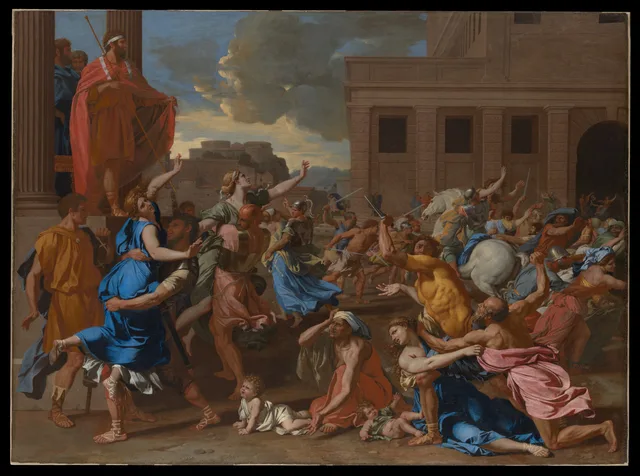 The Abduction of the Sabine WomenNicolas Poussinprobably 1633–34
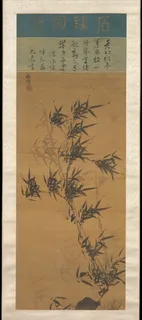 Bamboo in the WindYi Jeongearly 17th century
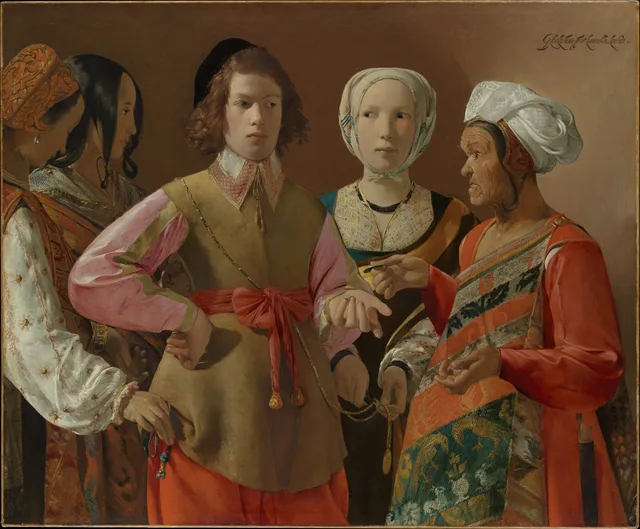 The Fortune-TellerGeorges de La Tourprobably 1630s
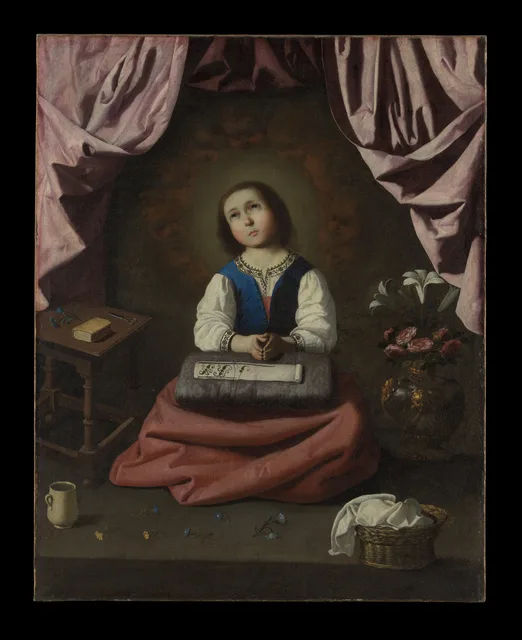 The Young VirginFrancisco de Zurbaránca. 1632–33
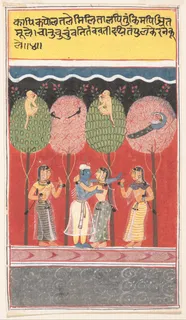 Krishna Revels with the Gopis: Page from a Dispersed Gita Govinda (Song of the Cowherds)Unknown artist · India (Madhya Pradesh, Malwa)ca. 1630–40
Too good to keep to yourself
This painting,
for someone who comes to mind
They open it at full size
and see every brushstroke.
About this work
- Artist
- Anthony van Dyck · 1599–1641
- Date
- 1636
- Medium
- Oil on canvas
- Size
- 105.7 × 84.5 cm
- Collection
- The Metropolitan Museum of Art
- Image
- Original long edge 4000px · shown at 2560px
- Original
- View on the museum's website ↗