 Pyeongye
Artwork · 17th century · Georges de La Tour
LeoTurn on Magnifier at the lower right and move slowly across the painting.
Full screen opens it edge to edge.Tap the painting to fill the screen.
Spread two fingers to look closer.
At a glance
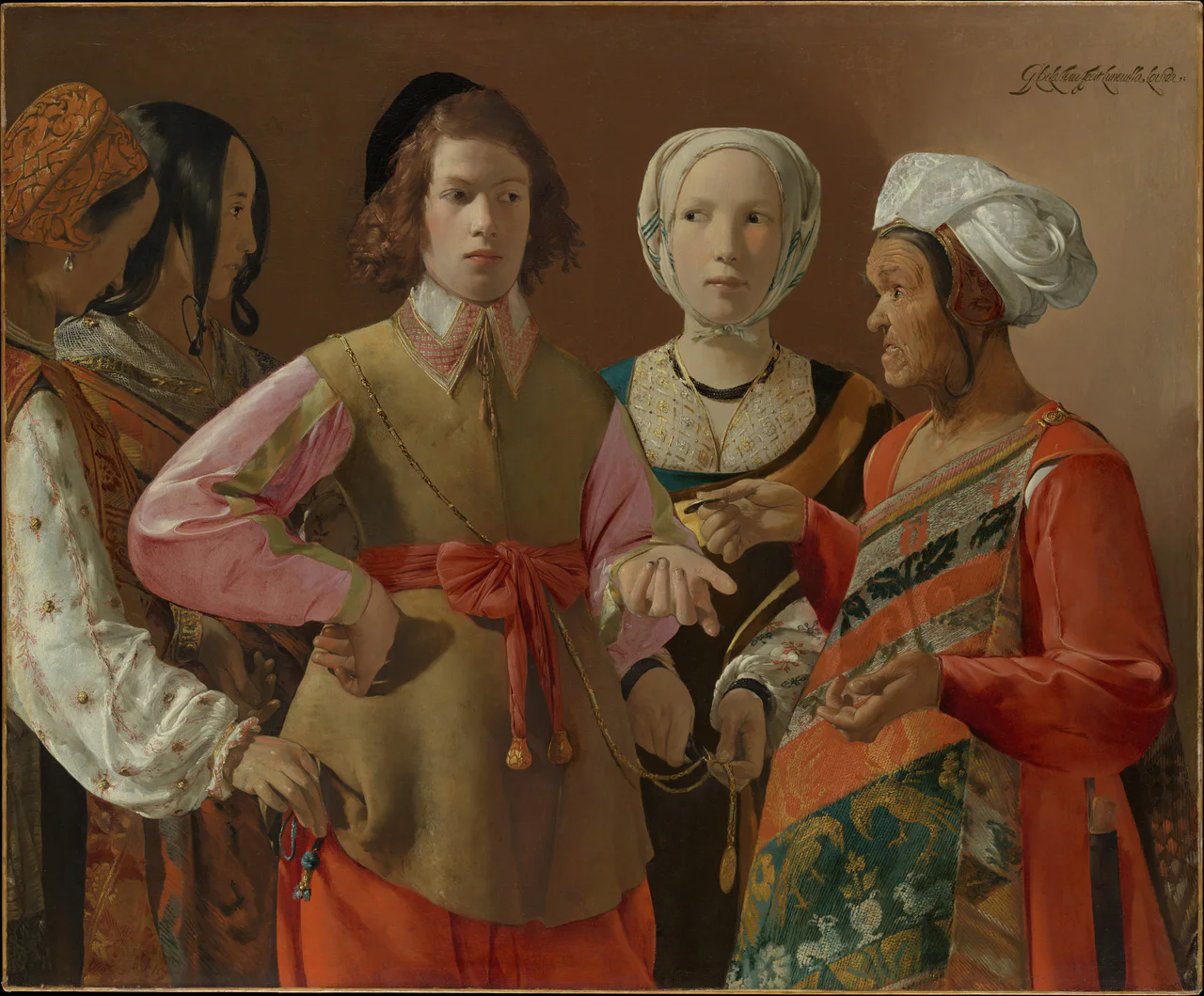
- A well-dressed young man has his palm read by an old fortune-teller, while the women around him quietly rob him.
- Georges de La Tour, a painter from Lorraine in what is now eastern France, probably painted it in the 1630s.
- Five people stand side by side, and each pair of eyes and hands is busy with something different. Follow them one by one and the crime unfolds.
Reading the picture
5 places to look closer
Tap a number on the painting to jump to its note, or a close-up to see that spot in the whole picture.
Zoom in on the two hands in the middle. The young man holds his palm open, and the fortune-teller holds a silvery coin just above it. It is her payment for telling his future.
Look at the face of the woman in the white headscarf. Her face points straight ahead, but her eyes slide sideways toward the young man. Her expression is calm, as if nothing is going on. So what are her hands doing?
Follow her arms down and zoom in. She holds the gold chain that hangs from the young man's chest, and she is cutting it with a small blade. A round gold medal dangles from the end of the chain.
Zoom in on the lower left. A hand in a white sleeve has slipped into the young man's side, at his waist. Behind it, another hand waits with its fingers spread. It is ready to take whatever is passed back.
Look at the upper right corner. On the brown wall, the painter's signature is written in looping script. In Latin it says that La Tour made this picture in Lunéville, in Lorraine.
When it was painted
In the 1630s La Tour was around forty and settled in Lunéville, a small town in the Duchy of Lorraine. He was a baker's son. He had married Diane Le Nerf, the daughter of a noble family, and moved to her hometown. The Duke of Lorraine even granted him special tax privileges.
Those were not peaceful years. Armies of the Thirty Years' War marched through Lorraine, plague broke out, and from 1633 French troops occupied the duchy. In 1638 Lunéville burned. The next year La Tour turned up in Paris with the title of painter to the King of France.
A fortune-teller working with pickpockets was a familiar story. The Met explains that the theme had spread through prints in northern Europe and through Caravaggio's paintings in Rome. La Tour took the old tale and packed his canvas with five faces and their busy hands.
La Tour died in Lunéville in 1652, and his name slipped almost completely out of memory. In 1915 the German scholar Hermann Voss began to gather his pictures together again and bring the painter back. This canvas surfaced in a private collection in France in the middle of the twentieth century.
When the Metropolitan Museum bought it in 1960, there was an uproar in France. People asked how such a picture had been allowed to leave the country, and the culture minister, André Malraux, had to answer the question in the National Assembly.
Look again at the signature in the upper right corner. La Tour wrote the name of his own town, Lunéville, into the paint. That small line of script has ended up on a wall across the ocean in New York.
More by the same painter
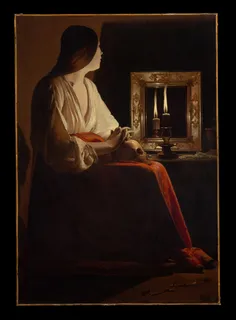
Hidden stories in this painting
Questions to think about
- Look for itAt the far left, can you find the woman who keeps her head bowed instead of looking at the young man?
- Why?Why do you think La Tour put the stealing hands low and in shadow, while keeping the faces bright and calm?
- What about you?The young man was so caught up in the fortune-teller's words that he didn't notice being robbed. How is that like getting pulled in by a tempting message online and losing money or personal information?
Same period
Painted around the same time,
somewhere else
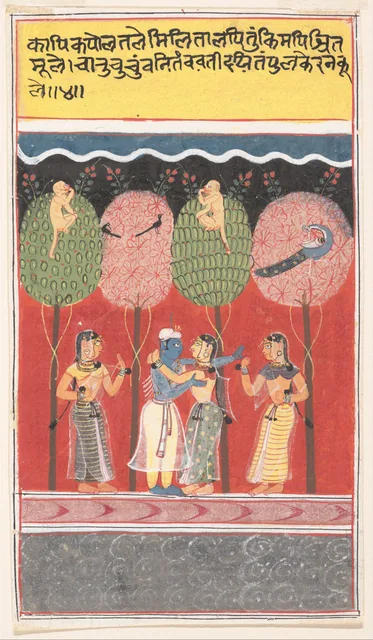 Krishna Revels with the Gopis: Page from a Dispersed Gita Govinda (Song of the Cowherds)Unknown artist · India (Madhya Pradesh, Malwa)ca. 1630–40
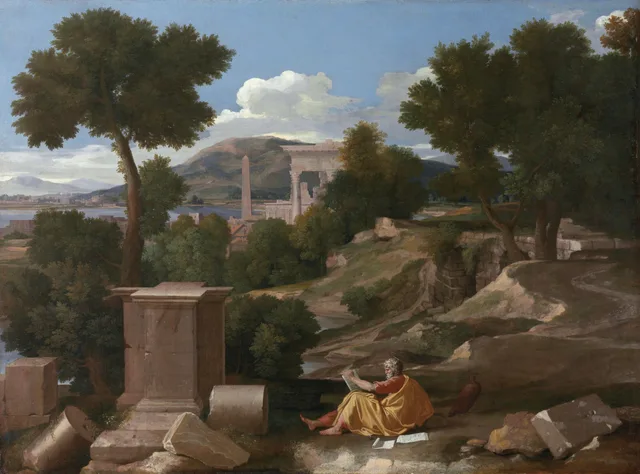 Landscape with Saint John on PatmosNicolas Poussin1640
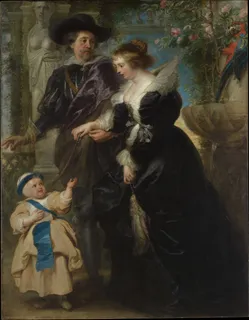 Rubens, Helena Fourment (1614–1673), and Their Son Frans (1633–1678)Peter Paul Rubensca. 1635
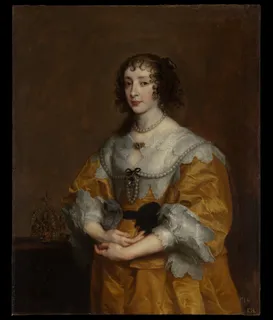 Queen Henrietta MariaAnthony van Dyck1636
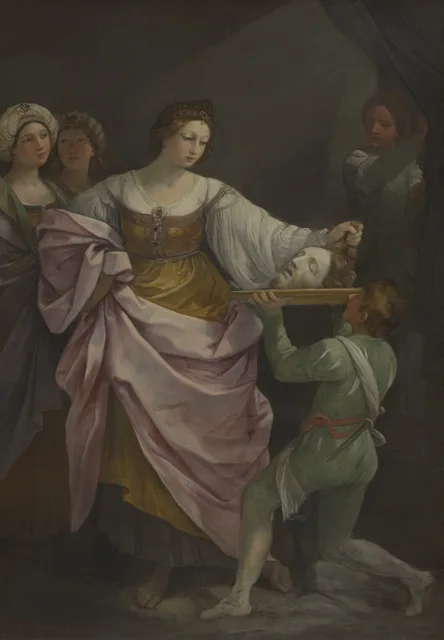 Salome with the Head of Saint John the BaptistGuido Renic. 1639–42
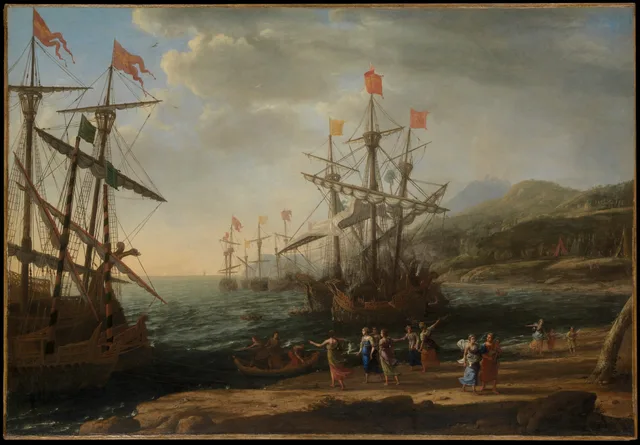 The Trojan Women Setting Fire to Their FleetClaude Lorrainca. 1643
Too good to keep to yourself
This painting,
for someone who comes to mind
They open it at full size
and see every brushstroke.
About this work
- Artist
- Georges de La Tour · 1593–1652
- Date
- probably 1630s
- Medium
- Oil on canvas
- Size
- 101.9 × 123.5 cm
- Collection
- The Metropolitan Museum of Art
- Image
- Original long edge 3970px · shown at 2560px
- Original
- View on the museum's website ↗