 Pyeongye
Artwork · 14th century
LeoTurn on Magnifier at the lower right and move slowly across the painting.
Full screen opens it edge to edge.Tap the painting to fill the screen.
Spread two fingers to look closer.
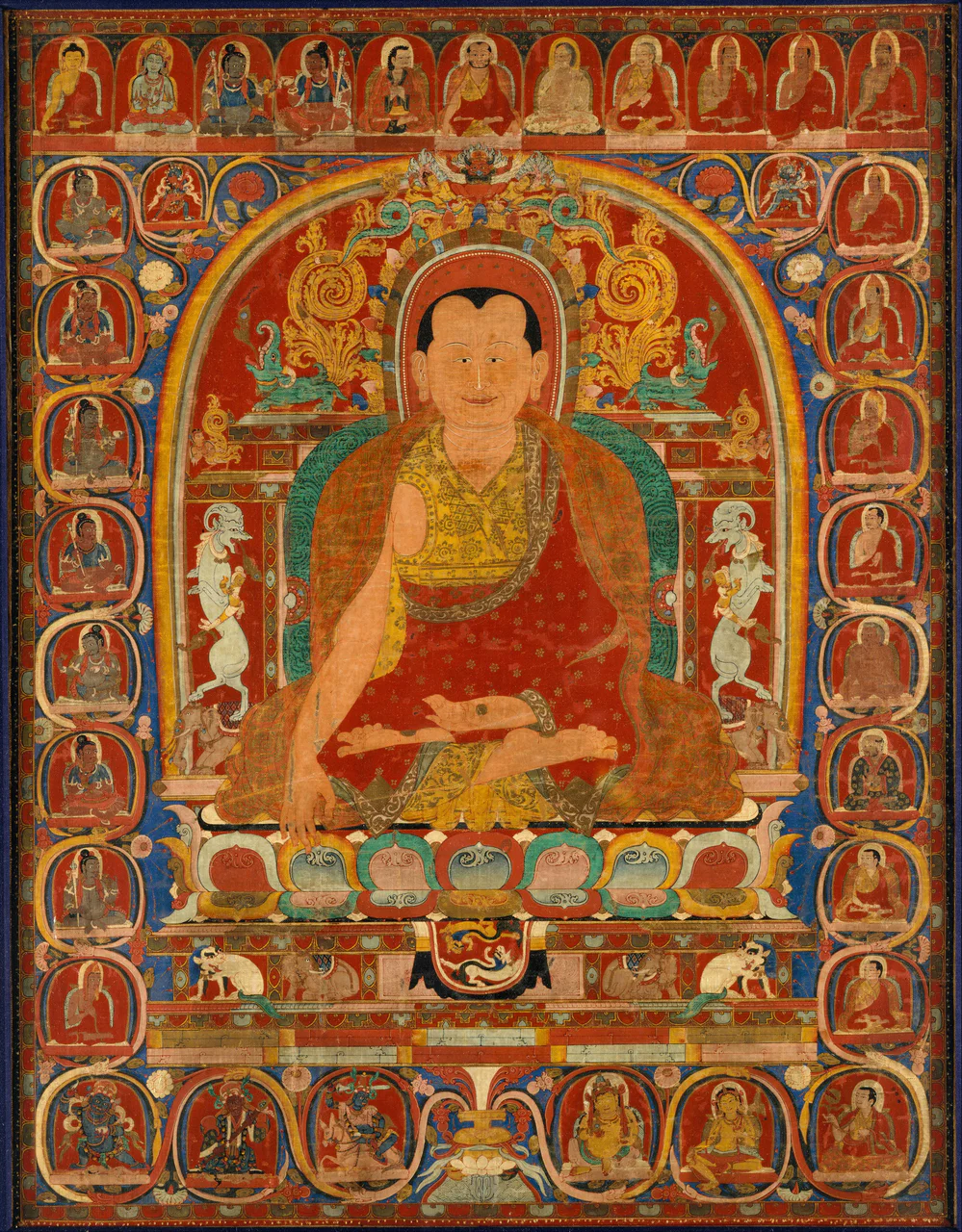
Lineage Portrait of an Abbot
Unknown artist · Central Tibetca. 1350Distemper on cloth77.2 × 59.7 cm
At a glance
- A monk in red robes sits smiling on a lotus throne, framed by rows of small niches filled with Buddhas, teachers and protectors.
- An unnamed painter made it in Central Tibet around 1350, using distemper on cloth.
- The large figure in the middle is not a god but a real monk who once lived. The museum's title calls him simply an abbot, with no name.
Reading the picture
5 places to look closer
Tap a number on the painting to jump to its note, or a close-up to see that spot in the whole picture.
Look at the face first. His hair is cropped short, with the hairline dipping to a point in the middle of his forehead. His cheeks are round and the corners of his mouth turn up. This is not the fixed, ideal face of a Buddha. It looks like a particular person.
Follow his right arm down. The fingertips reach over the edge and lightly touch the lotus seat. It is the same gesture the Buddha made when he touched the earth at the moment of his awakening.
Now go to the far left of the top row. A golden Buddha in a red robe sits there. Next to him is a crowned, pale bluish-white figure with both hands raised at the chest. Moving right, past two blue-bodied figures, robed monks follow one after another. This is the lineage, the chain of teachers passing the teaching from master to student.
Look at the chair back on the left side of the monk. A white beast rears up on its hind legs, and a tiny rider clings to its body. Under its feet you can see the head of an elephant. Creatures standing on creatures like this were a long-standing way to decorate a throne.
Drop down to the base below the lotus. A white lion with a blue mane and a green tail sits with its tongue out. A seat held up by lions is a sign that a Buddha or a great teacher sits there. In Tibet, these white lions are called snow lions.
When it was painted
Around 1350, in Central Tibet, someone was painting a monk's face onto cloth. Today we know neither the painter's name nor the monk's. Even the museum calls him simply an abbot.
Still, one clue survives. Look at the round niche in the bottom right corner. A monk with cropped hair holds a long-handled censer, and smoke curls up from it. The museum identifies him as the person who probably commissioned the painting.
If so, he paid for this portrait of the abbot and placed himself in a corner, offering incense. In Tibetan paintings, the people who gave a work often appear small like this, near the lower edge.
Tibet was going through great change at the time. For decades the Sakya order, backed by the Mongol Yuan court, had led the country. In the 1350s, Changchub Gyaltsen of the Phagmodru took over that power. Which monastery you belonged to, and whose teaching you carried, counted for a lot.
A painting like this was usually kept rolled up, then hung for rituals so people could pay their respects in front of it. This one entered The Metropolitan Museum of Art in 1991.
Look again at the smiling face in the middle. His name has been forgotten. But the man who burned incense before him is still sitting in the bottom corner, his smoke still rising.
Questions to think about
- Look for itAmong the small niches, can you find the fierce-faced protectors who are not monks?
- Why?Why do you think the painter gave this monk the same gesture as the Buddha?
- What about you?If you lined up the people who taught you what you know, who would stand at the front, and what would you want to give back to them?
Same period
Painted around the same time,
somewhere else
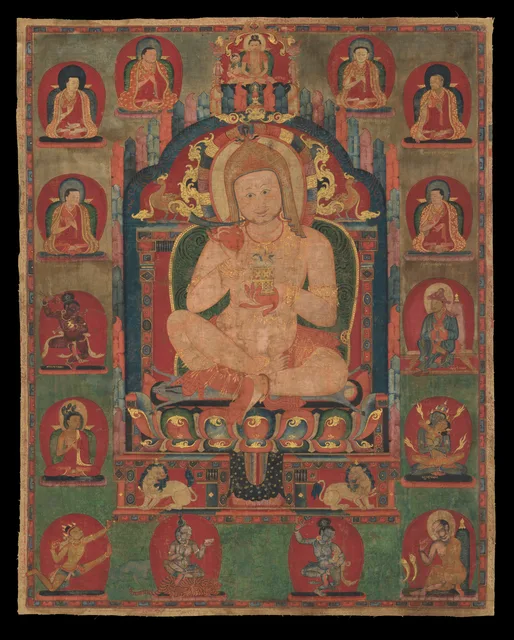 Mahasiddha JnanatapaUnknown artist · Eastern Tibet, Kham, Riwoche monasteryca. 1350
 Water-moon AvalokiteshvaraUnknown artist · Koreafirst half of the 14th century
 Woods and Valleys of Mount YuNi Zandated 1372
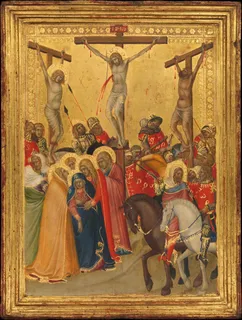 The CrucifixionPietro Lorenzetti1340s
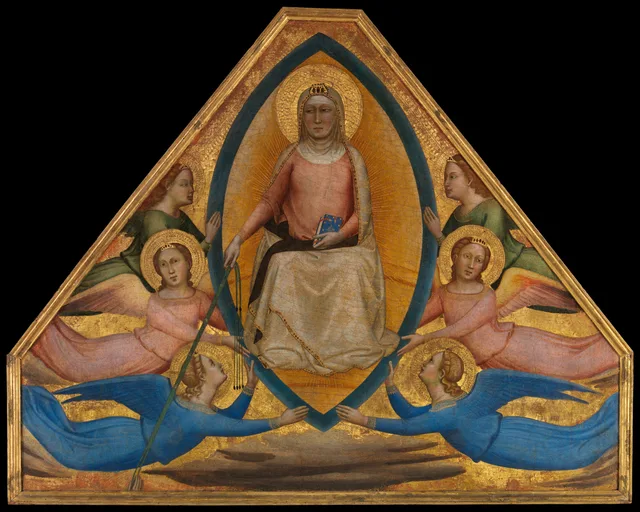 The Assumption of the VirginBernardo Daddi1337–38
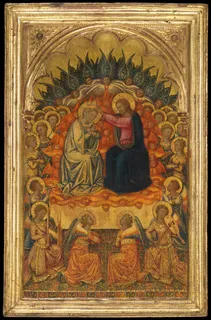 The Coronation of the VirginNiccolò di Buonaccorsoca. 1380
Too good to keep to yourself
This painting,
for someone who comes to mind
They open it at full size
and see every brushstroke.
About this work
- Artist
- Unknown artist · Central Tibet
- Date
- ca. 1350
- Medium
- Distemper on cloth
- Size
- 77.2 × 59.7 cm
- Culture
- Central Tibet
- Collection
- The Metropolitan Museum of Art
- Image
- Original long edge 3722px · shown at 2560px
- Original
- View on the museum's website ↗