 Pyeongye
Artwork · 14th century · Bernardo Daddi
LeoTurn on Magnifier at the lower right and move slowly across the painting.
Full screen opens it edge to edge.Tap the painting to fill the screen.
Spread two fingers to look closer.
At a glance
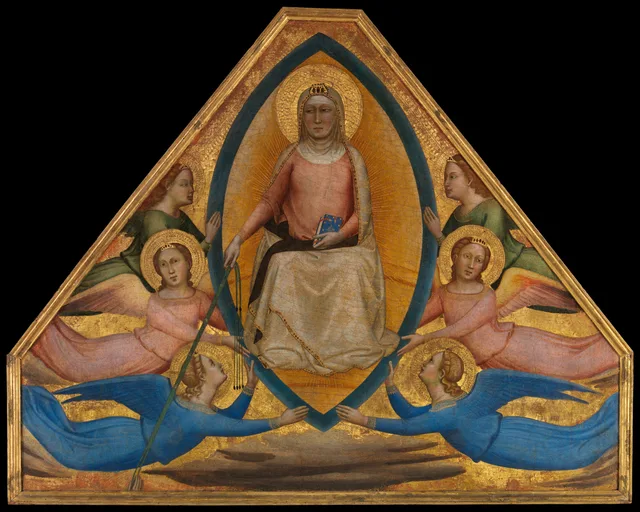
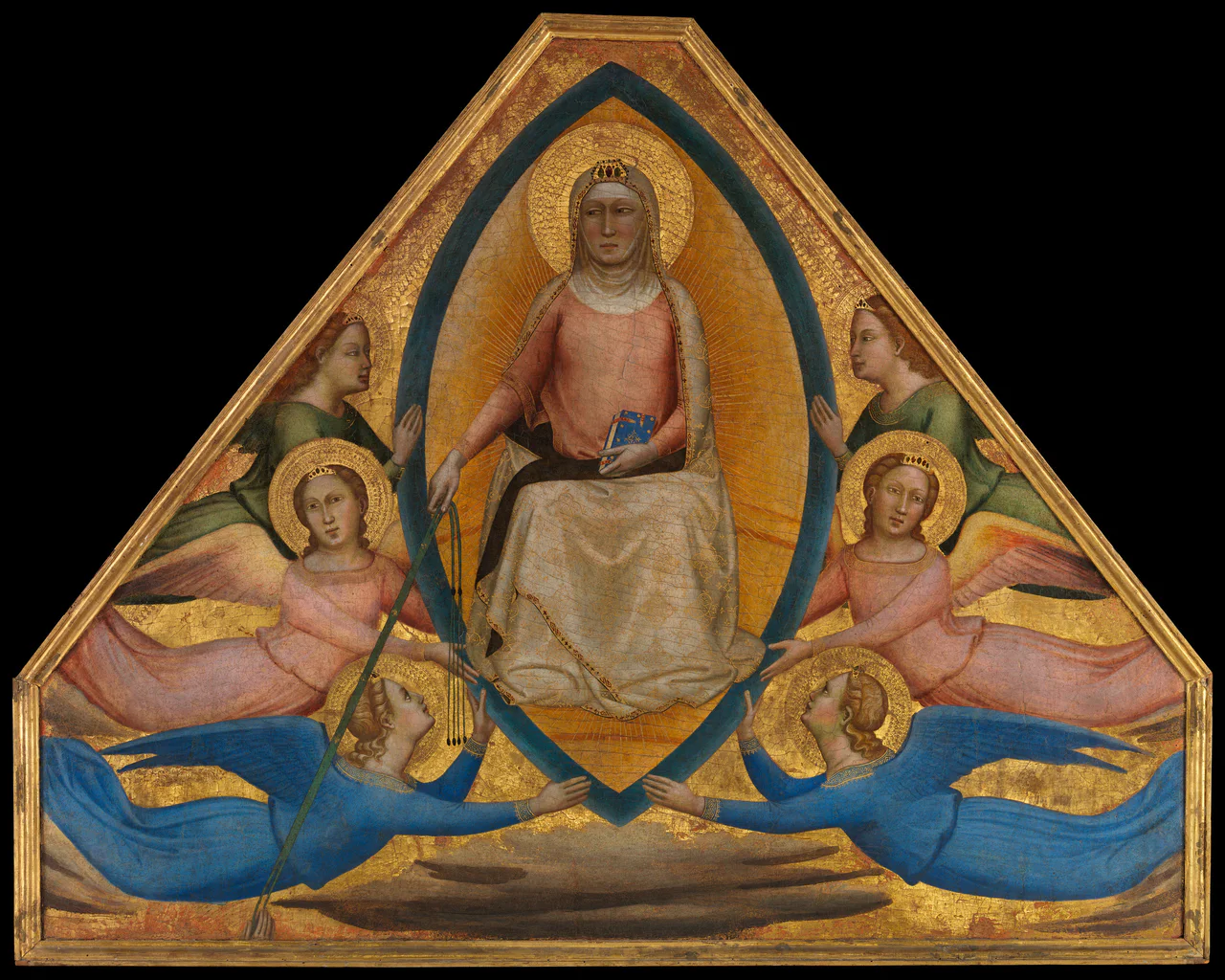
- The Virgin Mary sits in an almond-shaped glory while six angels carry her up to heaven. As she rises, she lets her belt fall to the earth.
- Bernardo Daddi of Florence painted it in 1337 to 1338, in tempera on wood with a gold ground.
- The triangular panel is more than a meter wide without its frame, and at the very bottom corner a hand reaches in from outside the picture.
Reading the picture
4 places to look closer
Tap a number on the painting to jump to its note, or a close-up to see that spot in the whole picture.
Start with Mary in the center. She wears a small crown and a pink dress under a cloak worked with gold thread. In her lap she holds a blue book studded with gold. Behind her, thin lines of golden light fan out in every direction.
Go down to the bottom tip of the blue border around her. Two angels in blue grip the two edges of it, one from each side, as if lifting it. You can even see the gold embroidery on their cuffs. Beneath them lies a band of dark cloud.
Look at the angels on the upper left. The one in green raises a flat palm and gazes at Mary. Below, an angel in pink wears a small crown and looks straight out at us. Her halo is ringed with tiny dots, punched one by one into the gold.
Now follow the green belt that hangs from Mary's right hand. It runs past an angel's robe, all the way to the bottom left corner. There a single hand, belonging to someone outside the picture, grabs the end. In an old legend, the apostle Thomas doubted that Mary had been taken up to heaven, and she dropped her belt to him as proof.
When it was painted
In 1337 Florence lost Giotto. He had been running the building works on the cathedral bell tower when he died. Right around then, Bernardo Daddi, a painter who had grown up in Giotto's way of painting, made this panel. In the years that followed, Daddi ran one of the busiest workshops in the city.
The order most likely came from Prato, a town just west of Florence. Prato's cathedral has long kept a belt honored as the Virgin's own. Many scholars think this panel was the upper part of a large altarpiece made for the chapel that housed it.
That explains the sudden hand at the bottom edge. Below it there was once more painting, showing Thomas receiving the belt, and that part is lost. The altarpiece also had a row of small scenes along its base, telling how the belt traveled all the way to Prato. That predella is still in Prato, in the museum of the Palazzo Pretorio.
Nearly seven hundred years later, the scattered pieces were back in the spotlight. In the autumn of 2017 the Palazzo Pretorio opened an exhibition built around Daddi's Assumption altarpiece. The top of it lives in New York. It entered the Lehman family collection and came to the Metropolitan Museum with the Robert Lehman Collection in 1975.
Daddi kept working for about ten more years. In the late 1340s he painted the Madonna for the shrine of Orsanmichele in Florence. He died in 1348, the year the Black Death swept through the city.
Now trace the green belt down from Mary's hand one more time. The hand that catches it is in New York today. The belt the faithful honor as the real one is still kept in Prato.
Questions to think about
- Look for itDid you spot the hand holding the belt at the bottom left corner?
- Why?Why might the painter show only Thomas's hand, and not the rest of him?
- What about you?Thomas needed proof before he would believe. Which kinds of news do we check before we believe them today, and which do we just accept?
Same period
Painted around the same time,
somewhere else
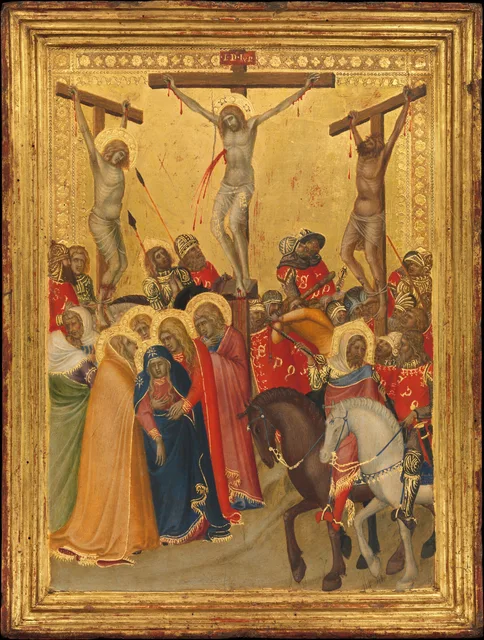 The CrucifixionPietro Lorenzetti1340s
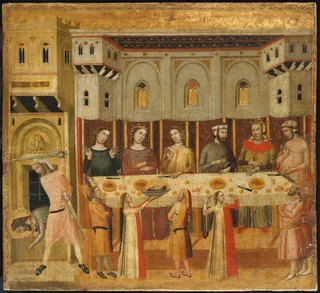 The Feast of Herod and the Beheading of the BaptistGiovanni Baronzioca. 1330–35
 Water-moon AvalokiteshvaraUnknown artist · Koreafirst half of the 14th century
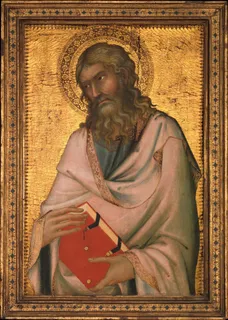 Saint AndrewSimone Martinica. 1326
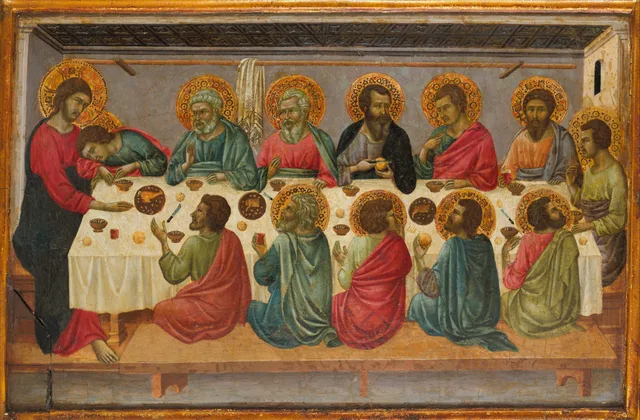 The Last SupperUgolino da Sienaca. 1325
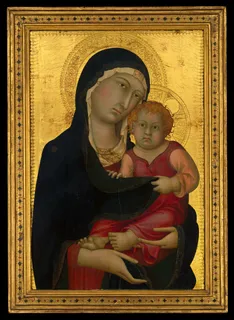 Madonna and ChildSimone Martinica. 1326
Too good to keep to yourself
This painting,
for someone who comes to mind
They open it at full size
and see every brushstroke.
About this work
- Artist
- Bernardo Daddi · 1290–1348
- Date
- 1337–38
- Medium
- Tempera on wood, gold ground
- Size
- 142.6 × 7 cm
- Collection
- The Metropolitan Museum of Art
- Image
- Original long edge 4000px · shown at 2560px
- Original
- View on the museum's website ↗