 Pyeongye
Artwork · 14th century
LeoTurn on Magnifier at the lower right and move slowly across the painting.
Full screen opens it edge to edge.Tap the painting to fill the screen.
Spread two fingers to look closer.
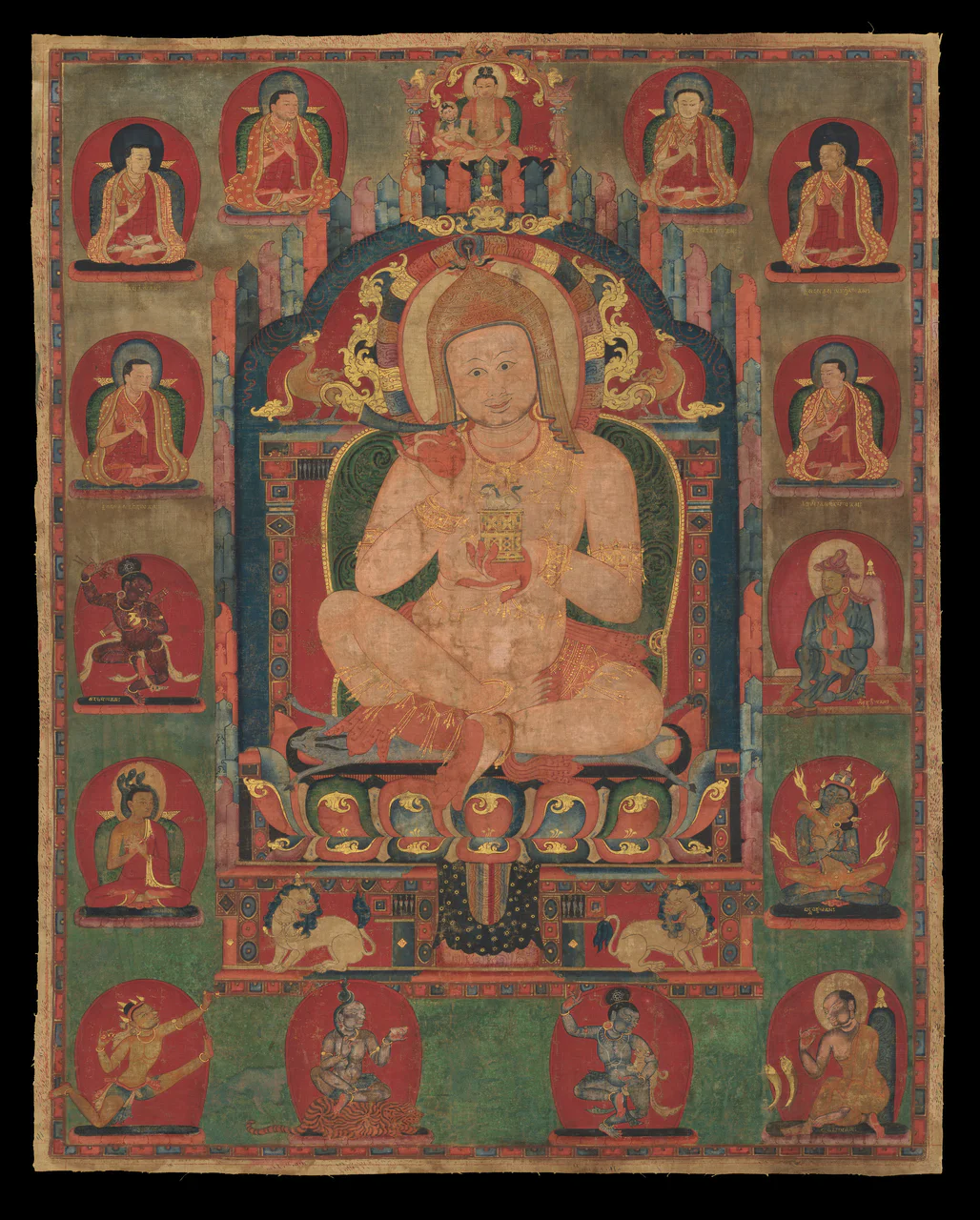
Mahasiddha Jnanatapa
Unknown artist · Eastern Tibet, Kham, Riwoche monasteryca. 1350Distemper on cloth
At a glance
- A yogi wearing little but gold jewelry sits at ease on a lotus seat, smiling, with a small golden box balanced in one hand.
- An unnamed painter made it around 1350 at Riwoche monastery in Kham, eastern Tibet, painting on cloth.
- He is not a stern saint but a man with a playful grin, and that face is hard to forget.
Reading the picture
5 places to look closer
Tap a number on the painting to jump to its note, or a close-up to see that spot in the whole picture.
Zoom in on the face. He wears a hood covered in curling gold patterns, with large gold hoops in his ears. His eyes are wide and round, and the corners of his mouth turn up. A short, dark beard shadows his chin.
Look at the hand raised at his chest. On top of his red fingers rests a golden box. Its sides are decorated with crisscrossing X patterns, and on the lid lies a tiny lion with a blue mane. The gold bracelets on his wrists and arms are drawn as carefully as jewelry.
Drop down to the base of the throne. A lion crouches on each side. Their bodies are pale ochre, their manes and tails a deep blue-green, and their red mouths gape open. A lion with a blue mane is the snow lion, a much-loved creature in Tibet.
Zoom in on a niche at the upper right. A monk sits in red robes under a cloak patterned with gold flowers. Below him, a line of gold Tibetan letters runs across the background. Almost every niche has a line like this.
Now the niche at the lower left. A crowned figure kicks one leg high and flings both arms wide in a dance, holding a small implement in one hand. Compared with the calm monks higher up, this body is all motion.
When it was painted
This painting was made for Riwoche monastery in Kham, eastern Tibet. Riwoche was founded in 1276 by a monk named Sangye On. Riwoche became a branch of Taklung, a major monastery in central Tibet.
So who is the grinning man in the middle? The painting does not label him directly. The clue is on the silk veil that once covered the picture, which carries the name Jnanatapa. In Sanskrit it means heat of wisdom.
Taklung's official history records that Riwoche's first abbot was an incarnation of the Indian adept Jnanatapa. The Met uses that record to connect the central figure with Riwoche's founder. Around him sit the founders and abbots of Taklung.
Mahasiddhas, or great adepts, were famous tantric practitioners of medieval India. They were believed to have reached awakening through their own practice rather than monastery rules, and their teachings traveled to Tibet to become roots of several Tibetan schools.
The picture was painted around 1350, about half a century after Sangye On died in 1296. The painter's name was not recorded. The painting came to the Metropolitan Museum in 1987.
Look at that smile once more. Behind it, two stories overlap: a famous adept of medieval India, and the founding abbot whom Riwoche's own history called his rebirth.
Questions to think about
- Look for itWhat creature is sitting on the box that Jnanatapa is holding?
- Why?Why might the painter have given this holy man a grin instead of a solemn face?
- What about you?How do you feel about people who learn in their own way instead of following the set path? Is there room for that in schools and workplaces today?
Same period
Painted around the same time,
somewhere else
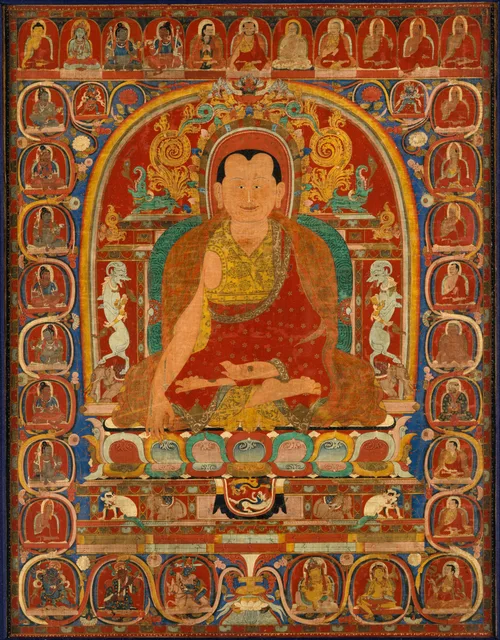 Lineage Portrait of an AbbotUnknown artist · Central Tibetca. 1350
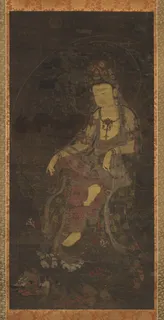 Water-moon AvalokiteshvaraUnknown artist · Koreafirst half of the 14th century
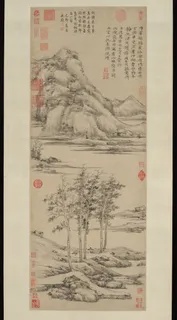 Woods and Valleys of Mount YuNi Zandated 1372
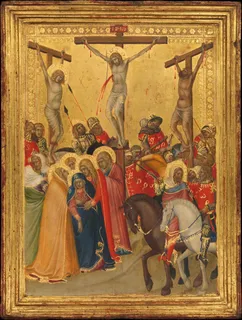 The CrucifixionPietro Lorenzetti1340s
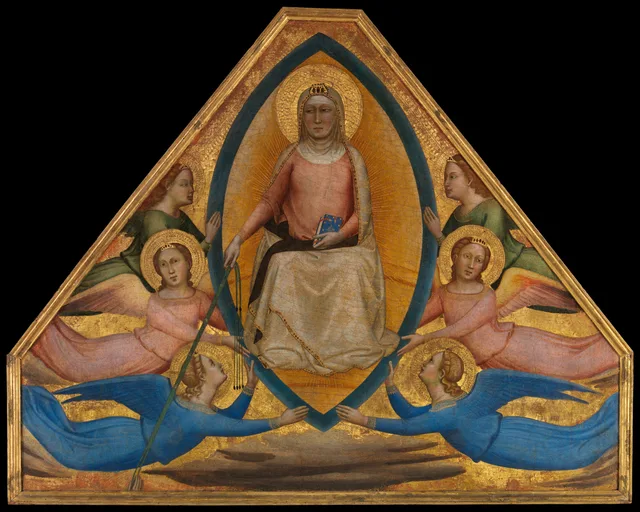 The Assumption of the VirginBernardo Daddi1337–38
 The Coronation of the VirginNiccolò di Buonaccorsoca. 1380
Too good to keep to yourself
This painting,
for someone who comes to mind
They open it at full size
and see every brushstroke.
About this work
- Artist
- Unknown artist · Eastern Tibet, Kham, Riwoche monastery
- Date
- ca. 1350
- Medium
- Distemper on cloth
- Culture
- Eastern Tibet, Kham, Riwoche monastery
- Collection
- The Metropolitan Museum of Art
- Image
- Original long edge 4000px · shown at 2560px
- Original
- View on the museum's website ↗