 Pyeongye
Artwork · 14th century
LeoTurn on Magnifier at the lower right and move slowly across the painting.
Full screen opens it edge to edge.Tap the painting to fill the screen.
Spread two fingers to look closer.
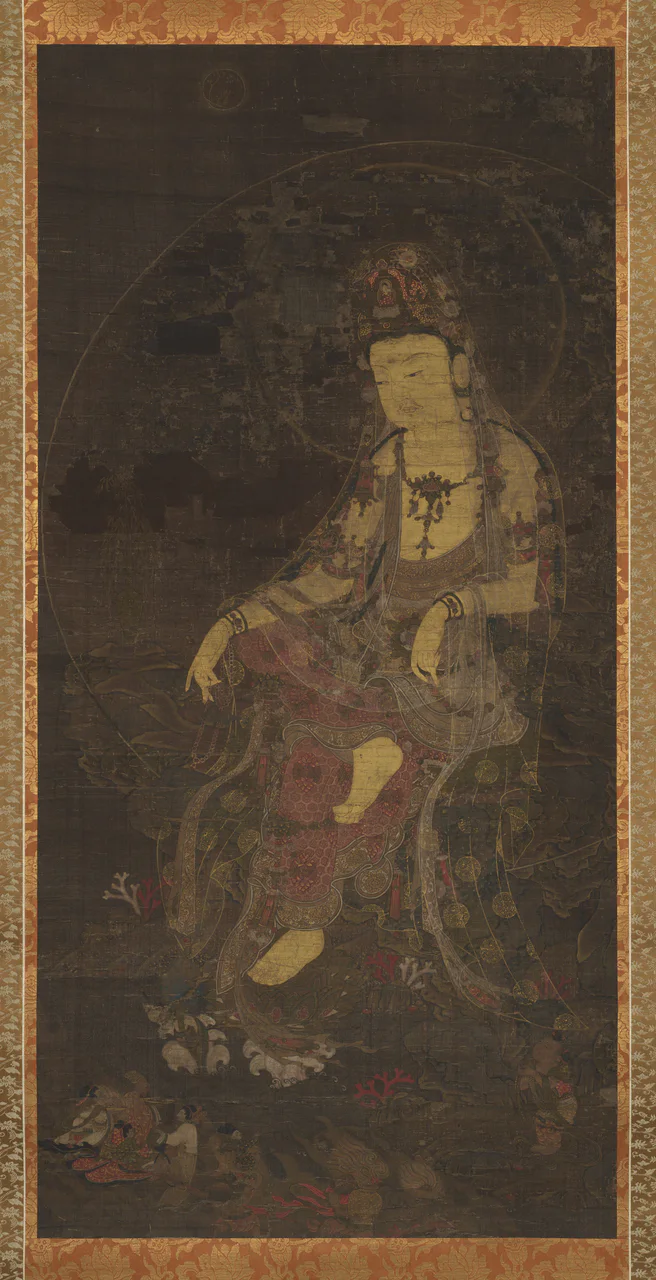
Water-moon Avalokiteshvara
Unknown artist · Koreafirst half of the 14th centuryHanging scroll; ink and color on silk114.5 × 55.6 cm
At a glance
- The bodhisattva Avalokiteshvara sits at ease on a rock by the sea, wrapped in a huge circle of light and a see-through veil.
- It was painted in Korea during the Goryeo period, in the first half of the 14th century, in ink and color on silk. The painter's name is not known.
- The veil is drawn in white lines finer than a hair, so the closer you look, the more patterns appear.
Reading the picture
5 places to look closer
Tap a number on the painting to jump to its note, or a close-up to see that spot in the whole picture.
Start with the face and the crown. The eyes are half closed and look down, calm and patient. In the middle of the red, flower-patterned crown sits a tiny Buddha. Placing the Buddha Amitabha in Avalokiteshvara's crown is a long-standing rule in Buddhist art, and it helps you know who this is.
Now move to the middle of the body. The red skirt is covered with a honeycomb of six-sided shapes and round flower medallions. Over all of it run thin white lines. That is the veil, falling from the head all the way down. One foot rests casually on the opposite knee.
Follow the other leg down. Under the foot a lotus opens, and below it white waves curl up like little hands. To the right a branch of red coral sticks out of the dark water. These details tell you where we are: in the middle of the sea.
Look at the bottom left corner. A figure in a red robe is surrounded by attendants, and one of them holds up a dish. In Goryeo paintings of this subject, a group like this is often read as the Dragon King and his court, coming up from the sea to bring treasures.
At the bottom right, a small figure faces the bodhisattva. Water-moon paintings often include the boy pilgrim Sudhana, who traveled far in search of wisdom and came to Avalokiteshvara for teaching. Notice how tiny the visitor is next to the great seated figure. The difference in size is part of the story.
When it was painted
No one recorded the name of the person who painted this. But we can look closely at the world it came from. In the first half of the 1300s, Korea's Goryeo kingdom lived in the shadow of the Mongol Yuan dynasty. Goryeo kings married Yuan princesses, and people and goods moved constantly between Goryeo and the Yuan capital, Dadu.
In those years, the Goryeo royal family and nobles paid for Buddhist paintings made with enormous care. Painters laid color on the back of the silk as well as the front, so it glowed softly through, and drew patterns in gold. One large Water-moon painting from this same era carries a firm date, 1310, and it is still kept at Kagami Shrine in Japan.
Few Goryeo Buddhist paintings survive, and most of them are in Japan. This one traveled even farther. In 1914 the family of the New York collector Charles Stewart Smith gave it to The Metropolitan Museum of Art in his memory. Smith had bought art on a trip to Japan in 1892, but no firm record says when or where he got this scroll.
Some Goryeo paintings that reached the West were long labeled as Chinese, and were only recognized as Korean in the 1960s. Even this scroll's date has been debated. The Met places it in the first half of the 1300s, while the art historian James Cahill once dated it to the 1400s.
Now zoom in on the dark sky at the upper left. Inside a small circle, faint lines draw a tree and a rabbit. The Met reads this as the moon, home of the rabbit who pounds the elixir of immortality. It brings to mind the painting's name, the moon reflected in water.
Questions to think about
- Look for itHow many pieces of red and white coral can you find around the bodhisattva?
- Why?Why do you think the painter finished the rich red clothes and then covered them again with a veil you can barely see?
- What about you?Most surviving Goryeo paintings now live in other countries. Where do you think works like this belong, and who should get to decide?
Same period
Painted around the same time,
somewhere else
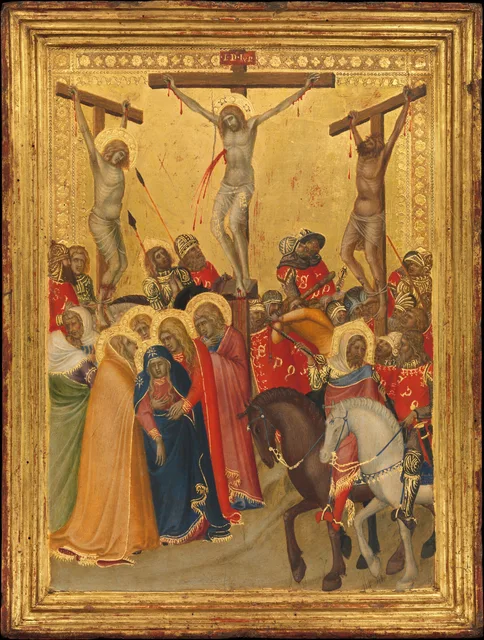 The CrucifixionPietro Lorenzetti1340s
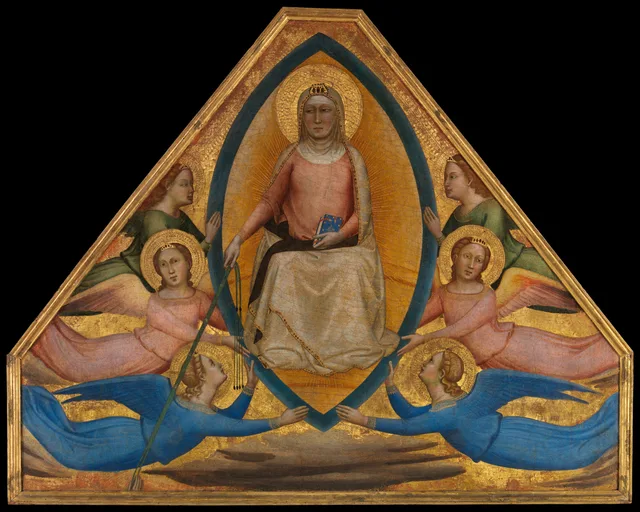 The Assumption of the VirginBernardo Daddi1337–38
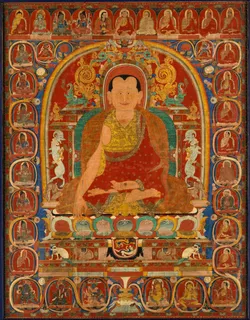 Lineage Portrait of an AbbotUnknown artist · Central Tibetca. 1350
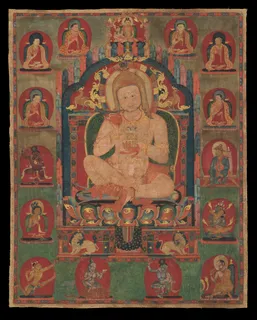 Mahasiddha JnanatapaUnknown artist · Eastern Tibet, Kham, Riwoche monasteryca. 1350
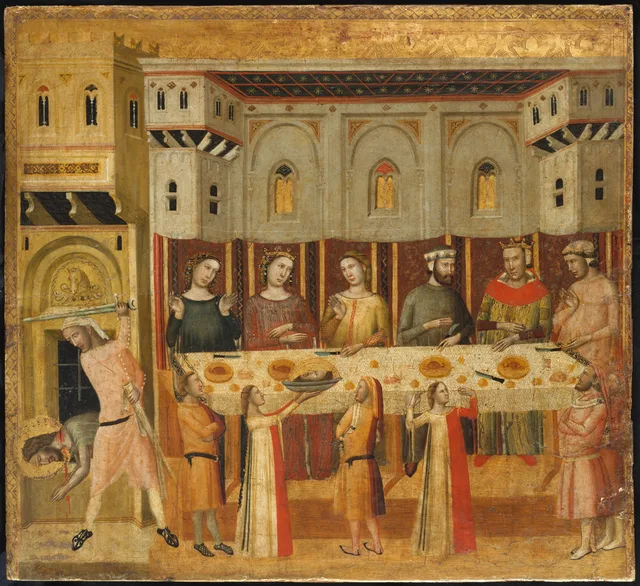 The Feast of Herod and the Beheading of the BaptistGiovanni Baronzioca. 1330–35
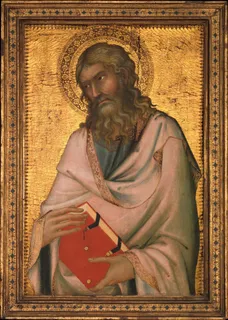 Saint AndrewSimone Martinica. 1326
Too good to keep to yourself
This painting,
for someone who comes to mind
They open it at full size
and see every brushstroke.
About this work
- Artist
- Unknown artist · Korea
- Date
- first half of the 14th century
- Medium
- Hanging scroll; ink and color on silk
- Size
- 114.5 × 55.6 cm
- Culture
- Korea
- Collection
- The Metropolitan Museum of Art
- Image
- Original long edge 4000px · shown at 2560px
- Original
- View on the museum's website ↗