 Pyeongye
Artwork · 18th century
LeoTurn on Magnifier at the lower right and move slowly across the painting.
Full screen opens it edge to edge.Tap the painting to fill the screen.
Spread two fingers to look closer.
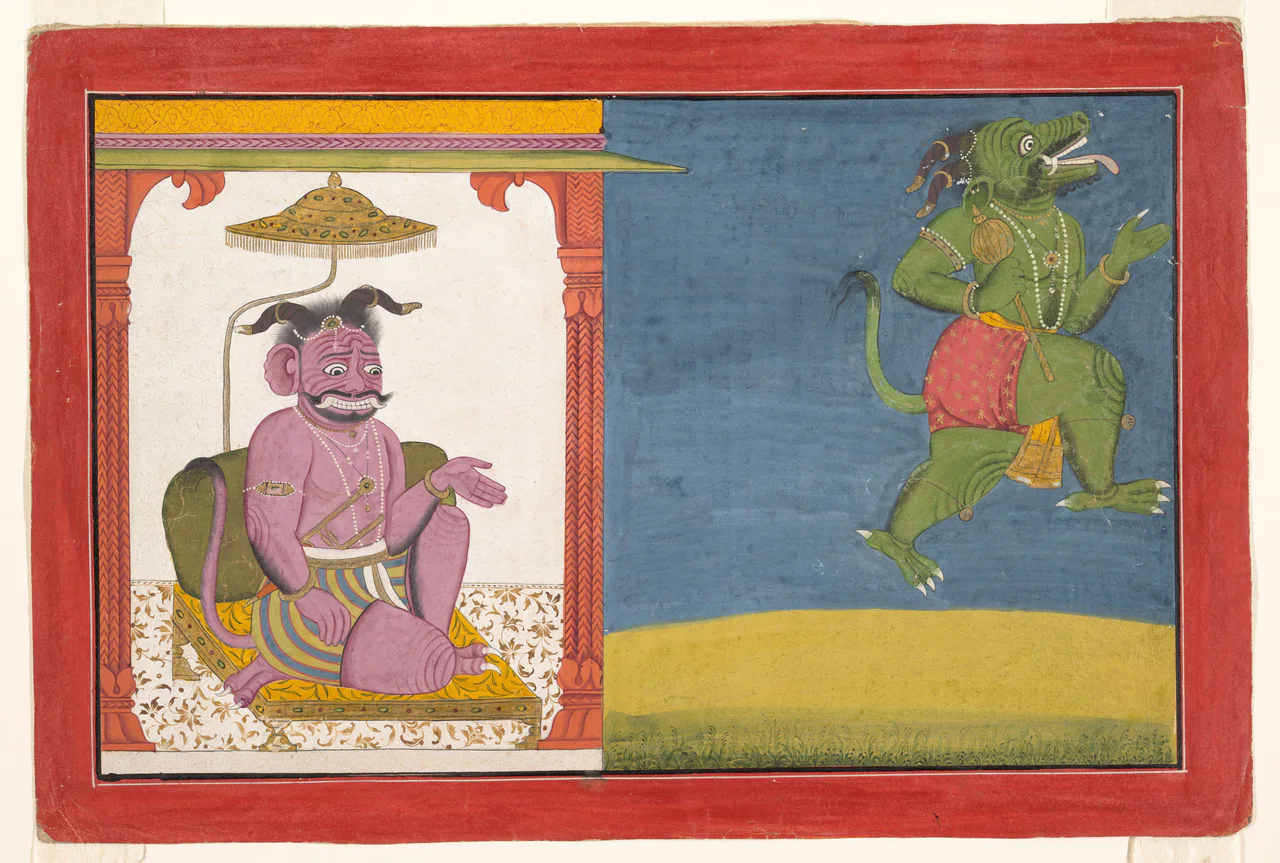
The Demon Hiranyaksha Departs the Demon Palace: Folio from a Bhagavata Purana Series
Unknown artist · Northern India, Guler, Himachal Pradeshca. 1740Opaque watercolor, ink and gold on paper21.6 × 32.4 cm
At a glance
- On the left, a horned pink demon sits in a palace; on the right, a green demon with a mace on his shoulder strides away.
- An unknown painter in Guler, a small hill kingdom in northern India, made it around 1740 with opaque watercolor, ink, and gold.
- It is one page from an illustrated set of the Bhagavata Purana, a Hindu sacred text, on a sheet about the size of a letter-size page.
Reading the picture
4 places to look closer
Tap a number on the painting to jump to its note, or a close-up to see that spot in the whole picture.
Look at the face of the pink demon inside the palace. Thick horns curl out to each side, and his eyes are wide and round. He bares every tooth in a grin, yet his eyebrows are raised as if he is worried. He is scary and a little funny at the same time.
Now look above his head. A golden parasol opens at the top of a long pole, trimmed with a fringe and set with green and red jewels. In India, a parasol like this marks a royal seat. It tells us he is the master of this palace.
Zoom in on the green demon on the right. A long snout like a crocodile's hangs open, with a red tongue and white tusks. A gold mace rests on his shoulder, and strings of pearls loop around his neck.
Look at his feet. The white-clawed feet do not touch the yellow ground. They float in the blue sky, tail swinging, one leg lifted high, as if he has just leapt. The calm inside the palace and the restless energy outside split the page in two.
When it was painted
Around 1740, in Guler, a small kingdom in the foothills of the Himalayas, a painter was turning the Bhagavata Purana into pictures, one page at a time. This Hindu text tells the stories of the god Vishnu and his many forms. The painter's name has not come down to us. What survives is this page, and the fact that it belonged to a long series.
Guler at that time was home to a well-known family of painters: Pandit Seu and his two sons, Manaku and Nainsukh. The Metropolitan Museum describes Manaku as active in Guler from about 1725 to 1760 and famous for illustrating the Bhagavata Purana. Still, no one knows whose hand made this particular page.
The scene comes from very early in the story. As the museum explains it, at the time of creation the demon Hiranyaksha tormented the Earth goddess and tried to sink her in the cosmic ocean. This picture shows him leaving his palace to attack her while Vishnu lies in his cosmic sleep. Vishnu was called on to rescue her, and he did, taking the form of the boar Varaha.
Hiranyaksha had a brother, Hiranyakashipu. According to the museum, this episode is the root of Hiranyakashipu's fierce hatred of Vishnu. That hatred leads, much later, to the story of Narasimha, Vishnu in the form of a man with a lion's head.
Series like this were often split up, their pages scattered to many owners. This one came to the Metropolitan Museum in 2002 through the Cynthia Hazen Polsky and Leon B. Polsky Fund.
Now look past the palace pillars again. A green foot is lifted high against the empty blue sky. Think of a long feud beginning with that single step, and the still white palace and the open blue outside seem to pull even further apart.
Questions to think about
- Look for itWhat do the pink demon and the green demon both have, if you compare them closely?
- Why?Why do you think the painter made the inside of the palace white and still, and the outside blue and empty?
- What about you?Hiranyaksha left home looking for a fight; when do people today go looking for a quarrel they did not need to have?
Same period
Painted around the same time,
somewhere else
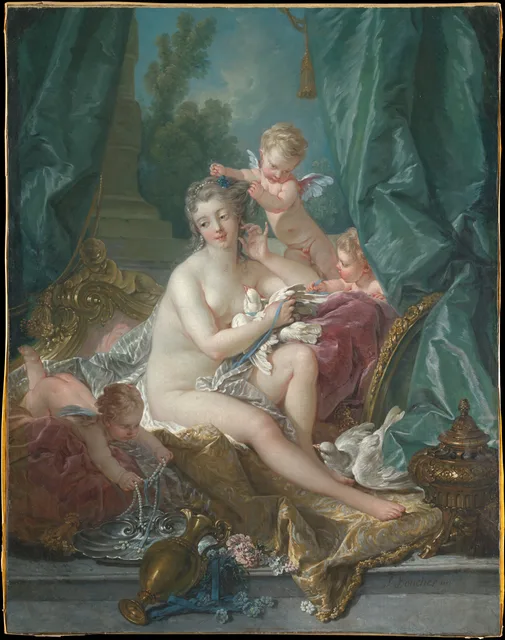 The Toilette of VenusFrançois Boucher1751
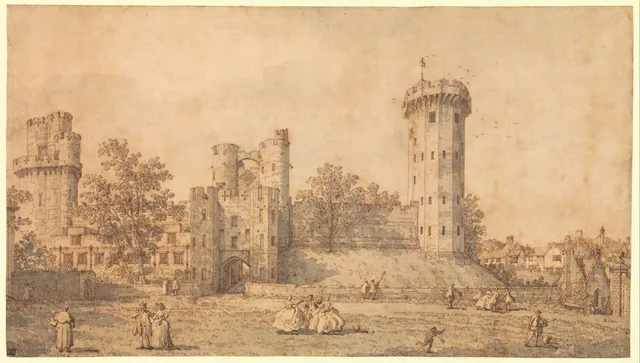 Warwick Castle: The East FrontCanaletto1752
 Allegory of the Planets and ContinentsGiovanni Battista Tiepolo1752
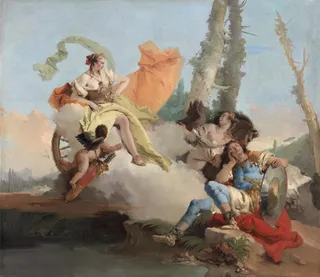 Armida Encounters the Sleeping RinaldoGiovanni Battista Tiepoloc. 1742–45
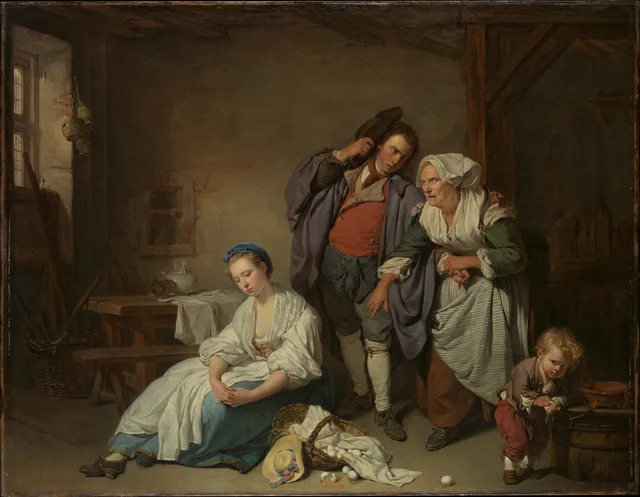 Broken EggsJean-Baptiste Greuze1756
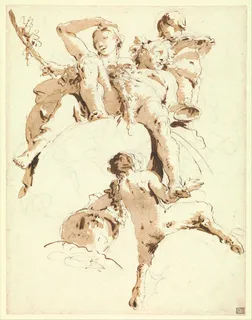 Bacchus and AriadneGiovanni Battista Tiepoloca. 1740
Too good to keep to yourself
This painting,
for someone who comes to mind
They open it at full size
and see every brushstroke.
About this work
- Artist
- Unknown artist · Northern India, Guler, Himachal Pradesh
- Date
- ca. 1740
- Medium
- Opaque watercolor, ink and gold on paper
- Size
- 21.6 × 32.4 cm
- Culture
- Northern India, Guler, Himachal Pradesh
- Collection
- The Metropolitan Museum of Art
- Image
- Original long edge 3876px · shown at 2560px
- Original
- View on the museum's website ↗