 Pyeongye
Artwork · 18th century · Giovanni Battista Tiepolo
LeoTurn on Magnifier at the lower right and move slowly across the painting.
Full screen opens it edge to edge.Tap the painting to fill the screen.
Spread two fingers to look closer.
At a glance
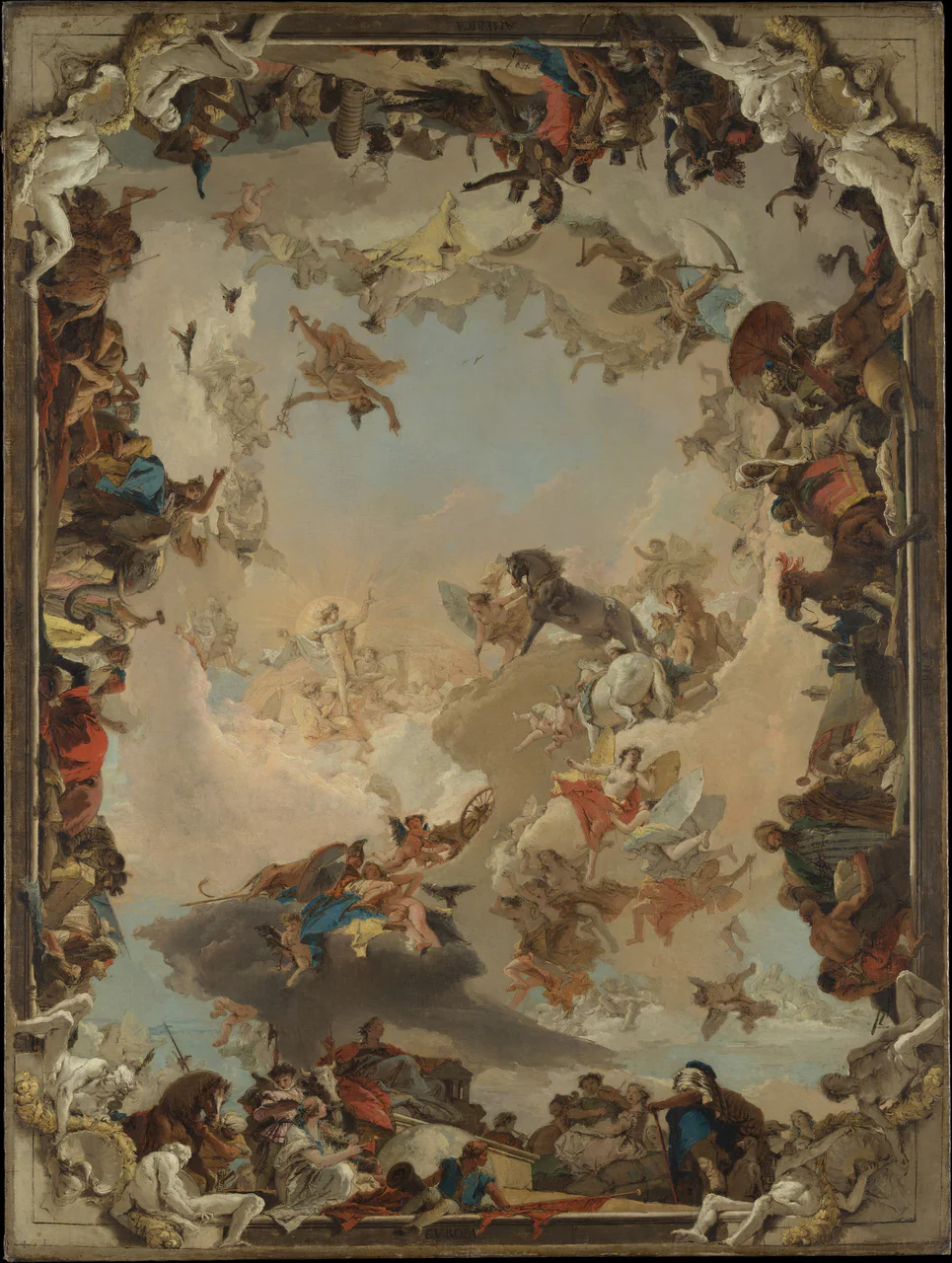
- Apollo and other gods float in the sky at the center, while people and animals from Europe, Asia, Africa, and America crowd around all four edges.
- The Venetian painter Giovanni Battista Tiepolo painted it in oil on canvas in 1752.
- It is a presentation sketch: a preview, shown to the patron, of a huge ceiling fresco above the grand staircase of the palace in Würzburg, Germany.
Reading the picture
5 places to look closer
Tap a number on the painting to jump to its note, or a close-up to see that spot in the whole picture.
Zoom in on the bright glow left of center. A young god stands against a round burst of sunlight with one arm flung up. This is Apollo, god of the sun. Rays spread in every direction, and other gods lounge on the clouds below him.
Look at the clouds at the upper right. A figure swoops through the sky, raising a huge scythe. In European art, the scythe identifies Saturn, the god whose name the planet carries. The planets are named after gods, so the gods in this sky are the planets.
Zoom in on the left edge. An elephant with long tusks pokes its head out, and on the frame below, the word ASIA runs sideways. Beside the elephant, a man holds something like a hammer, and many faces crowd together.
Move to the right edge. A camel wearing a red feather plume appears, and the frame is lettered AFRICA. People carrying goods gather around the camel.
Zoom in on the bottom center. A young man in blue sits on the frame and lets one leg dangle over the edge. The frame below him reads EUROPA. To someone looking up at the ceiling, he would seem to be sitting on a real ledge.
When it was painted
In December 1750, Tiepolo, then fifty-four, left Venice and arrived in the German city of Würzburg. With him were his sons Giovanni Domenico, twenty-three, and Lorenzo, just fourteen. They had been summoned by Carl Philipp von Greiffenclau, the prince-bishop who ruled the territory.
The first job was the palace's great hall, where Tiepolo painted the wedding of the medieval emperor Frederick Barbarossa across the ceiling and walls. While that work went on, the prince-bishop handed him something even bigger. It was the vast vault over the staircase, which the architect Balthasar Neumann had built with no columns holding it up from below.
This canvas is the plan for that ceiling. According to the Met's records, Tiepolo presented it to the prince-bishop on April 20, 1752. In the finished fresco, the patron's own portrait floats above Europe in a round medallion. Below it sits Neumann, perched on a cannon, along with Tiepolo himself and his son Domenico.
The family finished in 1753 and went home to Venice. Nine years later Tiepolo answered a call from the king of Spain, moved to Madrid, and died there in 1770. When bombs set the palace ablaze in March 1945, Neumann's vault held, and the staircase fresco is still in place today.
This sketch entered the Metropolitan Museum in 1977. Look again at the young man in blue at the bottom, sitting on the frame with one leg hanging over the edge. He is there because Tiepolo had already worked out how the ceiling would look to someone climbing the stairs and tipping their head back.
The painter
Giovanni Battista Tiepolo
1696–1770
When painting this, the artist was about 56 years old
All paintings by Giovanni Battista Tiepolo →More by the same painter
Questions to think about
- Look for itCan you find the continent name written upside down on the frame at the very top?
- Why?Why do you think Tiepolo wrote the four continent names facing four different directions?
- What about you?This picture shows other continents through European eyes, with camels, elephants, and feathers, so what simple images do we still use today when we picture other countries?
Same period
Painted around the same time,
somewhere else
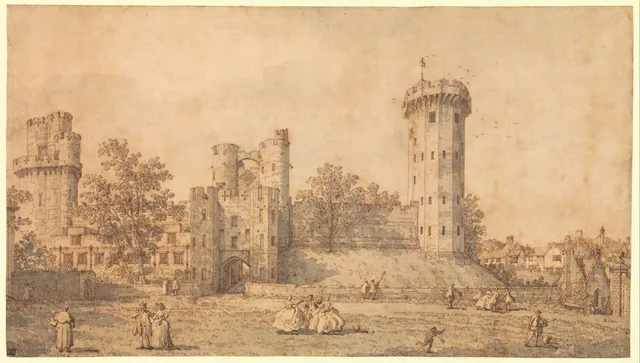 Warwick Castle: The East FrontCanaletto1752
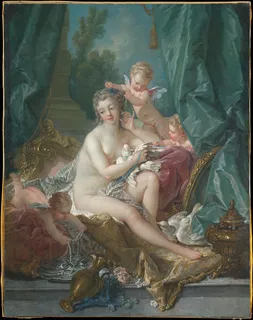 The Toilette of VenusFrançois Boucher1751
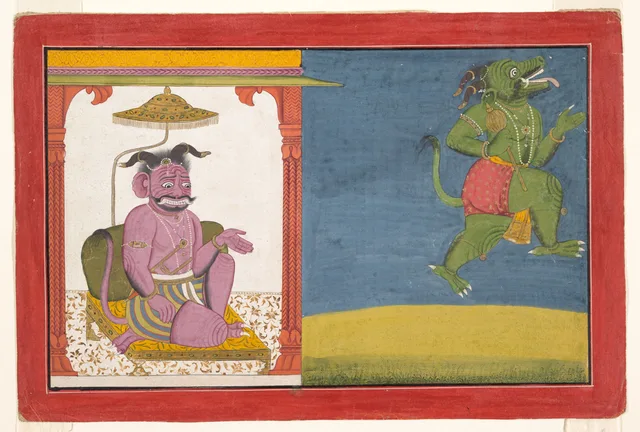 The Demon Hiranyaksha Departs the Demon Palace: Folio from a Bhagavata Purana SeriesUnknown artist · Northern India, Guler, Himachal Pradeshca. 1740
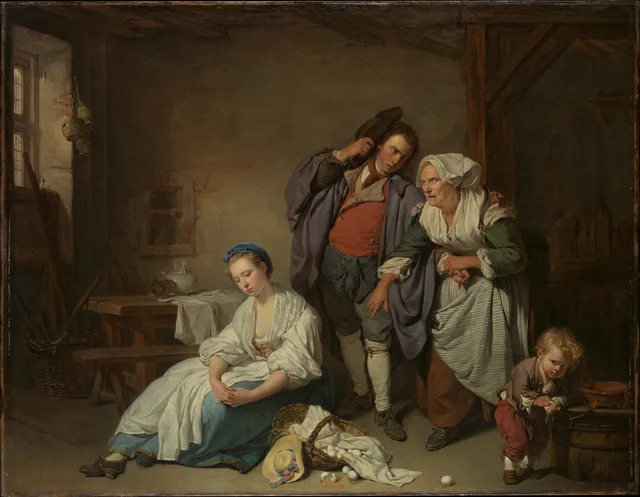 Broken EggsJean-Baptiste Greuze1756
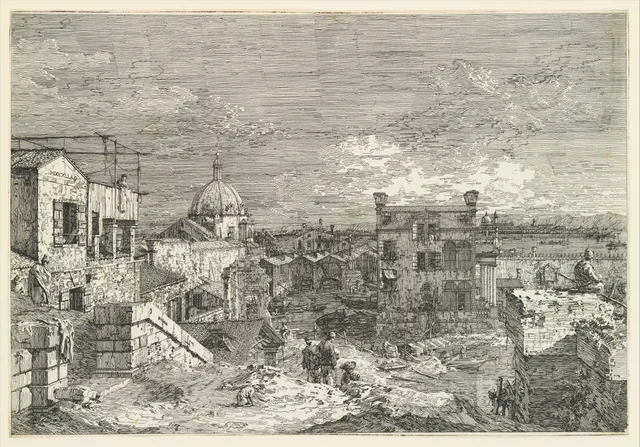 Imaginary View of Venice, houses at left with figures on terraces, a domed church at center in the background, boats and boat-sheds below, and a seated man observing from a wall at right in the foreground, from "Views" (Vedute altre prese da i luoghi altre ideate da Antonio Canal)Canaletto1741
 Pastoral SceneGiovanni Battista Piazzetta1740
Too good to keep to yourself
This painting,
for someone who comes to mind
They open it at full size
and see every brushstroke.
About this work
- Artist
- Giovanni Battista Tiepolo · 1696–1770
- Date
- 1752
- Medium
- Oil on canvas
- Size
- 185.4 × 139.4 cm
- Collection
- The Metropolitan Museum of Art
- Image
- Original long edge 3973px · shown at 2560px
- Original
- View on the museum's website ↗