 Pyeongye
Artwork · 14th century · Giovanni Baronzio
LeoTurn on Magnifier at the lower right and move slowly across the painting.
Full screen opens it edge to edge.Tap the painting to fill the screen.
Spread two fingers to look closer.
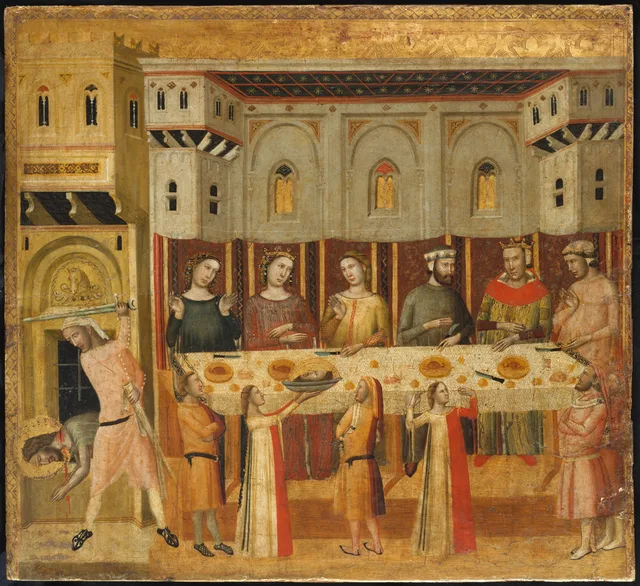
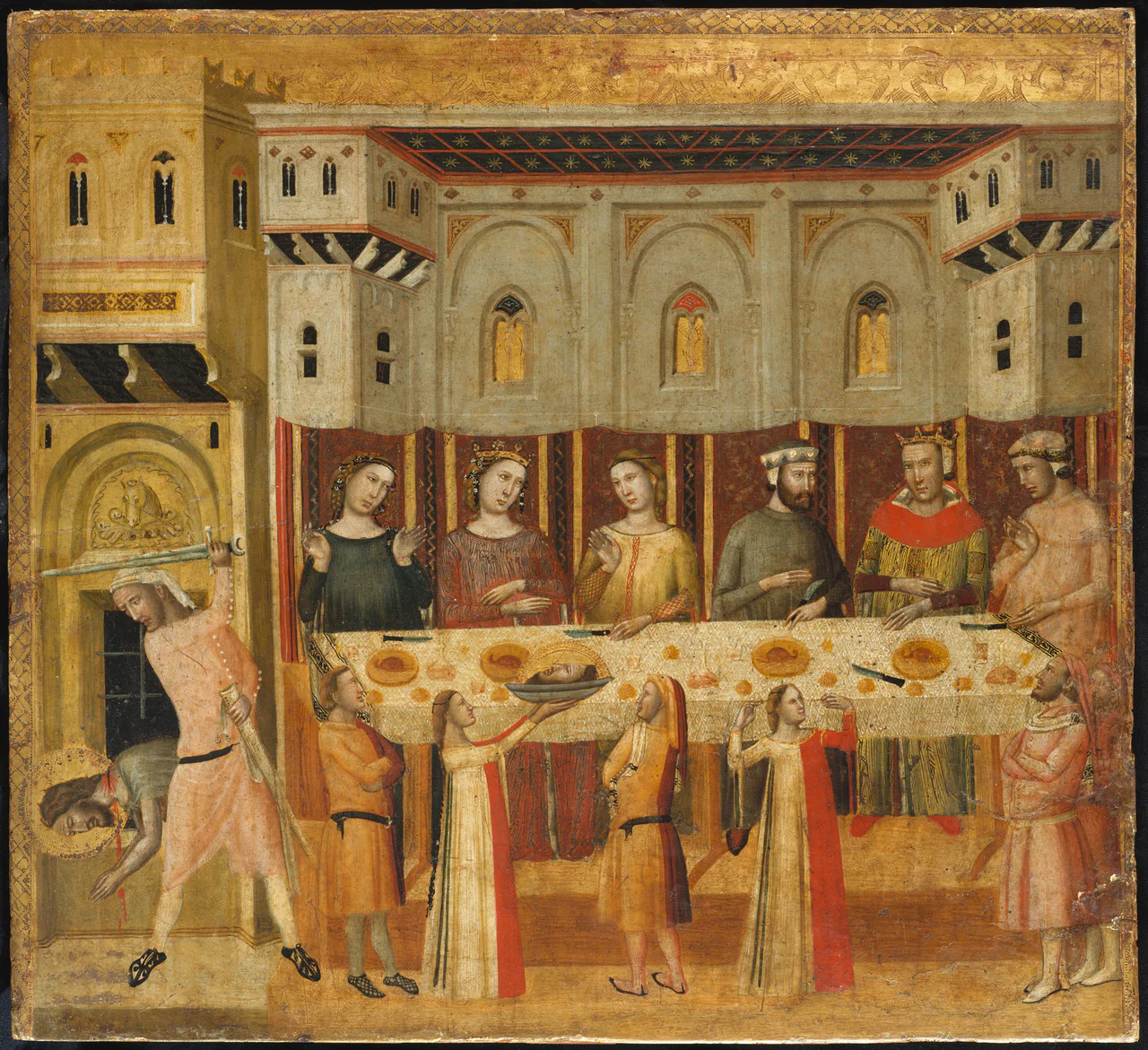
The Feast of Herod and the Beheading of the Baptist
Giovanni Baronzioca. 1330–35Tempera on wood, gold ground, and silver44.1 × 49.8 cm
At a glance
- King Herod's banquet, and right next to it, at a prison door, the moment John the Baptist is beheaded, all in one picture.
- Painted around 1330–35 by Giovanni Baronzio of Rimini, in tempera, gold and silver on a wooden panel.
- Three moments from different times sit side by side, so you can puzzle out which scene comes first.
Reading the picture
5 places to look closer
Tap a number on the painting to jump to its note, or a close-up to see that spot in the whole picture.
Start at the prison door at the lower left. An executioner in pink swings his sword high, while John, wearing a gold halo, leans out through the barred doorway. Red blood runs from his neck. In his other hand the executioner grips the empty scabbard.
In front of the table, a girl in white holds up a dish with both hands. On it lies John's head, still wearing its halo. She tilts her face up toward the table. Plates of food and knives sit on the cloth as if nothing has happened.
Move right and you see a girl in the same white dress, now with a red cloak, lifting both hands up to the level of her head. She is dancing at the feast. The same clothes tell us she is the same girl who carries the dish. The dance comes first. The dish comes after.
At the right end of the table sits a crowned man in a yellow robe with a red collar. This is King Herod. His brow is creased and one arm lies across his waist. The Gospel says the king was deeply sorry to give the order, and here his face looks stiff and troubled.
Zoom in on the crowned woman at the center of the table. Small white beads decorate her hair, her head tilts to one side, and her hands are folded. She can be read as Herodias, who told her daughter to ask for John's head.
When it was painted
Picture Rimini, a port on Italy's Adriatic coast, in the early 1300s. The Florentine painter Giotto had come to work in the city. Local painters studied his solid, lifelike figures and made that new way of painting their own. Baronzio picked up his brush in the middle of that wave.
Yet we know surprisingly little about him. We do not know when he was born, or how old he was when he made this panel. Only one surviving painting carries both his name and a date: an altarpiece of 1345, now in the Galleria Nazionale delle Marche in Urbino. Beyond that, his name shows up once more, as a witness on a legal document from 1343.
So scholars had to work like detectives. They compared that signed altarpiece with unsigned panels, side by side, and gave this one to Baronzio. Not everyone agreed. Some experts credited it to other hands, and the name on the label was argued over for years.
The panel was once one of eight scenes from the life of John the Baptist in a large altarpiece. Later the altarpiece was taken apart, and its other scenes ended up in different museums. In 1921 the New York banker Philip Lehman bought this one. It passed to his son Robert Lehman, and in 1975 it came to The Metropolitan Museum of Art with the Robert Lehman Collection.
Now look again at the gold halo on the dish in front of the table. Only one of the eight scenes hangs here, yet the dance, the sword and the dish all fit inside it. Almost seven hundred years later, the feast is still going on.
Questions to think about
- Look for itHow many times does the girl appear, and how many knives can you spot?
- Why?Why do you think the painter squeezed the feast and the execution together, with only a wall between them?
- What about you?Herod kept a promise made in front of his guests even though it meant doing something terrible. When a public promise and our conscience pull apart, which should we follow?
Same period
Painted around the same time,
somewhere else
Too good to keep to yourself
This painting,
for someone who comes to mind
They open it at full size
and see every brushstroke.
About this work
- Artist
- Giovanni Baronzio · 1325–1349
- Date
- ca. 1330–35
- Medium
- Tempera on wood, gold ground, and silver
- Size
- 44.1 × 49.8 cm
- Collection
- The Metropolitan Museum of Art
- Image
- Original long edge 4000px · shown at 2560px
- Original
- View on the museum's website ↗