 Pyeongye
Artwork · 19th century · Gustave Caillebotte
LeoTurn on Magnifier at the lower right and move slowly across the painting.
Full screen opens it edge to edge.Tap the painting to fill the screen.
Spread two fingers to look closer.
At a glance
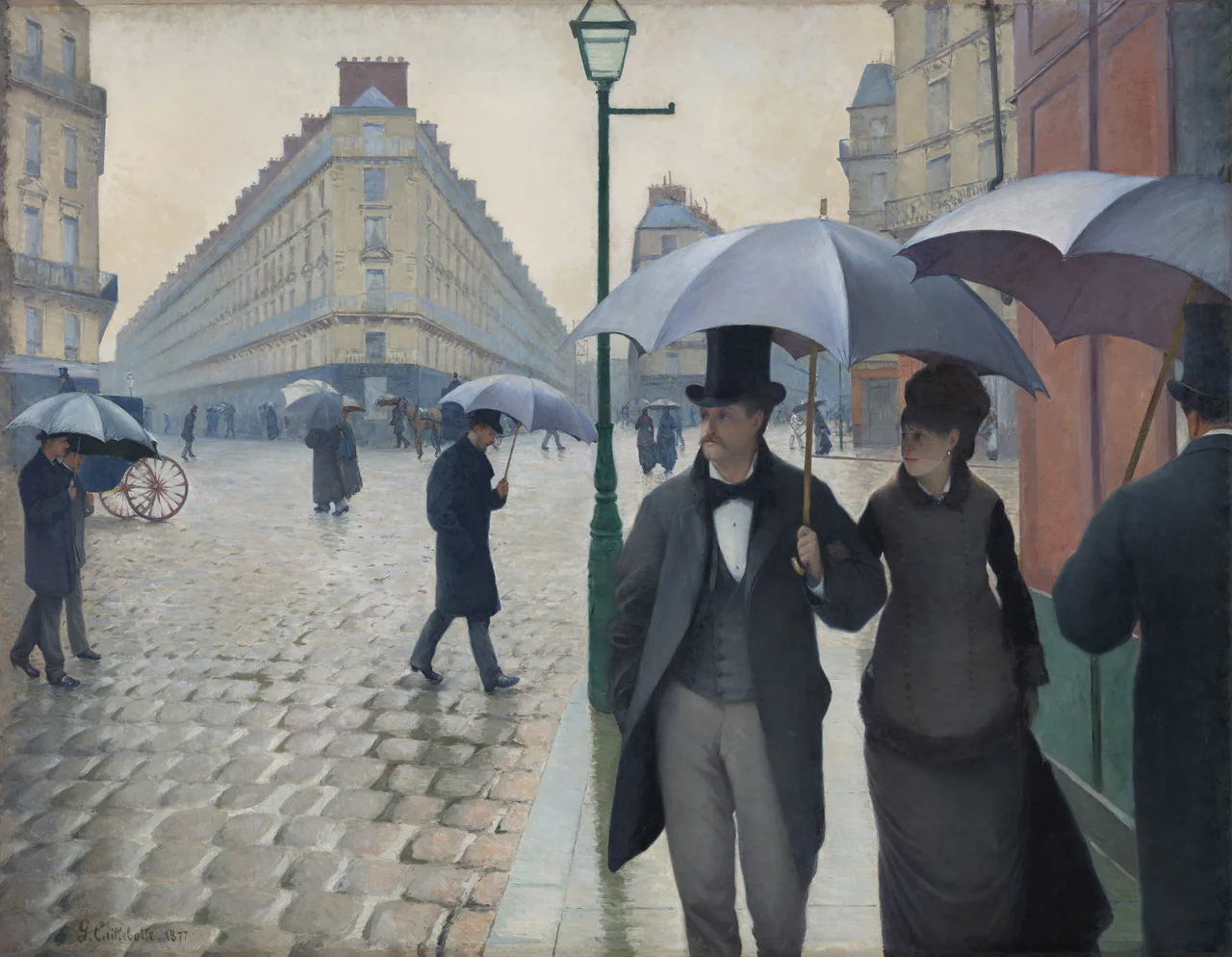
- People with umbrellas cross a wide Paris intersection in the rain, while a couple in front walks straight toward us.
- The French painter Gustave Caillebotte painted it in oil on canvas in 1877.
- At more than nine feet wide, it is his largest work. New boulevards, the latest fashions, and the newly invented folding umbrella all meet in one scene.
Reading the picture
5 places to look closer
Tap a number on the painting to jump to its note, or a close-up to see that spot in the whole picture.
Zoom in on the couple at the front right. A man in a top hat and a woman in a dark veil walk arm in arm under one umbrella. Her veil is sprinkled with tiny dots, and a pearl earring catches the light. Both of them are looking at something outside the picture, off to the right.
Look at the man on the far right edge. He stands with his back to us, holding an umbrella, and half his body is cut off by the frame. The Art Institute of Chicago suggests this bold cropping may owe something to photography, which was spreading fast at the time. He and the couple look about to bump umbrellas.
Follow the green lamppost up the middle of the canvas. At the top sits a lantern with glass panes. The post splits the picture in two: the open square on the left and the crowded sidewalk on the right. Even the small crossbar under the lamp is crisp.
Zoom in on the paving stones at the lower left. Each rounded cobble shines silver with rain. Caillebotte did not paint a single raindrop. The wet gleam of the stones and the open umbrellas tell you the weather.
Check the lower left corner. The artist's name and the year 1877 are written there on the wet stones. Even the signature looks like part of the street.
When it was painted
In the spring of 1877, Caillebotte was twenty-eight. His father had died a few years earlier and left him a fortune, so he could paint without worrying about money. He also used it to buy work from his struggling Impressionist friends and to help put on their shows.
That April the third Impressionist exhibition opened at 6 rue Le Peletier in Paris. Caillebotte was one of its main organizers. This painting was number one in the catalogue. Once the show opened, critics wrote about it in paper after paper.
The crossing in the picture was a short walk from Caillebotte's home. Paris was in the middle of a decades-long rebuilding that tore out narrow medieval streets for broad boulevards and uniform stone buildings. The wedge-shaped building in the background is that new city. The Art Institute notes that Caillebotte rarely painted Paris beyond his own familiar neighborhoods.
The Art Institute bought the painting in 1964. At the time, Caillebotte's part in Impressionism was still not widely recognized. Since then the canvas has become a visitor favorite.
Look again at where the couple's eyes are pointing. Nearly a hundred and fifty years later, they are still stepping toward us, still watching something we will never see.
The painter
Gustave Caillebotte
1848–1894
When painting this, the artist was about 29 years old
All paintings by Gustave Caillebotte →More by the same painter
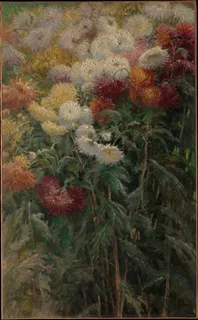
Hidden stories in this painting
Questions to think about
- Look for itHow many open umbrellas can you count in the whole picture?
- Why?Why do you think Caillebotte cut the man on the right in half instead of fitting him in?
- What about you?The Paris in this picture was tearing down old streets to build new ones. When your own neighborhood is redeveloped, how should people weigh what becomes easier against what is lost?
Same period
Painted around the same time,
somewhere else
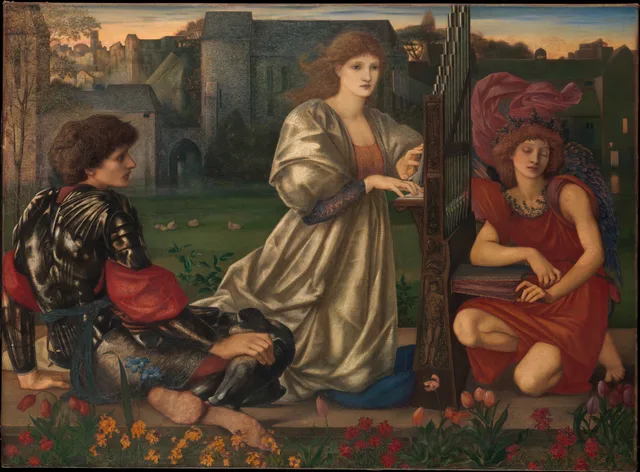 The Love SongSir Edward Burne-Jones1868–77
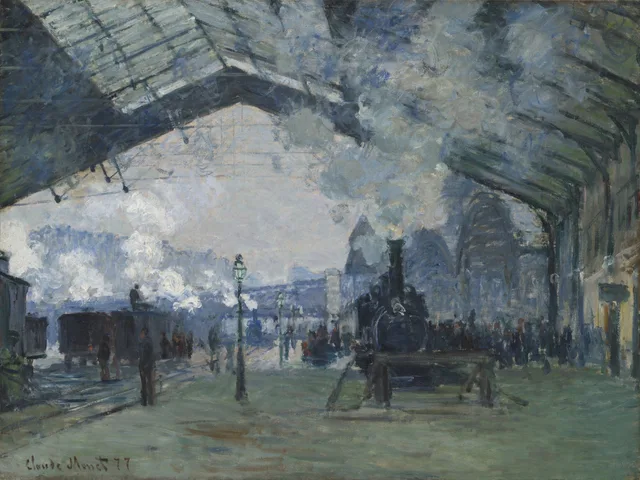 Arrival of the Normandy Train, Gare Saint-LazareClaude Monet1877
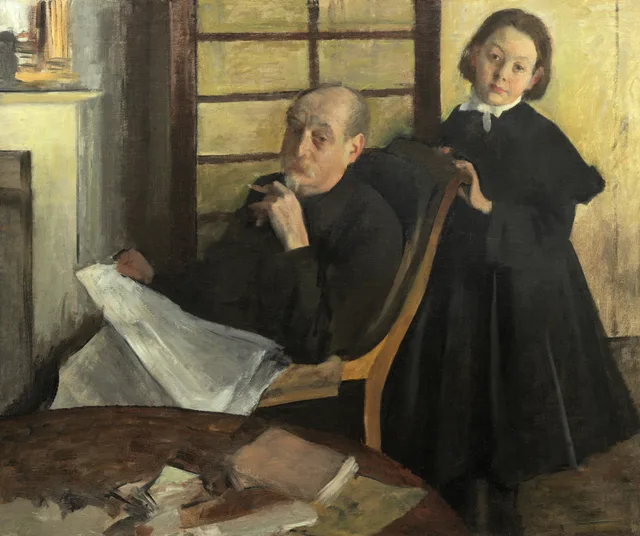 Henri Degas and His Niece Lucie Degas (The Artist's Uncle and Cousin)Edgar Degas1875–76
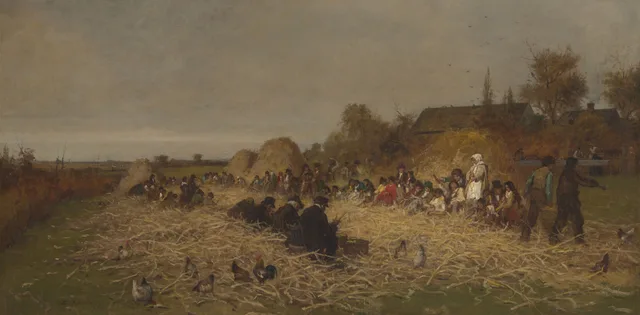 Husking Bee, Island of NantucketEastman Johnson1876
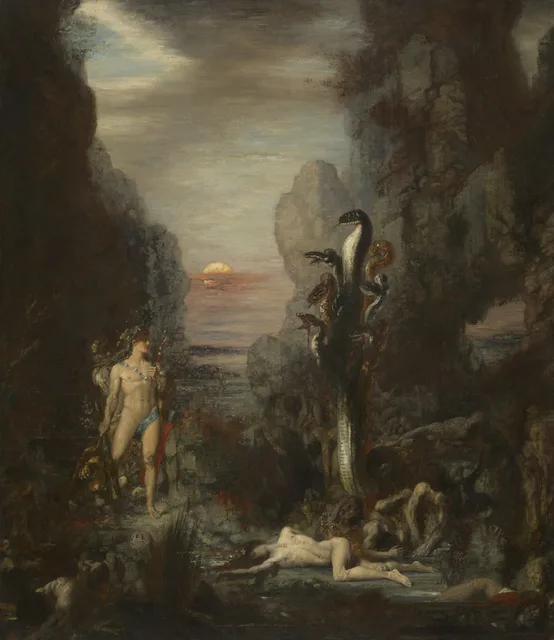 Hercules and the Lernaean HydraGustave Moreau1875–76
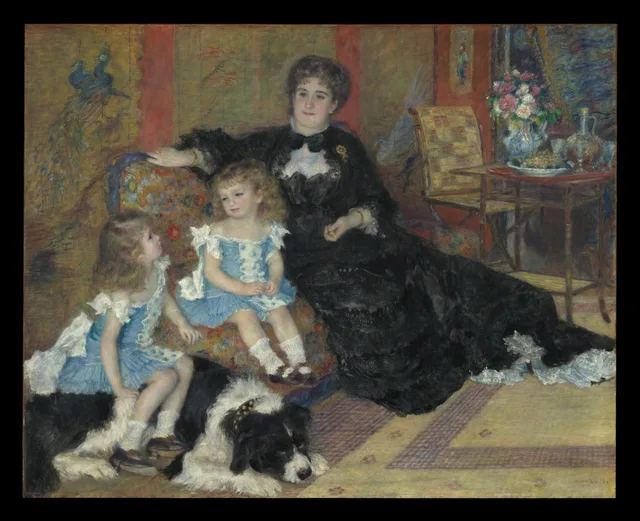 Madame Georges Charpentier (Marguerite-Louise Lemonnier, 1848–1904) and Her Children, Georgette-Berthe (1872–1945) and Paul-Emile-Charles (1875–1895)Auguste Renoir1878
Too good to keep to yourself
This painting,
for someone who comes to mind
They open it at full size
and see every brushstroke.
About this work
- Artist
- Gustave Caillebotte · 1848–1894
- Date
- 1877
- Medium
- Oil on canvas
- Size
- 212.2 × 276.2 cm
- Culture
- Paris
- Collection
- The Art Institute of Chicago
- Image
- Original long edge 9987px · shown at 2560px
- Original
- View on the museum's website ↗