 Pyeongye
Artwork · 19th century · Sir Edward Burne-Jones
LeoTurn on Magnifier at the lower right and move slowly across the painting.
Full screen opens it edge to edge.Tap the painting to fill the screen.
Spread two fingers to look closer.
At a glance
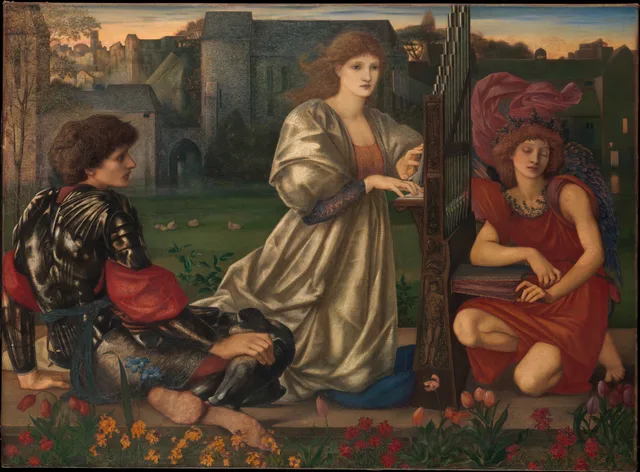
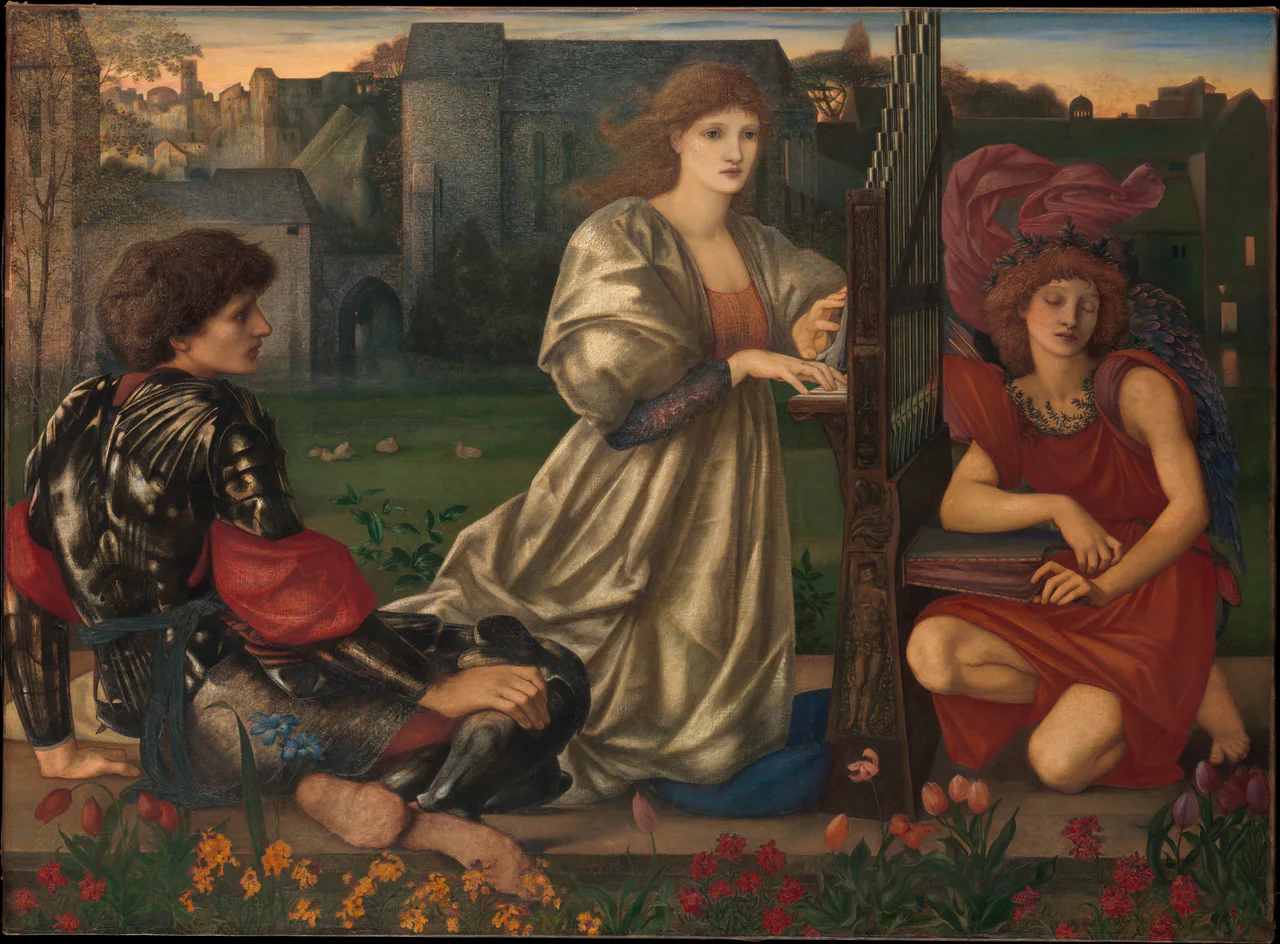
- In a garden at dusk, a woman plays a small pipe organ, with a knight in armor and a winged god of love beside her.
- The English painter Edward Burne-Jones worked on it over many years, from 1868 to 1877.
- No one is speaking, yet the quiet scene feels as if music is drifting through it.
Reading the picture
4 places to look closer
Tap a number on the painting to jump to its note, or a close-up to see that spot in the whole picture.
Zoom in on the woman's hands. The fingers of one hand rest neatly on the keys, while the other hand hovers just above. The wooden case beside the keyboard is carved with fine patterns. Above it, silver pipes stand in a row, from tall to short.
Look at the boy in red on the right. He has dark blue wings, and the feathered ends of arrows poke up behind his shoulder. He is Love himself. With his eyes closed, he presses both hands on the leather box beside the organ. It is the bellows. An organ like this only sounds when one person plays the keys and another pumps air into it.
Zoom in on the knight's armor at left. Every black steel plate flashes with white reflections of the sky. A blue sash is knotted at his waist, with red cloth wrapped around him. But look down: the knight is barefoot. He seems to have set the battle aside to listen to the song.
Look far off at upper left. Under a pink evening sky, an old town with a dome and a tall tower rises in layers. In front of it run walls covered with ivy, and trees. The time and place are as blurry as a dream.
When it was painted
In 1868 Burne-Jones began work on this large canvas. It was not a new idea. A few years earlier he had painted the same composition as a small watercolor, now in the Museum of Fine Arts, Boston. The buyer was William Graham, one of his most loyal patrons.
In a letter of 1868, Graham accepted the artist's offer to let him have first refusal of a version in oil. That is how this picture began. Its title comes from the refrain of an old Breton song, about knowing a love song that is sad and happy by turns. Burne-Jones always called the picture by its French name, Chant d'Amour.
Then the work dragged on. In 1870 another of his paintings drew harsh criticism at an exhibition because of a nude male figure. He took it down and resigned from the society that had shown it. For several years after that he exhibited almost nothing and kept reworking his pictures in the studio. That quiet stretch is part of why this one took nine years.
In 1877 the Grosvenor Gallery opened in London. When Burne-Jones finally showed his work there, his name suddenly became widely known. This painting was finished the same year. The Met notes that the figures recall the work of the Venetian painter Vittore Carpaccio. When Burne-Jones exhibited it, he displayed the words of that Breton refrain alongside it.
The picture crossed the ocean and entered the Met in 1947. Look at it again. The woman plays, Love works the bellows, and the knight only listens. Is the song they hear the sad kind or the happy kind?
Questions to think about
- Look for itCan you find the arrows hidden behind Love's shoulder, and the knight's bare feet?
- Why?Why do you think Burne-Jones painted the god of love with his eyes closed?
- What about you?This organ cannot make a sound with just one person. What things in our lives today only work when several people do them together?
Same period
Painted around the same time,
somewhere else
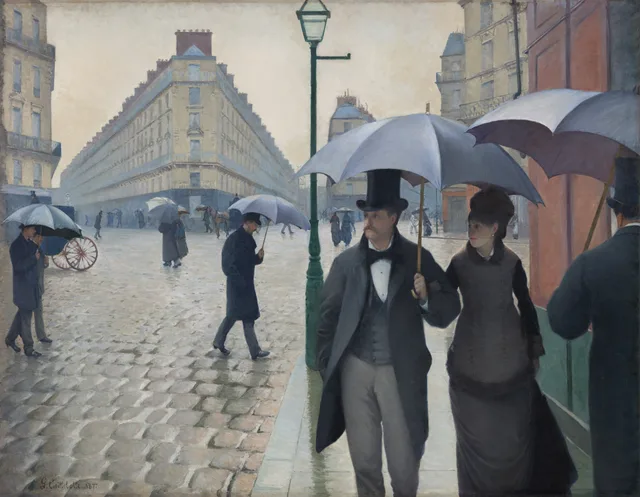 Paris Street; Rainy DayGustave Caillebotte1877
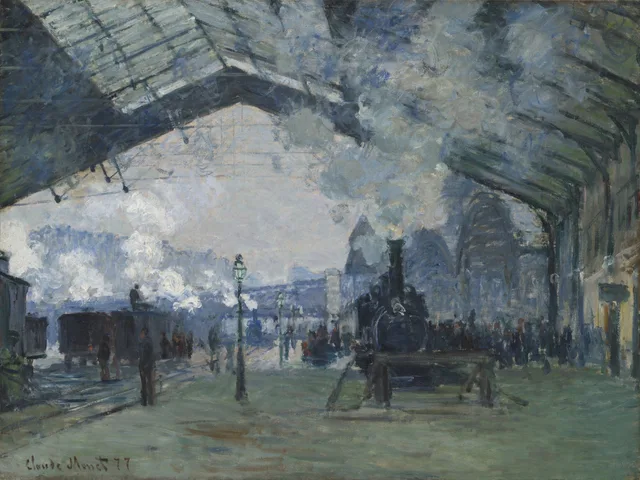 Arrival of the Normandy Train, Gare Saint-LazareClaude Monet1877
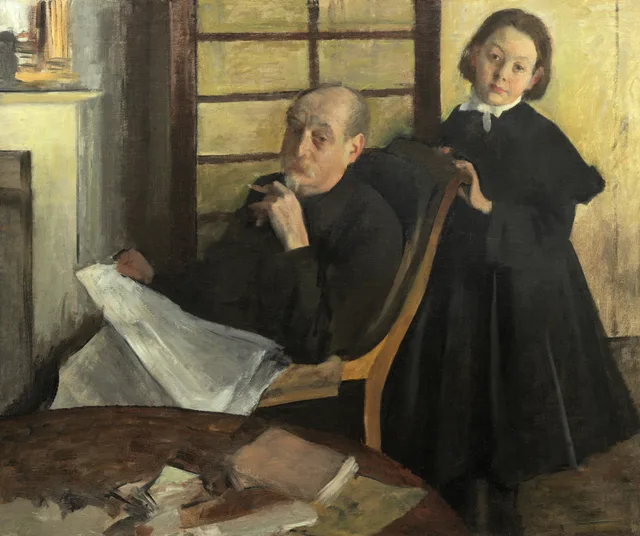 Henri Degas and His Niece Lucie Degas (The Artist's Uncle and Cousin)Edgar Degas1875–76
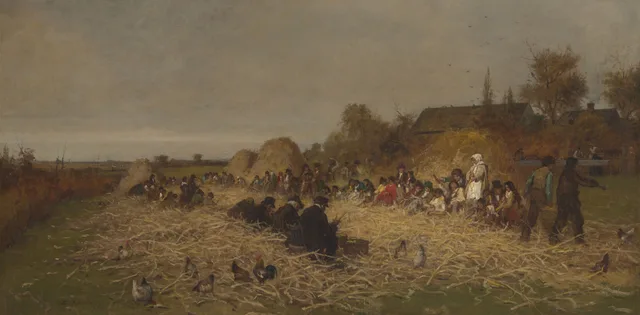 Husking Bee, Island of NantucketEastman Johnson1876
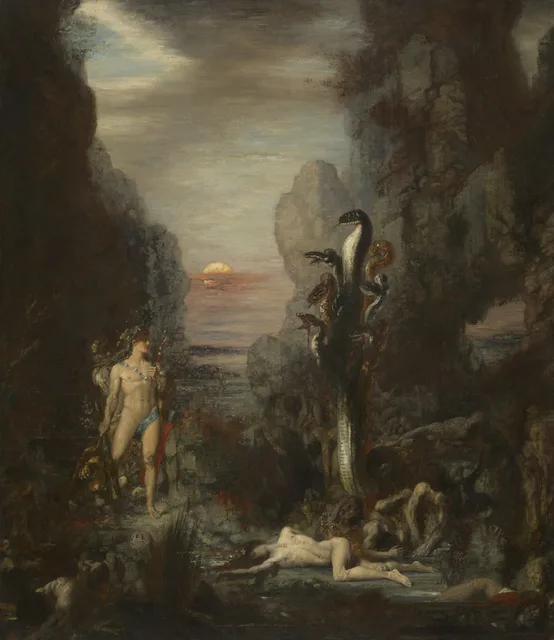 Hercules and the Lernaean HydraGustave Moreau1875–76
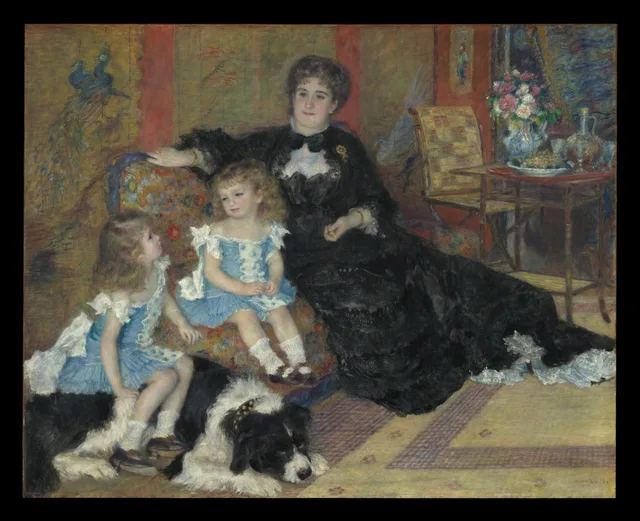 Madame Georges Charpentier (Marguerite-Louise Lemonnier, 1848–1904) and Her Children, Georgette-Berthe (1872–1945) and Paul-Emile-Charles (1875–1895)Auguste Renoir1878
Too good to keep to yourself
This painting,
for someone who comes to mind
They open it at full size
and see every brushstroke.
About this work
- Artist
- Sir Edward Burne-Jones · 1833–1898
- Date
- 1868–77
- Medium
- Oil on canvas
- Size
- 114.3 × 155.9 cm
- Collection
- The Metropolitan Museum of Art
- Image
- Original long edge 4000px · shown at 2560px
- Original
- View on the museum's website ↗