 Pyeongye
Artwork · 15th century · Giovanni Bellini
LeoTurn on Magnifier at the lower right and move slowly across the painting.
Full screen opens it edge to edge.Tap the painting to fill the screen.
Spread two fingers to look closer.
At a glance
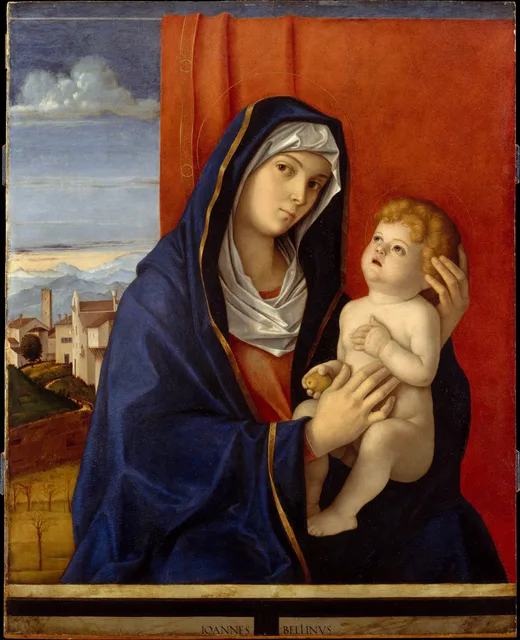
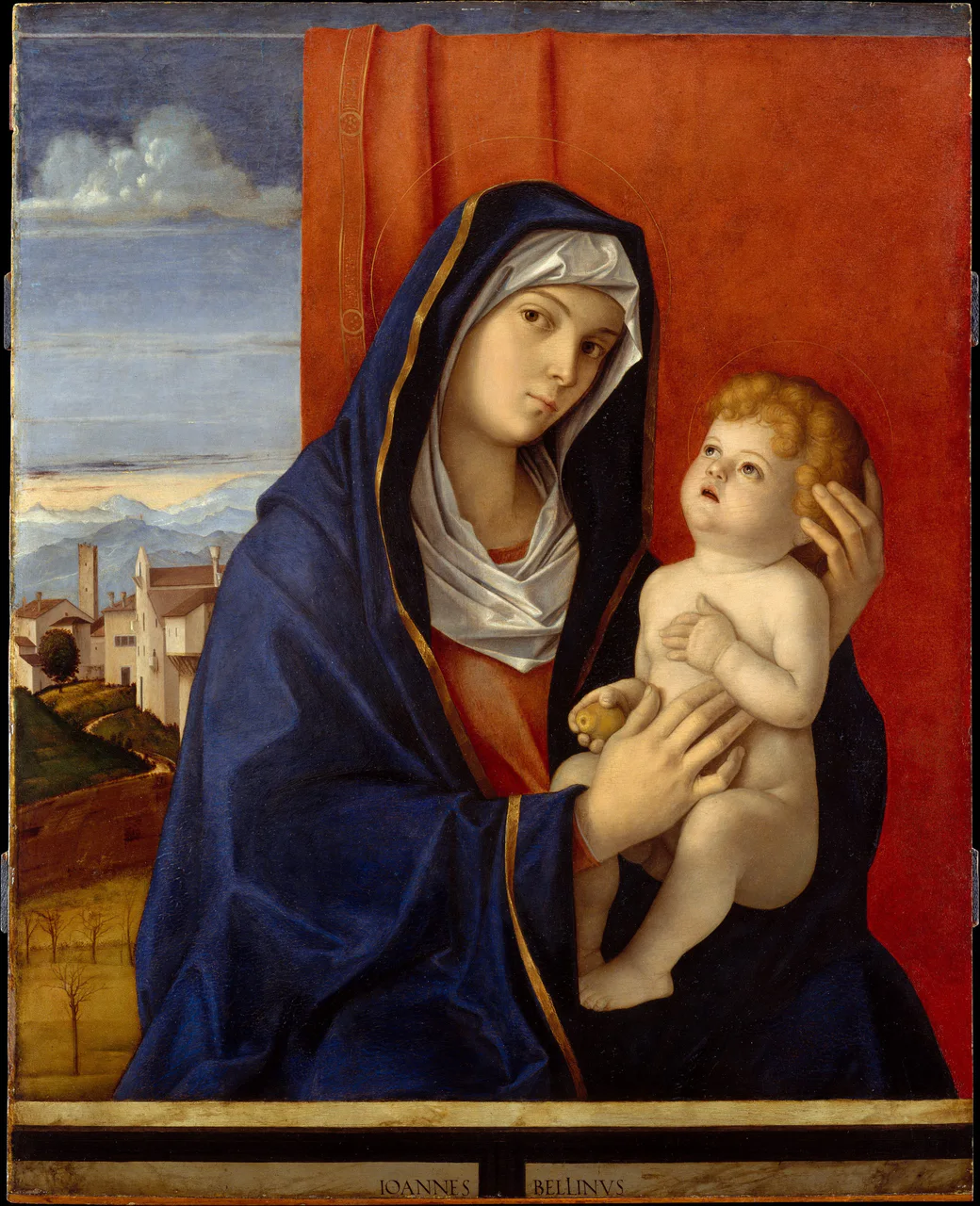
- The Virgin Mary sits in front of a red cloth and holds the Christ Child on her lap.
- The Venetian painter Giovanni Bellini made it in oil on wood in the late 1480s.
- The baby gazes upward while his mother looks out at us, and that crossing of glances keeps you looking.
Reading the picture
5 places to look closer
Tap a number on the painting to jump to its note, or a close-up to see that spot in the whole picture.
Zoom in on the baby's face. He has curly orange hair, his mouth is slightly open, and his eyes are turned up toward something far above. Mary's long fingers rest lightly on the back of his head. A very thin gold circle is drawn around his head, so fine you have to lean in to see it.
Now look at Mary's face. Over a white veil she wears a deep blue mantle, and a gold band runs down its edge. Her head tilts a little, and her eyes meet ours. She is neither smiling nor sad, which makes you wonder what she is thinking.
Look closely at the baby's small hand, just above Mary's fingers. He grips a small yellow fruit. In pictures of the Madonna and Child, a fruit in the baby's hand was often used to recall the sin of Adam and Eve and the salvation that would wash it away.
Move to the view on the left. A square tower and white houses gather on a hill, and a road winds down toward us. Thin, leafless trees stand in the field below. With blue mountains and clouds in the distance, this narrow strip beside the red cloth holds a whole second world.
Look at the stone ledge along the bottom. Two small panels carry the words IOANNES and BELLINVS. That is the painter's name, Giovanni Bellini, written in Latin. Mary and the child sit just behind this ledge, as if they were only a step away from us.
When it was painted
Picture Venice in the late 1480s. Nobody knows exactly when Giovanni Bellini was born, but by now he was a seasoned painter in middle age with a big name in the city. Painting ran in the family: his father Jacopo and his brother Gentile were painters too. Since 1483 Giovanni had also served as the official painter of the Venetian Republic.
A few years earlier, the family had a surprise. In 1479 the Ottoman sultan asked Venice for a painter, and Gentile sailed off to Constantinople. While he was away, Giovanni took over the huge history paintings for the Great Council Hall in the Doge's Palace. Sadly, none of them survive. A fire swept through the palace in 1577 and destroyed them.
Palace work was only part of his week. In 1488 he finished a three-part altarpiece for the Frari church, and he kept turning out half-length Madonnas like this one. People hung them at home or in small chapels and looked at them while they prayed. Demand was high, so assistants in his busy workshop helped paint many similar versions.
Bellini kept working into old age. When the German painter Albrecht Dürer came to Venice in 1506, he wrote home that Bellini was very old, yet no one painted better. Bellini died in 1516. This panel reached the Metropolitan Museum in 1908. The man who bought it was Roger Fry, an English critic who had published a book on Bellini in 1899 and was working for the museum at the time.
Now go back to the narrow view beside the red cloth. The great palace canvases are gone, but this little world of tower, white houses, and bare trees has lasted more than five hundred years.
Questions to think about
- Look for itCan you find the thin gold circles drawn around the heads of Mary and the baby?
- Why?Why do you think Bellini made Mary look at us while the baby looks up?
- What about you?Mary's hands seem both tender and careful as she holds the child. Does our society give people who care for others today enough support to lean on?
Same period
Painted around the same time,
somewhere else
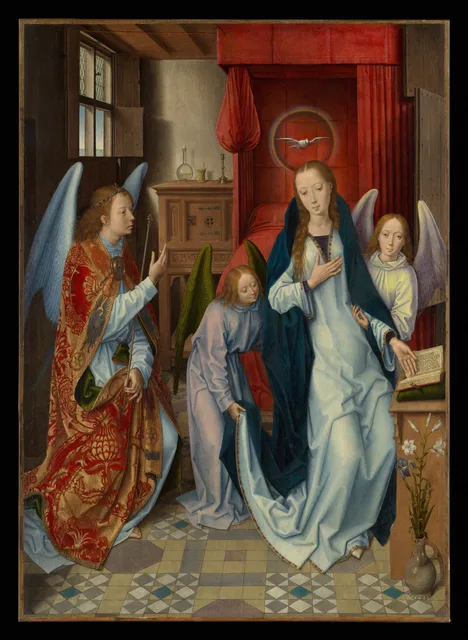 The AnnunciationHans Memling1480–89
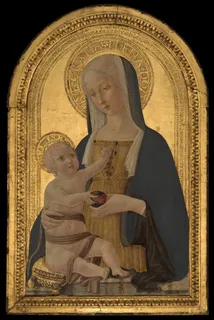 Madonna and ChildBenvenuto di Giovannica. 1475–85
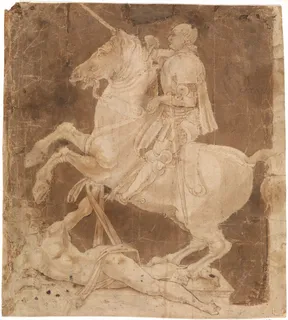 Study for the Equestrian Monument to Francesco SforzaAntonio Pollaiuoloearly to mid 1480s
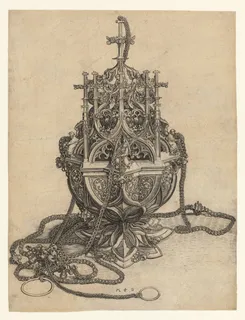 The CenserMartin Schongauer1470–91
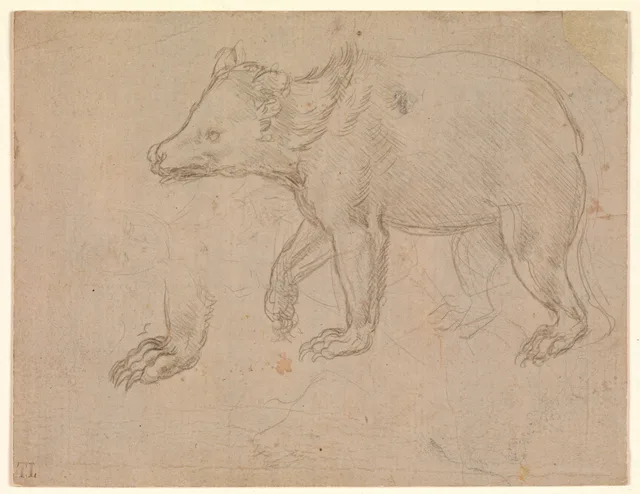 A Bear WalkingLeonardo da Vincica. 1482–85
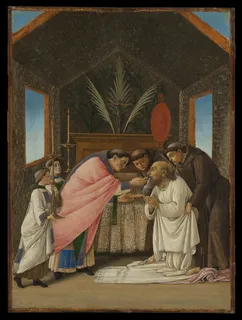 The Last Communion of Saint JeromeBotticelliearly 1490s
Too good to keep to yourself
This painting,
for someone who comes to mind
They open it at full size
and see every brushstroke.
About this work
- Artist
- Giovanni Bellini · 1424–1516
- Date
- late 1480s
- Medium
- Oil on wood
- Size
- 88.9 × 71.1 cm
- Collection
- The Metropolitan Museum of Art
- Image
- Original long edge 3718px · shown at 2560px
- Original
- View on the museum's website ↗