 Pyeongye
Artwork · 15th century · Benvenuto di Giovanni
LeoTurn on Magnifier at the lower right and move slowly across the painting.
Full screen opens it edge to edge.Tap the painting to fill the screen.
Spread two fingers to look closer.
At a glance
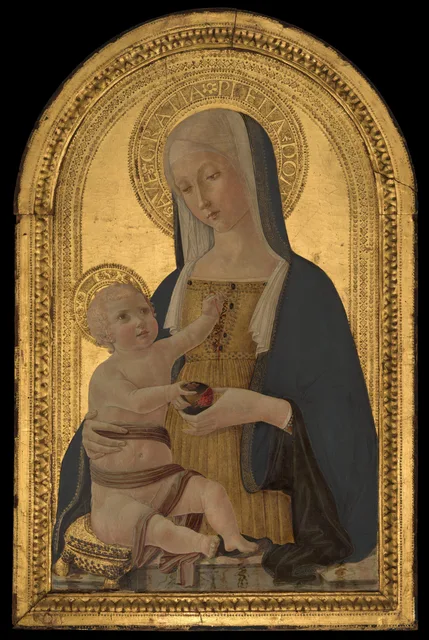
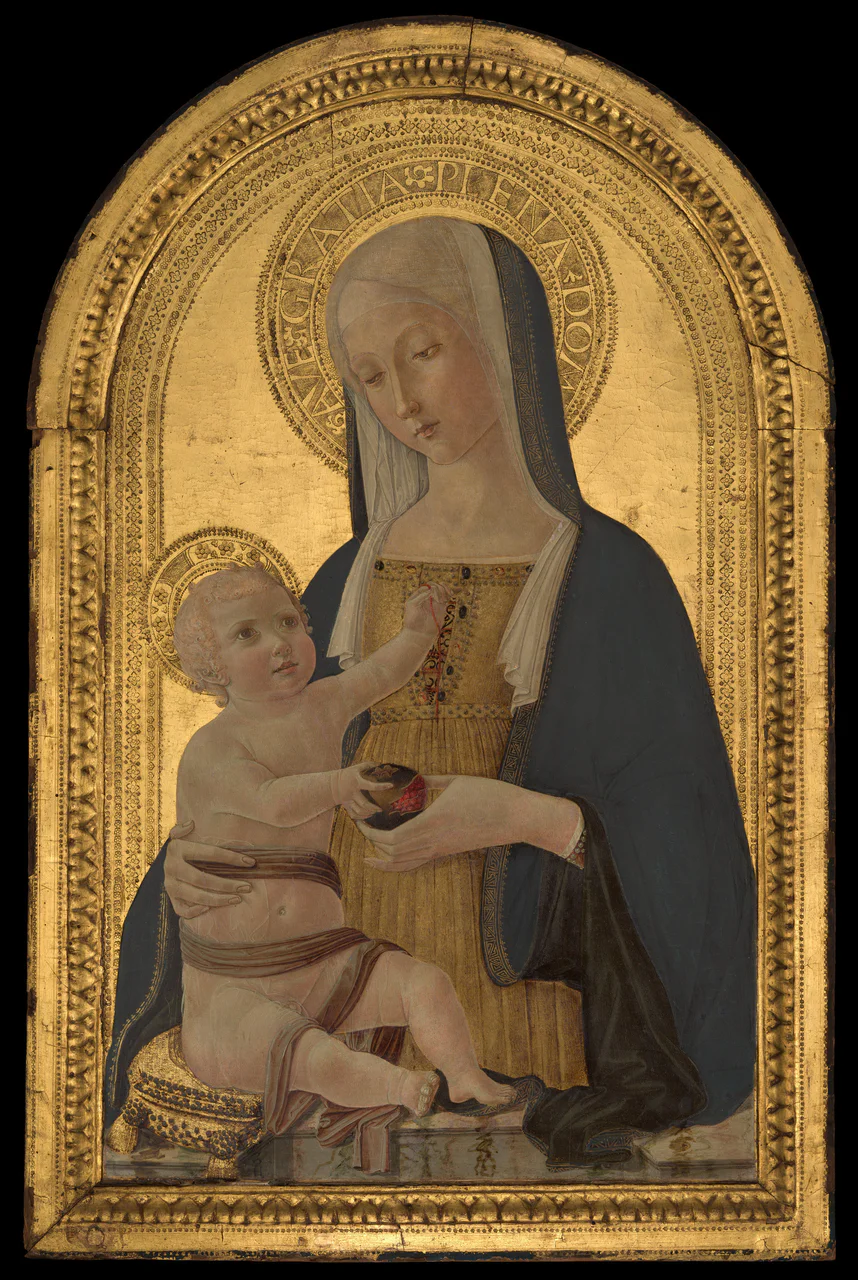
- Against a gold background, the Virgin Mary holds the Christ Child, who grips a split pomegranate.
- Benvenuto di Giovanni of Siena painted it around 1475 to 1485, in tempera on wood with a gold ground.
- Up close it is full of small surprises: patterns punched into gold, words around a halo, and a red cord in a baby's fist.
Reading the picture
4 places to look closer
Tap a number on the painting to jump to its note, or a close-up to see that spot in the whole picture.
Zoom in on the halo behind Mary's head. Latin letters run around it, pressed into the gold. Read them in order and you get Ave gratia plena, Hail, full of grace. These are the first words the angel Gabriel spoke to Mary.
Now find the Child's raised hand. He has hooked his fingers around the red cord that laces up the front of Mary's gold bodice, and he is tugging it. Next to the cord runs a line of black embroidered pattern. It is exactly what a real baby would do.
His other hand shares a fruit with Mary's hand. It is a pomegranate, cracked open so the red seeds crowd out of the gap. In Christian art the pomegranate was a familiar sign. Its many seeds in one skin could stand for the Church, and its red juice could recall Christ's suffering and his rising again.
Drop to the bottom left, to the cushion the Child is sitting on. It is gold cloth studded with rows of dark beads, with a tassel at the corner. The painter took as much care over this cushion as over a fine object in a wealthy home. Below it, the gilded border closes the picture like a frame.
When it was painted
Picture the baptistery of Siena in 1453. The painter and sculptor Vecchietta is at work on its frescoes, and a young Siena-born painter, Benvenuto di Giovanni, is helping him. That is the first time Benvenuto's name turns up in the records. It is also why many scholars see Vecchietta as his teacher.
His earliest painting that carries both a signature and a date is an Annunciation from 1466, in the church of San Girolamo in the Tuscan hill town of Volterra. It shows the angel greeting Mary. That is the same greeting you can read around the halo in this panel.
By the time he made this Madonna, sometime around 1475 to 1485, Benvenuto had been painting for more than twenty years. His son, Girolamo di Benvenuto, was growing up in the household. Girolamo was born around 1470, learned to paint from his father, and worked alongside him on many projects before becoming a Sienese painter in his own right.
A modest panel like this, with only Mary and her child, was made for prayer at home or in a small chapel. This one did not stay home. It belonged to the Chabrières-Arlès collection in France, then passed to Duveen Brothers, the New York dealers. In 1916 the banker Philip Lehman bought it.
His son Robert Lehman carried the family collection forward. After Robert's death, the whole collection came to The Metropolitan Museum of Art in 1975. The museum describes the panel as well preserved, and you can see why: after more than five hundred years and many owners, the gold still glows.
Look again at the hands meeting over the pomegranate. From a wall where someone once prayed to a museum in New York, think about how far those hands have traveled.
Questions to think about
- Look for itThe gold border around the picture is punched with patterns too. How many different shapes can you find?
- Why?Why do you think the painter gave the holy Child such an ordinary game, tugging on a cord?
- What about you?People once read meaning into a single piece of fruit in a painting. What hidden symbols do we tuck into gifts or photos today?
Same period
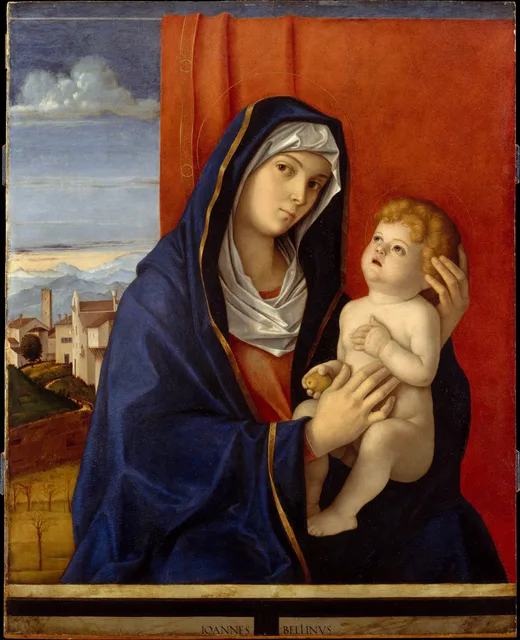
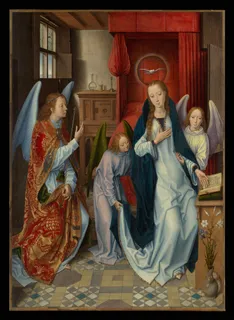
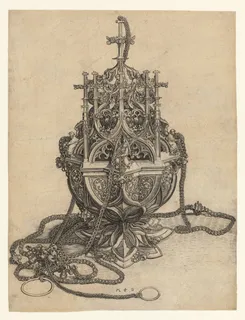
Painted around the same time,
somewhere else
Too good to keep to yourself
This painting,
for someone who comes to mind
They open it at full size
and see every brushstroke.
About this work
- Artist
- Benvenuto di Giovanni · 1430–1518
- Date
- ca. 1475–85
- Medium
- Tempera on wood, gold ground
- Size
- 70.5 × 46 cm
- Collection
- The Metropolitan Museum of Art
- Image
- Original long edge 4000px · shown at 2560px
- Original
- View on the museum's website ↗