 Pyeongye
Artwork · 15th century · Antonio Pollaiuolo
LeoTurn on Magnifier at the lower right and move slowly across the painting.
Full screen opens it edge to edge.Tap the painting to fill the screen.
Spread two fingers to look closer.
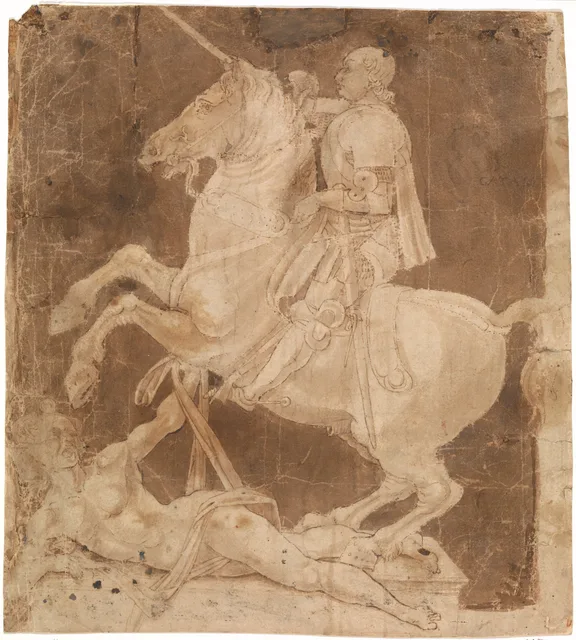
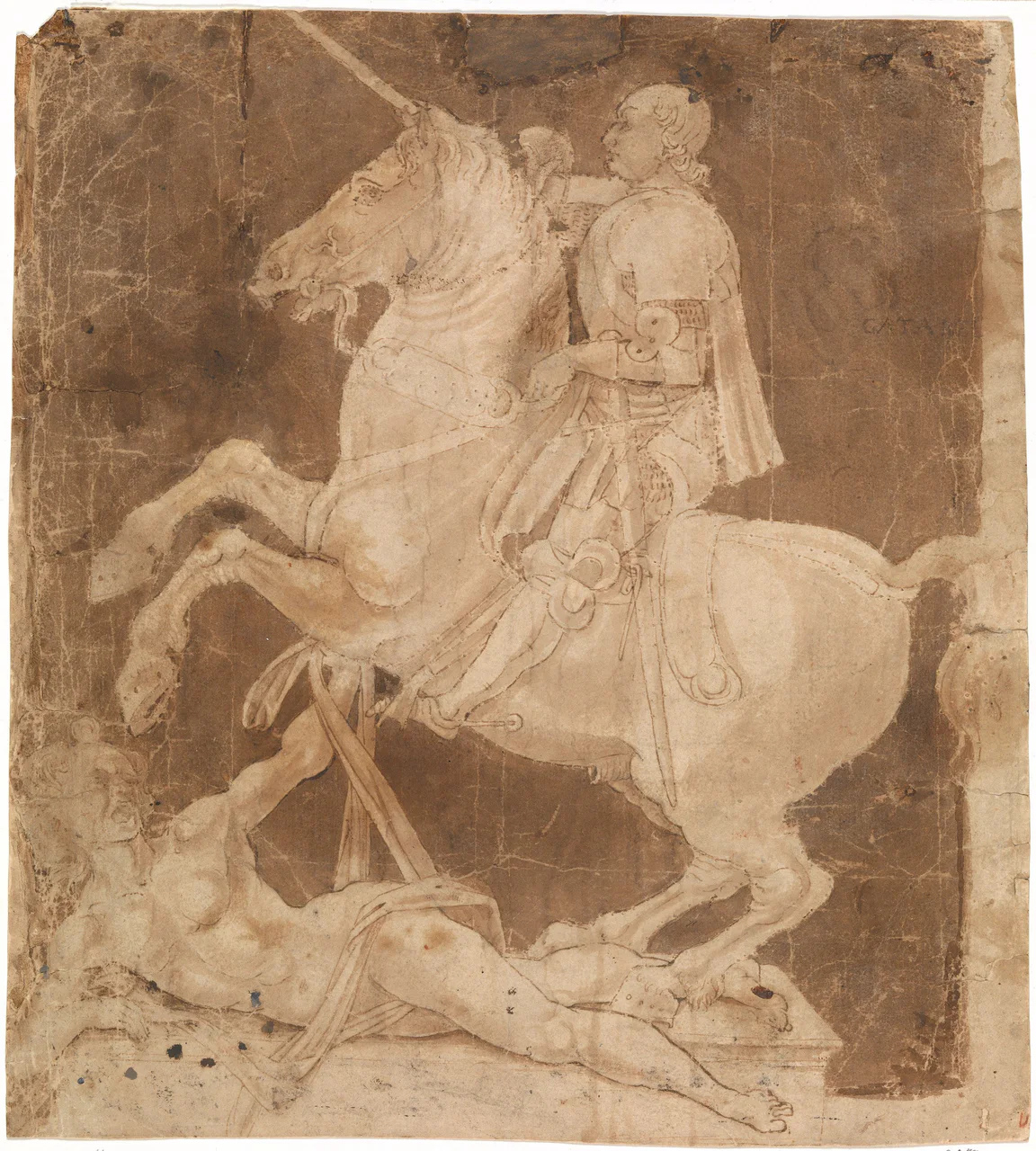
Study for the Equestrian Monument to Francesco Sforza
Antonio Pollaiuoloearly to mid 1480sPen and brown ink, light and dark brown wash; outlines of the horse and rider pricked for transfer.28.1 × 25.4 cm
At a glance
- A commander in armor sits on a rearing horse, and under the hooves lies a fallen enemy.
- Antonio Pollaiuolo, a Florentine goldsmith and sculptor, drew it in the early to mid 1480s while planning a bronze horse-and-rider statue for the ruling family of Milan.
- Tiny pinholes run along the outlines, the leftover marks of a plan to transfer the design onto another surface.
Reading the picture
5 places to look closer
Tap a number on the painting to jump to its note, or a close-up to see that spot in the whole picture.
Zoom in on the rider's face at the upper right. He is shown in profile, bareheaded, with no helmet. Short curls roll back behind his ear, and his jaw is heavy. This is Francesco Sforza, Duke of Milan.
Look at the horse's head. Its eye is wide open, its nostril flared, and its head twisted around. A row of small dots follows the brow and the line of the bridle. They are not ink dots. They are holes pricked with a needle.
Zoom in on the saddle area below the rider's waist. Holes run along the outlines of the round ornaments and the long lines hanging beside them too. If you dab charcoal dust over a pricked sheet, a dotted outline appears on the surface underneath. Artists used this trick to copy a design onto another surface or repeat it.
Look at the fallen man at the lower left. He lies on his back, naked, with an arm raised. The muscles of his chest and belly swell up through nothing more than light and dark brown wash. Pollaiuolo was especially interested in drawing bare bodies with muscles in action.
Zoom in on the horse's hind hooves at the lower right. With both front legs in the air, the horse has to carry its whole weight on these two hind legs. Making a heavy bronze stand in this pose was a serious engineering problem.
When it was painted
In the early 1480s, Antonio Pollaiuolo was about fifty. He had trained as a goldsmith in Florence, and with his younger brother Piero he ran a workshop that turned out goldwork, bronzes, paintings, and prints. His engraving Battle of the Nudes, a tangle of naked men slashing at each other with swords and axes, is his work too.
In Milan, the Sforza family wanted a giant bronze statue of Francesco Sforza on horseback. Francesco had risen from mercenary captain to Duke of Milan in 1450. His eldest son, Galeazzo Maria, first took up the idea, and after Galeazzo Maria was assassinated in 1476, his brother Lodovico carried it on.
The Met suggests this sheet may have been made to show the design to Lodovico. A matching drawing survives in Munich. Some scholars think Lodovico may have had Pollaiuolo and Leonardo da Vinci compete for the job.
Leonardo got the commission, and years later he built a huge clay model of the horse. But in 1494 the bronze set aside for it went into cannons, and after French troops entered Milan in 1499 the clay horse was ruined. Pollaiuolo had gone to Rome in 1484 to make the bronze tomb of Pope Sixtus IV, and then the tomb of Innocent VIII. He died in Rome in 1498.
Later this sheet belonged to Giorgio Vasari, the author of the Lives of the Artists. The Met thinks Vasari described this very drawing in the 1568 edition of the Lives, and that he may have added the brown wash around the figures himself.
Look again at the dark brown ground around the horse and rider. Around Pollaiuolo's pen lines, you may be seeing the brush of a later artist who treasured the sheet.
Questions to think about
- Look for itWhere on the horse can you see the pinholes most clearly?
- Why?Why do you think Pollaiuolo put a fallen enemy under the horse's hooves?
- What about you?This monument shows a victor with a defeated man beneath him. When we put up statues in public squares today, who are we honoring, and who might they be standing on?
Same period
Painted around the same time,
somewhere else
Too good to keep to yourself
This painting,
for someone who comes to mind
They open it at full size
and see every brushstroke.
About this work
- Artist
- Antonio Pollaiuolo · 1432–1498
- Date
- early to mid 1480s
- Medium
- Pen and brown ink, light and dark brown wash; outlines of the horse and rider pricked for transfer.
- Size
- 28.1 × 25.4 cm
- Collection
- The Metropolitan Museum of Art
- Image
- Original long edge 2971px · shown at 2560px
- Original
- View on the museum's website ↗