 Pyeongye
Artwork · 15th century · Botticelli
LeoTurn on Magnifier at the lower right and move slowly across the painting.
Full screen opens it edge to edge.Tap the painting to fill the screen.
Spread two fingers to look closer.
At a glance
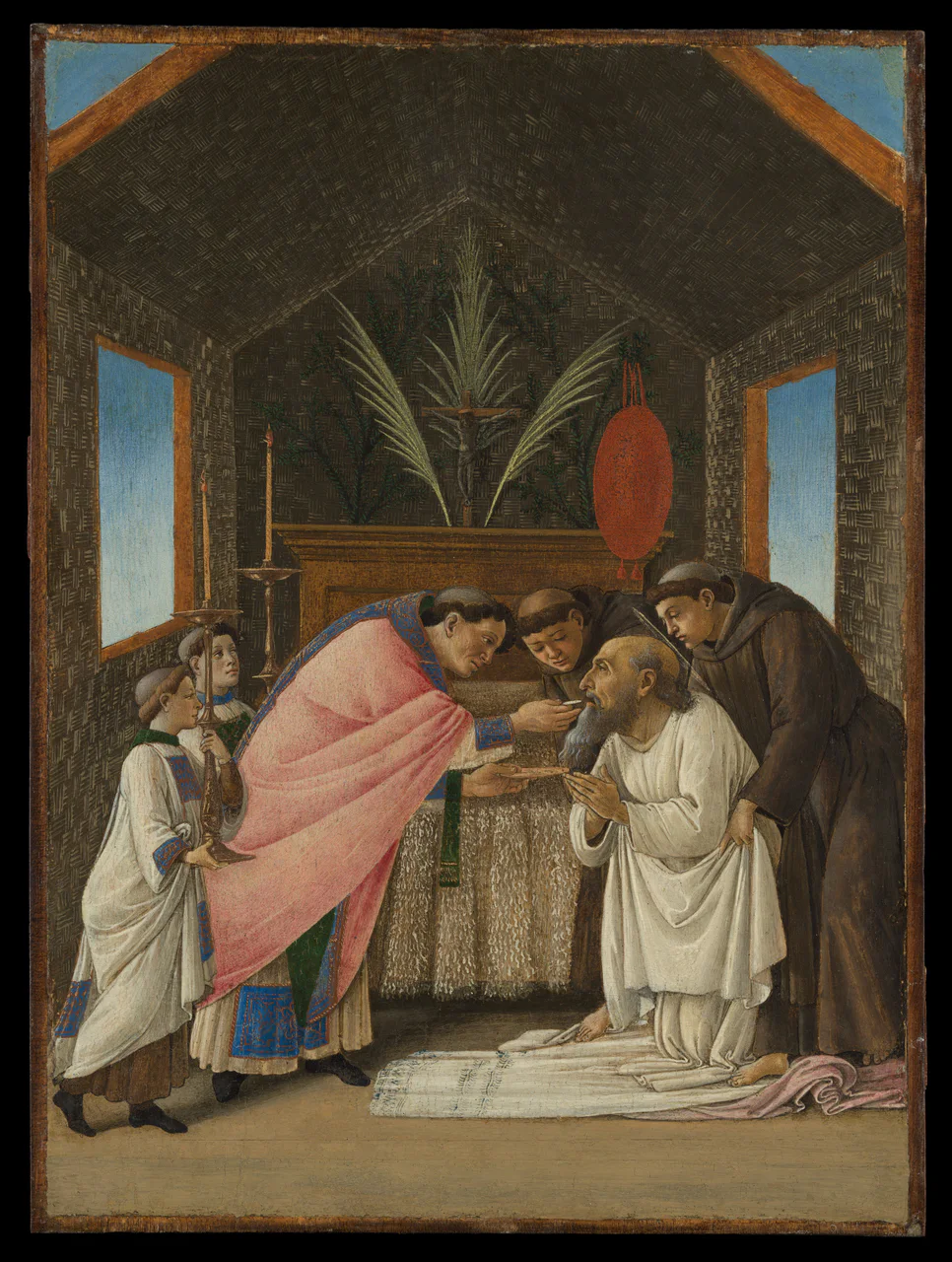
- The aged Saint Jerome kneels to receive Communion for the last time before his death.
- Sandro Botticelli painted it in Florence in the early 1490s, in tempera and gold on wood.
- The panel is only about 34 centimeters tall, yet it is packed with detail, from the woven walls of the hut to the embroidered bands on the priest's robe.
Reading the picture
4 places to look closer
Tap a number on the painting to jump to its note, or a close-up to see that spot in the whole picture.
Zoom in on the center. The priest holds a white wafer between his fingertips, about to place it in Jerome's mouth. His other hand holds a small plate beneath it. The old man, bald with a long gray beard, presses his hands together and opens his mouth. Behind them, a friar in a brown habit bends down to watch.
Look above the altar. Palm fronds fan out behind a small crucifix. On the wall to the right hangs a red hat with long cords. It is a cardinal's hat. Pictures of Jerome often include this red hat as a way to recognize him.
Zoom in on the boy at left. An altar server in white, with a green collar, holds up a tall candlestick with both hands. His cuffs and shoulder carry patches of blue cloth embroidered with red. His profile looks serious and focused.
Look at the wall and ceiling at upper left. Short strokes cross back and forth to make a pattern like basketwork. The room seems less like a stone church and more like a simple hut built of woven reeds or straw. Through the window you can see blue sky.
When it was painted
By the early 1490s Sandro Botticelli was in his late forties and a well-known painter in Florence. As a younger man he had worked for members of the Medici family, and in the early 1480s he had been called to Rome to paint on the walls of the Sistine Chapel. But the Florence he lived in was changing fast.
In 1492 Lorenzo de' Medici, the man who had steered the city for years, died. Around the same time, another voice was growing louder: the Dominican friar Savonarola. His sermons attacked luxury and vanity and called on Florentines to repent, and crowds came to hear him.
The man who ordered this little panel was Francesco del Pugliese, a Florentine wool merchant. He was a follower of Savonarola. Scholars identify this picture with one listed in a document he left in 1502.
Botticelli was caught up in the same currents. Giorgio Vasari, who wrote lives of artists in the 1500s, said Botticelli became a devoted follower of Savonarola. The friar himself was executed in Florence's Piazza della Signoria in 1498. More than four hundred years later, the panel belonged to the American collector Benjamin Altman, and it came to the Metropolitan Museum through his bequest in 1913.
Now look at Jerome's side. The friar in brown behind him grips a fold of the old man's white robe, holding him steady. Even at the moment of his last Communion, Jerome is not left to stand alone.
More by the same painter
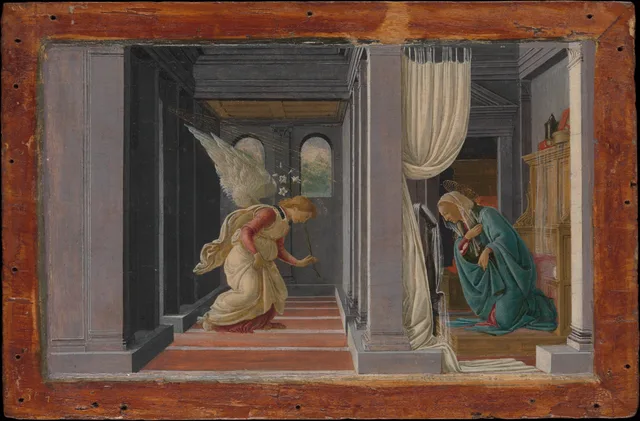
Questions to think about
- Look for itCan you find the red cardinal's hat and its cords hanging on the wall to the right of the altar?
- Why?Why do you think Botticelli set this scholar's final moment in a woven hut rather than a grand church?
- What about you?Jerome does not die alone; he is surrounded by people. What could we do today for people who face the end of life alone?
Same period
Painted around the same time,
somewhere else
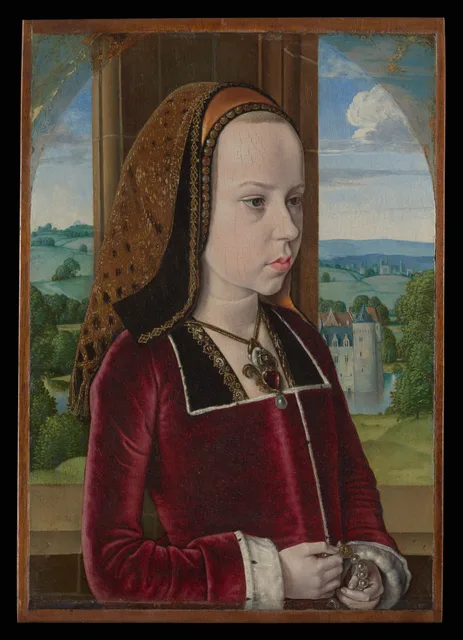 Margaret of AustriaJean Heyca. 1490
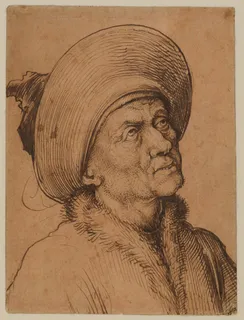 Bust of a Man in a Hat Gazing UpwardMartin Schongauerca. 1480–90
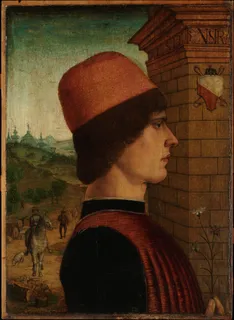 Portrait of a Man, possibly Matteo di Sebastiano di Bernardino GozzadiniMaestro delle Storie del Pane1494(?)
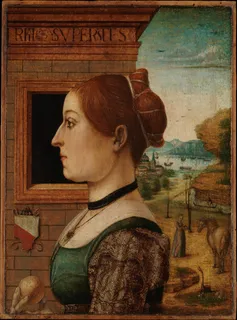 Portrait of a Woman, possibly Ginevra d'Antonio Lupari GozzadiniMaestro delle Storie del Pane1494?
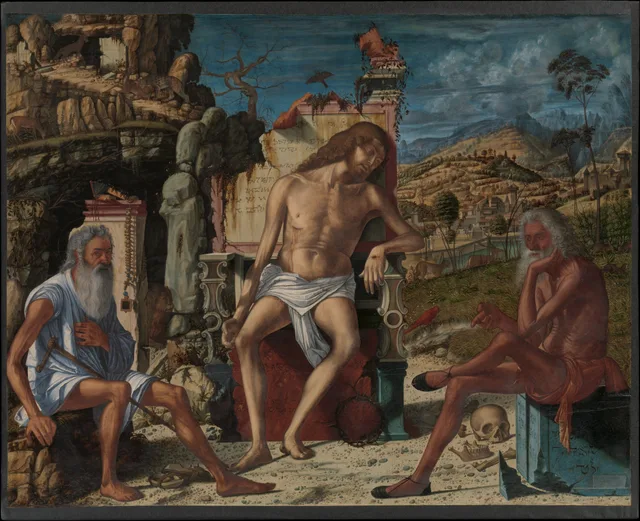 The Meditation on the PassionVittore Carpaccioca. 1490
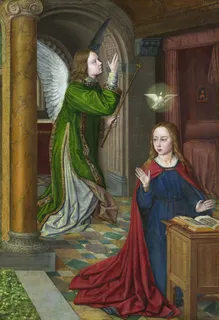 The AnnunciationJean Hey1490–95
Too good to keep to yourself
This painting,
for someone who comes to mind
They open it at full size
and see every brushstroke.
About this work
- Artist
- Botticelli · 1444–1510
- Date
- early 1490s
- Medium
- Tempera and gold on wood
- Size
- 34.3 × 25.4 cm
- Collection
- The Metropolitan Museum of Art
- Image
- Original long edge 4000px · shown at 2560px
- Original
- View on the museum's website ↗