 Pyeongye
Artwork · 20th century · Henri-Edmond Cross
LeoTurn on Magnifier at the lower right and move slowly across the painting.
Full screen opens it edge to edge.Tap the painting to fill the screen.
Spread two fingers to look closer.
At a glance
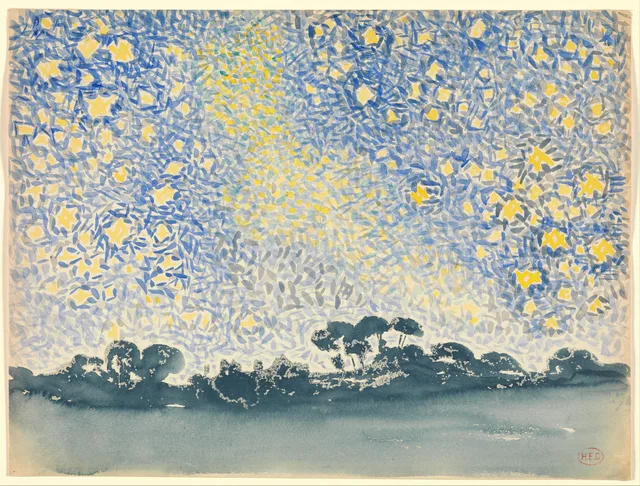
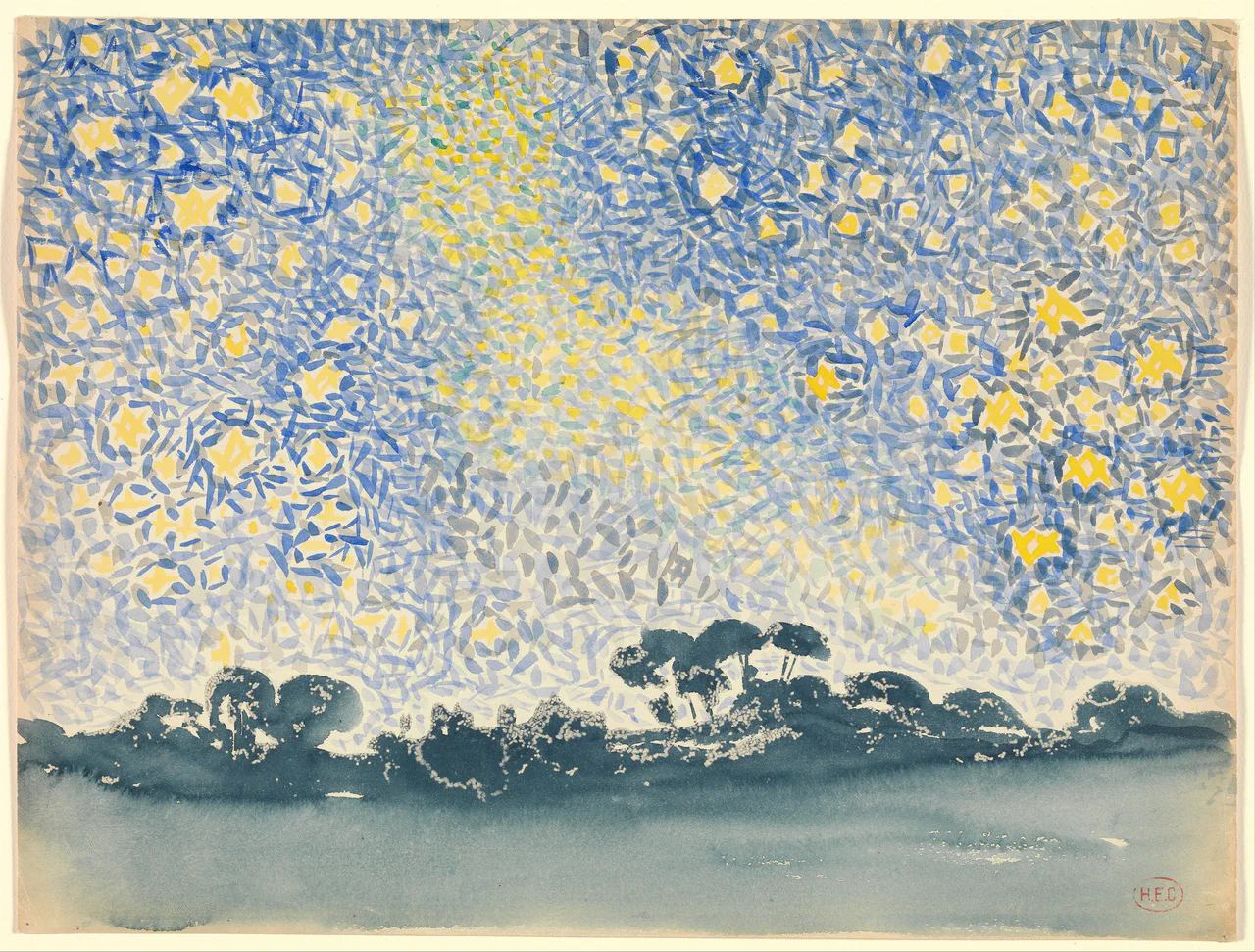
- A night landscape: a dark band of trees above still water, and a sky crowded with blue brushstrokes and yellow stars.
- The French painter Henri-Edmond Cross made it in watercolor around 1905–1908.
- On a sheet about 32 cm wide, you can see how a painter trained to place tiny dots let his strokes grow big and loose.
Reading the picture
5 places to look closer
Tap a number on the painting to jump to its note, or a close-up to see that spot in the whole picture.
Zoom in on the large stars at the right. Each one is built from strokes of yellow crossed like an X. In the middle of many stars the paper is left bare. Gray and blue dabs crowd around them, so the stars seem to flicker.
The sky near the top center is brighter than anywhere else. Here the yellow mixes with spots of blue-green, and the marks get smaller and closer together. Farther out, the blue strokes grow longer, as if the light were spreading outward.
Come down to the middle of the tree line. Tall trees with thin trunks and wide, flat tops stand against the sky like open umbrellas. They are painted with one broad wash of dark blue-gray. These are not the chopped-up strokes of the sky.
Look closely at the edges of the trees. Tiny white specks run around the dark paint like strings of beads. These are spots where the paint never touched the paper. They make the outline of the trees glitter, as if moonlight were catching it.
Check the bottom right corner. The letters H.E.C sit inside a red oval stamp. They are the initials of Henri-Edmond Cross.
When it was painted
Around 1905, Henri-Edmond Cross was nearly fifty. He lived by the Mediterranean, in the village of Saint-Clair near Le Lavandou. Suffering from rheumatism, he had left Paris for the south of France in 1891. He stayed first at Cabasson and soon settled in Saint-Clair.
He was born Henri-Edmond Delacroix. To avoid being confused with the famous painter Eugène Delacroix, he took the name Cross, an English version of croix, the French word for cross. In 1884 he helped found the Société des Artistes Indépendants in Paris, where he came to know Georges Seurat and Paul Signac. Like them, he became a Neo-Impressionist, building pictures from small separate touches of color.
Signac soon moved south too, settling a little way along the coast in Saint-Tropez. In the summer of 1904 the young Henri Matisse came to Saint-Tropez to paint near Signac, and he met Cross as well. After that summer Matisse painted Luxe, Calme et Volupté in dabs of color, and the next year he and his friends were nicknamed the Fauves, the wild beasts, for their raw, intense color.
In these years Cross's own marks were growing from tiny dots into larger blocks and dashes. He also painted many watercolors. He was ill during his last years, and he died at Saint-Clair in May 1910, at fifty-three.
Later this watercolor entered the collection of the New York banker Robert Lehman, and in 1975 it came to the Met with the Robert Lehman Collection.
Look again at the yellow stars on the right. In the night sky of a painter who had come south to escape his pain, they shine not as tiny dots but as big strokes crossed like an X.
Questions to think about
- Look for itHow many stars can you find where the center is left as bare paper?
- Why?Why do you think Cross broke the sky into small strokes but painted the trees and water in broad, flat washes?
- What about you?In most cities today it is hard to see stars at all. When did you last see a sky full of them, and is a dark night sky something worth protecting?
Same period
Painted around the same time,
somewhere else
Too good to keep to yourself
This painting,
for someone who comes to mind
They open it at full size
and see every brushstroke.
About this work
- Artist
- Henri-Edmond Cross · 1856–1910
- Date
- ca. 1905–1908
- Medium
- Watercolor on white wove paper
- Size
- 24.4 × 32.1 cm
- Collection
- The Metropolitan Museum of Art
- Image
- Original long edge 3905px · shown at 2560px
- Original
- View on the museum's website ↗