 Pyeongye
Artwork · 18th century · Elisabeth Louise Vigée Le Brun
LeoTurn on Magnifier at the lower right and move slowly across the painting.
Full screen opens it edge to edge.Tap the painting to fill the screen.
Spread two fingers to look closer.
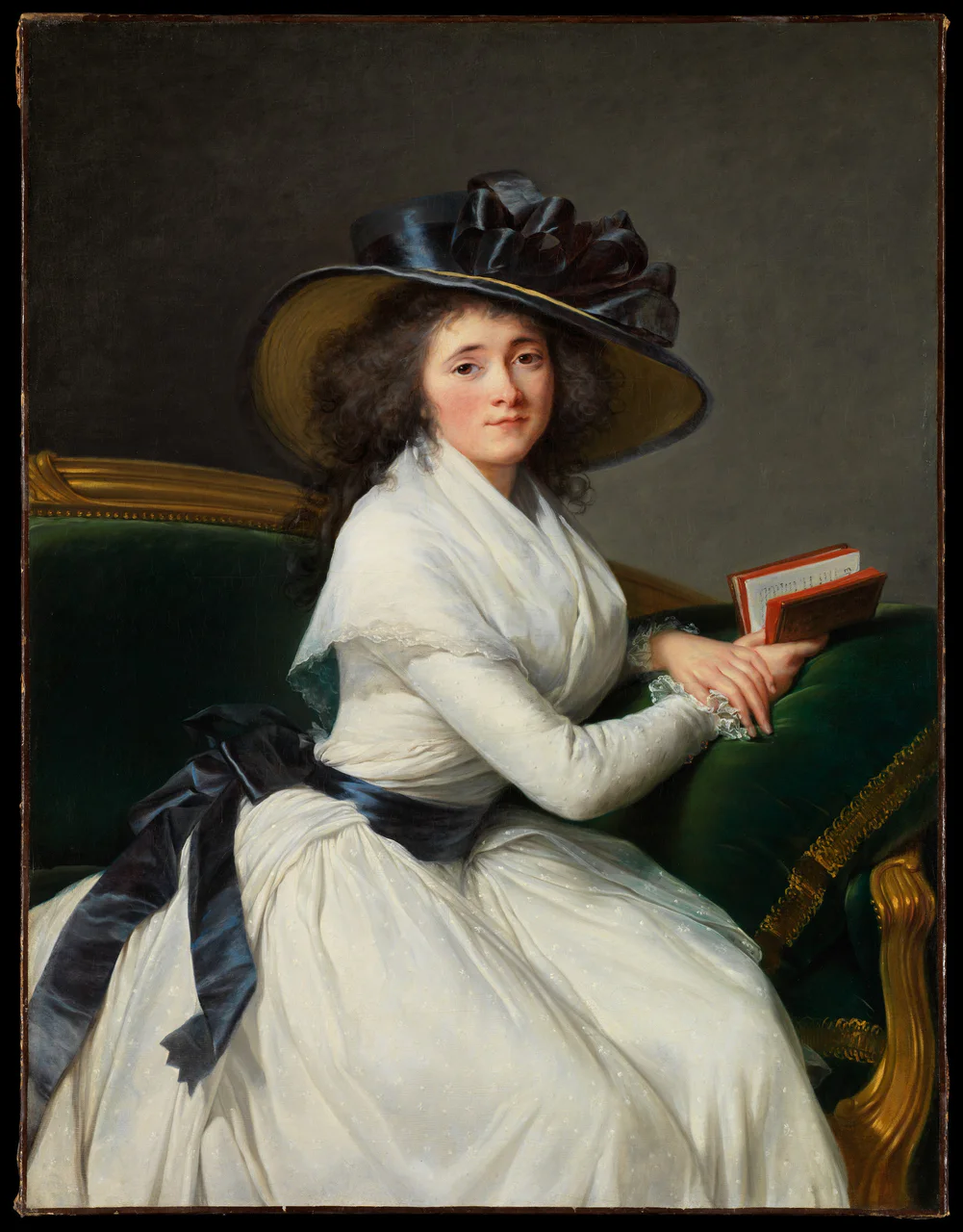
Comtesse de la Châtre (Marie Charlotte Louise Perrette Aglaé Bontemps, 1762–1848)
Elisabeth Louise Vigée Le Brun1789Oil on canvas114.3 × 87.6 cm
At a glance
- A young countess in a wide straw hat and a white dress sits on a green sofa, a book in her hand, and turns to look at us.
- Elisabeth Louise Vigée Le Brun, best known as the portrait painter of the French queen, painted it in 1789.
- It was made in the very year the French Revolution broke out, and it shows the dress and manner of an aristocratic Parisian woman on the eve of that upheaval.
Reading the picture
5 places to look closer
Tap a number on the painting to jump to its note, or a close-up to see that spot in the whole picture.
Zoom in on her face. Her cheeks are flushed, and her closed lips hold the start of a smile. She tilts her head a little and looks right at us. The sitter was born in 1762, so she was about twenty-seven here.
Move up to the hat. A huge bow of dark blue-black silk billows over the yellow straw brim. White light slides along every loop of ribbon, which is how you can tell the silk is glossy.
Zoom in on the little book in her hands. Its page edges are red, and the open pages are lined with dark marks. One finger is tucked between the pages. It feels as if she has just looked up from her reading.
Look at her hands and cuffs. The white sleeve is scattered with tiny dots, and frills of lace ripple around the wrist. The painter dabbed on white with the tip of the brush, so the lace looks thin enough to see through.
Now follow the sash trailing down at the lower left. It is the same dark silk as the hat ribbon, and it cuts across the white skirt. White dress, green sofa, dark ribbon: those three colors hold the whole picture together.
When it was painted
In 1789 Vigée Le Brun was about thirty-four. She was married to a Paris art dealer, she had a nine-year-old daughter named Julie, and she was the portraitist the French aristocracy lined up to sit for. She had painted Queen Marie Antoinette many times.
In 1783 she was admitted to the Royal Academy of Painting, which accepted very few women. That same year she showed a portrait of the queen in a simple white muslin dress, and critics complained that the queen looked as if she were in her underclothes. The countess's white gown here is that same fashionable style, six years on.
The sitter came from the Bontemps family; her father was first valet de chambre to King Louis XV. When this was painted she was the wife of the comte de la Châtre. She later divorced him and married François Arnail de Jaucourt, which is why the portrait was once known as Madame de Jaucourt.
In July 1789 the Revolution broke out in Paris. In October a furious crowd marched on Versailles and brought the royal family back to the city. Vigée Le Brun, so closely tied to the queen, slipped out of Paris at that moment, plainly dressed, riding a public coach with her daughter. Her husband stayed behind.
She spent the next years painting portraits in Italy, Vienna, and Russia, and did not come home to Paris until 1802. The countess's portrait passed through other hands and reached the Met in 1954 as a gift of Jessie Woolworth Donahue.
Now look again at the background behind her. It is a plain gray wall with nothing on it. None of the noise outside gets in, only one quiet moment with a book.
The painter
Elisabeth Louise Vigée Le Brun
1755–1842
When painting this, the artist was about 34 years old
All paintings by Elisabeth Louise Vigée Le Brun →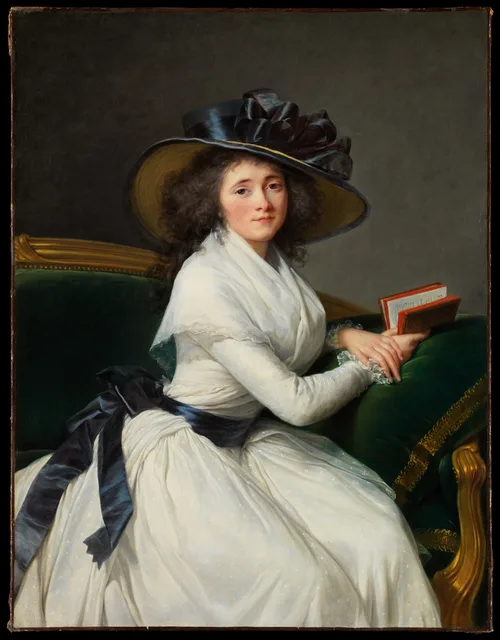
Questions to think about
- Look for itAt the lower right, can you find the curving gilded wood of the sofa's leg?
- Why?Why do you think the painter chose to show this woman holding a book?
- What about you?One dress worn by a queen set off both gossip and a new fashion. When a celebrity's outfit spreads across the internet overnight today, how freely are we really choosing what we wear?
Same period
Painted around the same time,
somewhere else
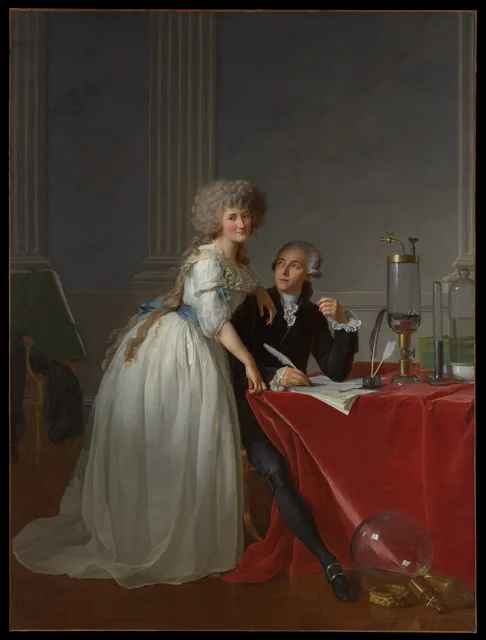 Antoine Laurent Lavoisier (1743–1794) and Marie Anne Lavoisier (Marie Anne Pierrette Paulze, 1758–1836)Jacques Louis David1788
 Queen CharlotteThomas Gainsborough1788
 Condesa de Altamira and Her Daughter, María AgustinaGoya1787–88
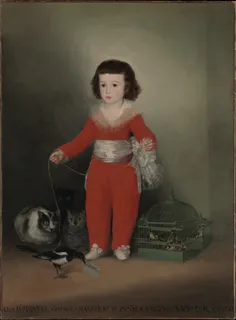 Manuel Osorio Manrique de Zuñiga (1784–1792)Goya1787–88
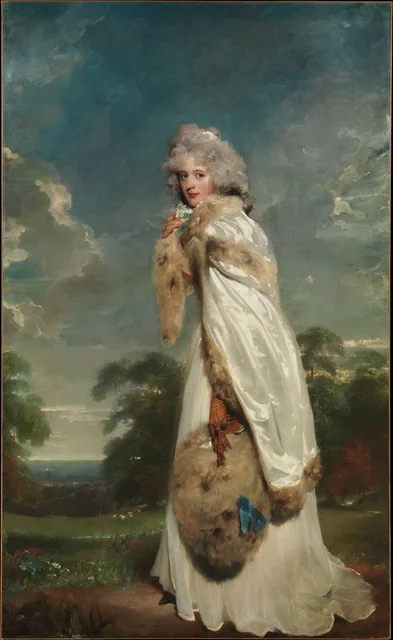 Elizabeth Farren (born about 1759, died 1829), Later Countess of DerbySir Thomas Lawrence1790
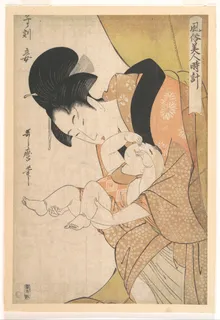 “Hour of the Rat: Mistress,” from the series Women’s Daily Customs (Fuzoku bijin tokei)Kitagawa Utamaro1790
Too good to keep to yourself
This painting,
for someone who comes to mind
They open it at full size
and see every brushstroke.
About this work
- Artist
- Elisabeth Louise Vigée Le Brun · 1755–1842
- Date
- 1789
- Medium
- Oil on canvas
- Size
- 114.3 × 87.6 cm
- Collection
- The Metropolitan Museum of Art
- Image
- Original long edge 4000px · shown at 2560px
- Original
- View on the museum's website ↗