 Pyeongye
At a glance
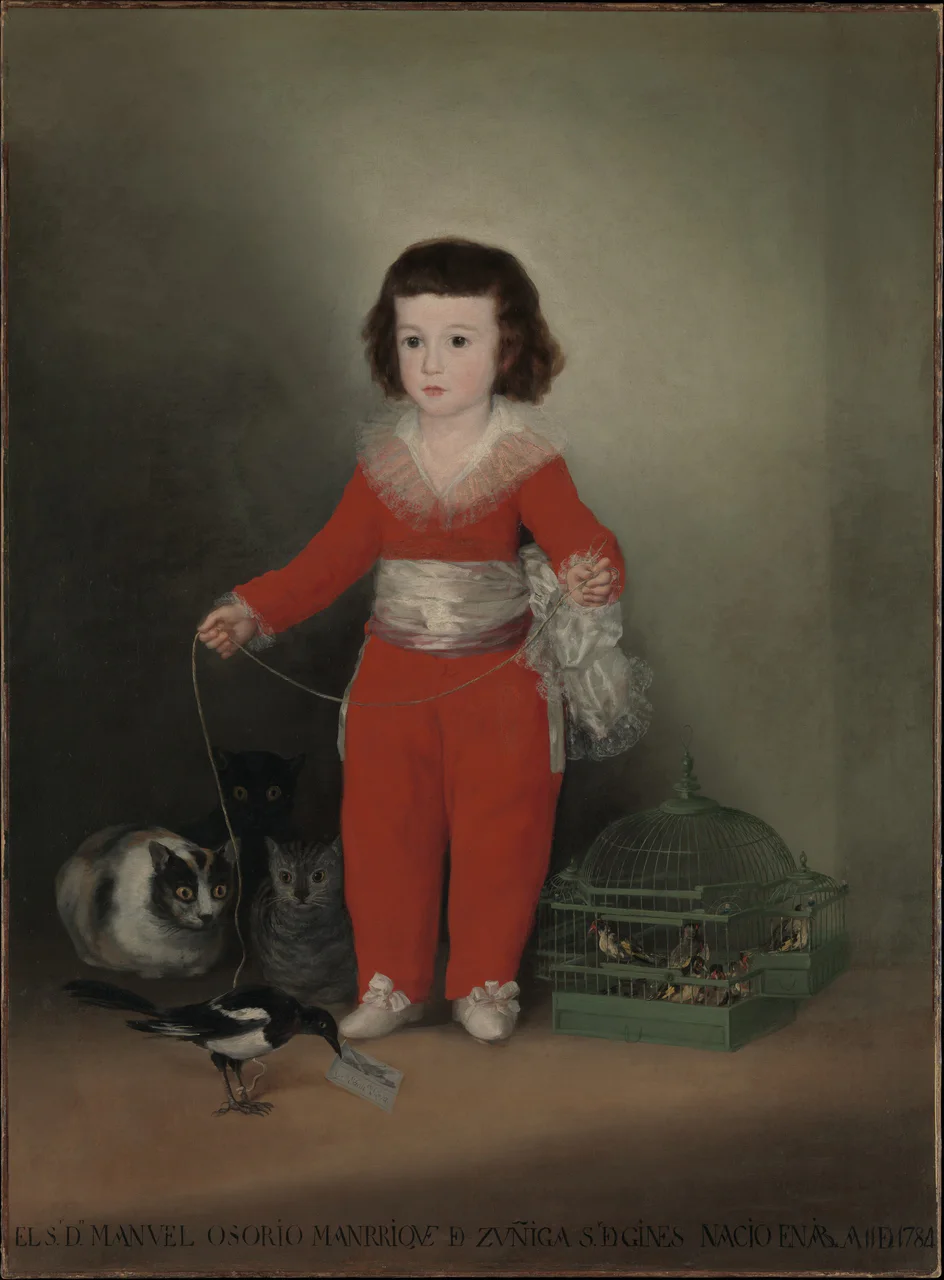
- A small boy in a red suit holds a pet magpie on a string, while three wide-eyed cats sit in the shadows beside him.
- Francisco de Goya painted it in oil on canvas in 1787 to 1788.
- At first it looks like a sweet child's portrait, but with a birdcage, three cats, and a magpie in the scene, it gets more nerve-racking the longer you look.
Reading the picture
5 places to look closer
Tap a number on the painting to jump to its note, or a close-up to see that spot in the whole picture.
Zoom in on the magpie at the lower left. A string is tied to its leg, and the other end is in the boy's hand. In its beak the bird holds a small white card. The card carries Goya's name, so the painter has slipped his signature right into the picture.
Look into the shadows behind the magpie. There is a patchy calico cat, a gray striped cat, and a black cat almost lost in the dark. All three have round, wide-open yellow eyes. You can guess what would happen if the boy let go of the string.
Zoom in on the green birdcage on the right. Small birds with red faces crowd together behind the wires. The magpie is tied, and these birds are caged. Not one bird in this picture is free to fly.
Move up to the boy's face. With his neatly cut bangs, he looks straight at us with dark eyes. His white lace collar, silvery sash, and bright red suit glow against the dark background. He stands very still, as if he has no idea of the tension at his feet.
Look at the band of writing along the bottom. In black capital letters, it gives the boy's name and says in Spanish that he was born on April 11, 1784. The year shows at the far right end.
When it was painted
The Banco de San Carlos in Madrid asked Goya for a set of portraits. The sitters were the bank's directors. One of them was the Count of Altamira, Manuel's father. Goya was about forty at the time.
In 1786, he had been named a painter to the king of Spain. For an artist from Aragon, that was a big step toward the royal court. He was still busy with large designs for the royal tapestry factory. Between those jobs, Madrid's noble families kept asking him for portraits.
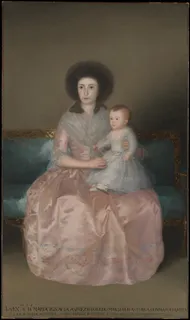
The Altamira family wanted more than the count's picture. Goya also painted the countess with their little daughter on her lap. That portrait now hangs at the Met too, in the same museum as her son.
Manuel was three or four when Goya painted him. He died in 1792. The two years in the title are the whole span of his short life.
Much later, the painting left Spain. It appeared at an auction in Paris in 1878. In time it joined the collection of Jules Bache, a New York banker. When the Bache collection came to the Met in 1949, the little boy in red came with it.
So a story that began with a bank passed through a banker's hands on its way to a museum. Look again at the thin string running from the boy's fingers to the magpie's leg. That one line is all that keeps the bird and the cats apart.
Hidden stories in this painting
Questions to think about
- Look for itFollow the string in the boy's hand. Where does it end?
- Why?Why do you think Goya put three cats eyeing a magpie into a portrait of a noble child?
- What about you?Every bird in this picture is tied or caged. When we keep and cuddle pets today, what might look different if we saw it from the animal's side?
Same period
Painted around the same time,
somewhere else
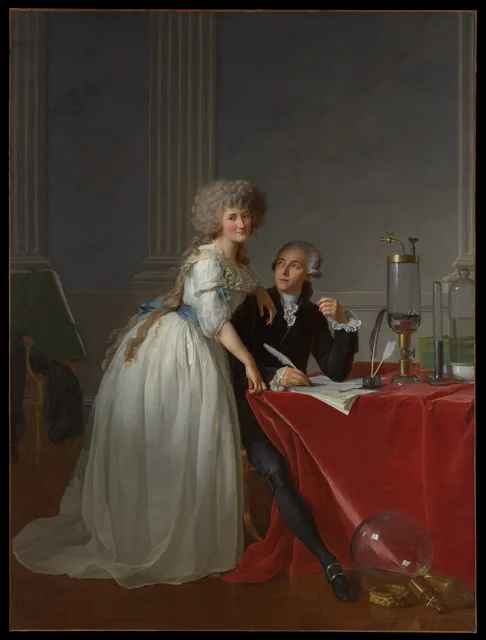 Antoine Laurent Lavoisier (1743–1794) and Marie Anne Lavoisier (Marie Anne Pierrette Paulze, 1758–1836)Jacques Louis David1788
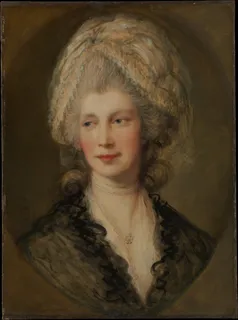 Queen CharlotteThomas Gainsborough1788
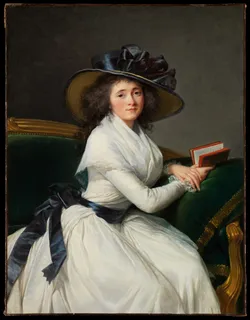 Comtesse de la Châtre (Marie Charlotte Louise Perrette Aglaé Bontemps, 1762–1848)Elisabeth Louise Vigée Le Brun1789
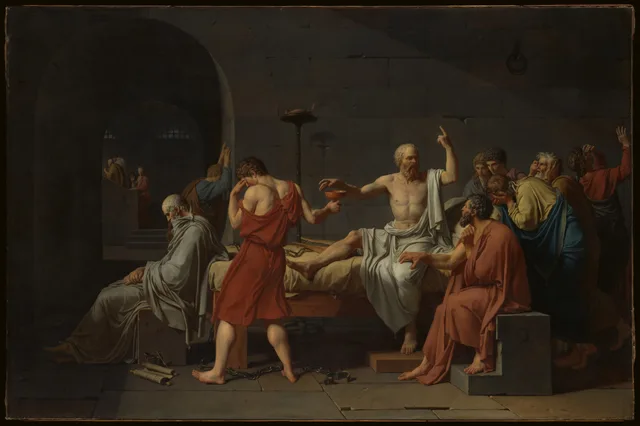 The Death of SocratesJacques Louis David1787
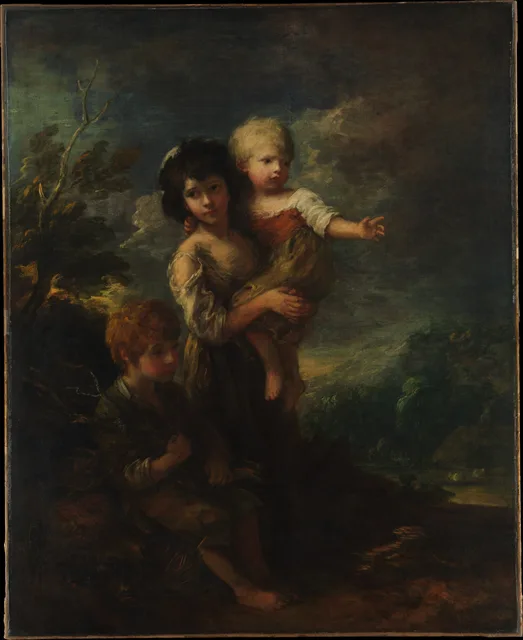 Cottage Children (The Wood Gatherers)Thomas Gainsborough1787
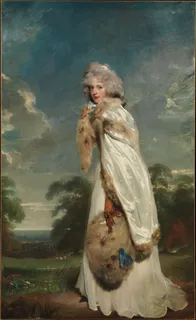 Elizabeth Farren (born about 1759, died 1829), Later Countess of DerbySir Thomas Lawrence1790
Too good to keep to yourself
This painting,
for someone who comes to mind
They open it at full size
and see every brushstroke.
About this work
- Artist
- Goya · 1746–1828
- Date
- 1787–88
- Medium
- Oil on canvas
- Size
- 127 × 101.6 cm
- Collection
- The Metropolitan Museum of Art
- Image
- Original long edge 3873px · shown at 2560px
- Original
- View on the museum's website ↗