 Pyeongye
Artwork · 18th century · Jacques Louis David
LeoTurn on Magnifier at the lower right and move slowly across the painting.
Full screen opens it edge to edge.Tap the painting to fill the screen.
Spread two fingers to look closer.
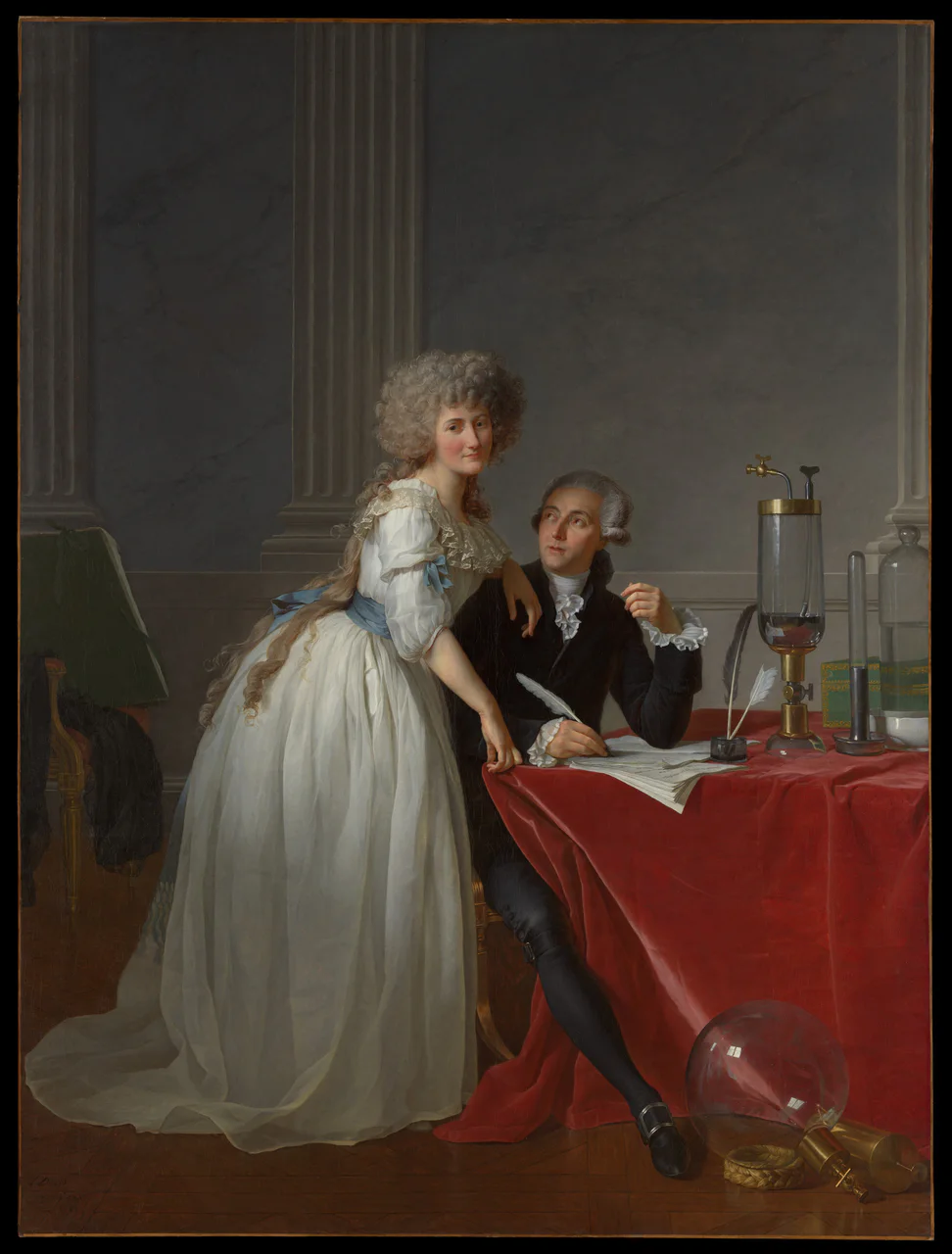
Antoine Laurent Lavoisier (1743–1794) and Marie Anne Lavoisier (Marie Anne Pierrette Paulze, 1758–1836)
Jacques Louis David1788Oil on canvas259.7 × 194.6 cm
At a glance
- The chemist Antoine Lavoisier looks up from his writing at his wife, Marie Anne, who leans on his shoulder and looks out at us.
- Jacques Louis David painted it in 1788, one year before the French Revolution began.
- The canvas is more than 2.5 meters tall, and every glass instrument on the table is painted clearly enough to study.
Reading the picture
5 places to look closer
Tap a number on the painting to jump to its note, or a close-up to see that spot in the whole picture.
Zoom in on the two faces. Marie Anne, with a cloud of powdered curls and a lace collar, tilts her head and looks straight at us. Antoine turns his eyes up toward her. A 2019 study by the museum found that those curls were first painted under a large decorated hat.
Look at Antoine's hand. Under his quill lies a thick stack of papers covered in lines of small handwriting, with an inkwell to the right. He has stopped in the middle of writing and just lifted his head.
Zoom in on the right end of the red velvet table. A tall glass cylinder holding some liquid stands on a brass base. Beside it are a narrow glass tube and a glass bell jar. David painted the light gleaming on the glass and even the red cloth seen through it. The same study showed that these instruments were not in the first version. David added them as he worked.
Now look at the floor at the lower right. A large glass globe rests there, and two windows are reflected on its surface as small white shapes. Next to it lie a braided ring and a brass cylinder with a valve. It is as if the laboratory has spilled into the drawing room.
On the chair at the back left stands a big portfolio with a dark green cover, tied with a ribbon. A portfolio like this held drawings. Marie Anne had studied drawing with David himself.
When it was painted
In 1788 David was forty. Three years earlier his Oath of the Horatii had caused a sensation, and the year before he had painted The Death of Socrates, which now hangs in the same museum as this portrait. The Lavoisiers commissioned him to paint them, and David was paid 7,000 livres, a very large fee.
That year Antoine was forty-five and Marie Anne was thirty. Antoine gave oxygen and hydrogen their names and showed by careful weighing that matter is not lost when it burns or changes form. Marie Anne had married him at thirteen. She translated an English chemistry book into French, and she drew the plates of laboratory equipment for his 1789 chemistry textbook.
But Antoine had another job. He was a tax farmer, one of the private financiers who collected taxes for the crown. The portrait was supposed to appear at the Salon of 1789. As the Revolution turned the mood dangerous, it was kept out of the show.
Five years later, in 1794, Antoine was sent to the guillotine for his role as a tax farmer. Marie Anne's father was executed the same day. Marie Anne went on to gather her husband's chemical papers and publish them.
In the twentieth century the painting crossed the Atlantic. John D. Rockefeller Jr. bought it and gave it to the Rockefeller Institute for Medical Research, and in 1977 the Metropolitan Museum purchased it. Now let your eyes move between the glass instruments on the table and the portfolio at the back left. His experiments and her drawings share the same room.
The painter
Jacques Louis David
1748–1825
When painting this, the artist was about 40 years old
All paintings by Jacques Louis David →More by the same painter
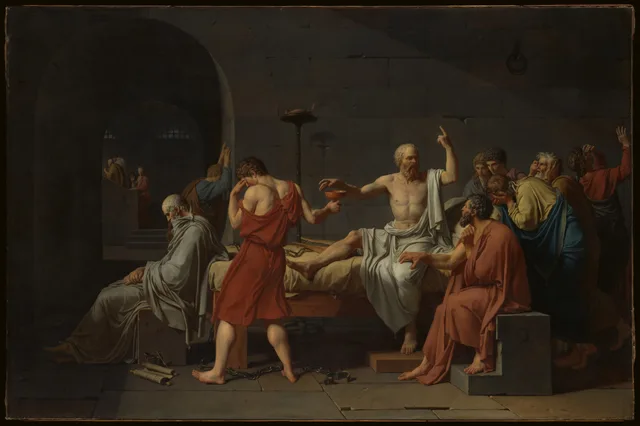
Hidden stories in this painting
Questions to think about
- Look for itCan you spot the two windows reflected in the glass globe on the floor?
- Why?Why do you think David had the wife, not the husband, look out at us?
- What about you?Marie Anne recorded experiments and drew the illustrations, yet for a long time only her husband's name was remembered. How can we make sure everyone who shares in the work gets credit today?
Same period
Painted around the same time,
somewhere else
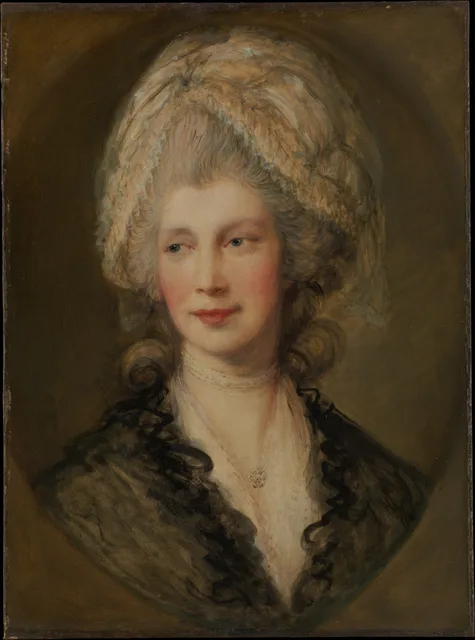 Queen CharlotteThomas Gainsborough1788
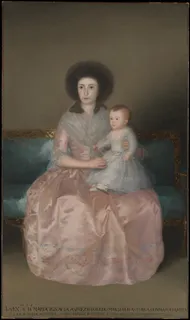 Condesa de Altamira and Her Daughter, María AgustinaGoya1787–88
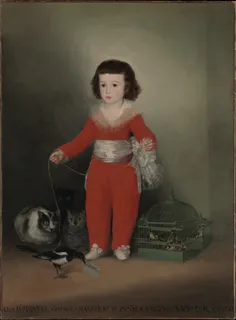 Manuel Osorio Manrique de Zuñiga (1784–1792)Goya1787–88
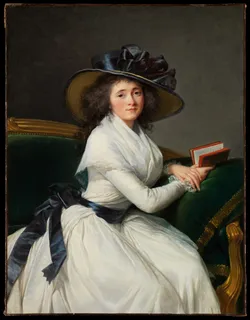 Comtesse de la Châtre (Marie Charlotte Louise Perrette Aglaé Bontemps, 1762–1848)Elisabeth Louise Vigée Le Brun1789
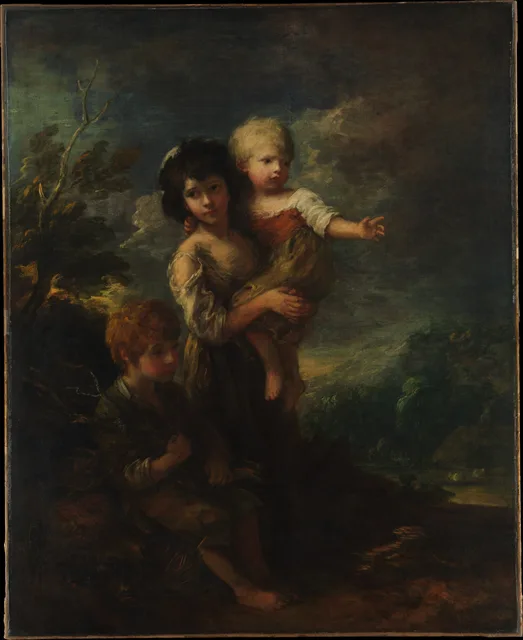 Cottage Children (The Wood Gatherers)Thomas Gainsborough1787
 Elizabeth Farren (born about 1759, died 1829), Later Countess of DerbySir Thomas Lawrence1790
Too good to keep to yourself
This painting,
for someone who comes to mind
They open it at full size
and see every brushstroke.
About this work
- Artist
- Jacques Louis David · 1748–1825
- Date
- 1788
- Medium
- Oil on canvas
- Size
- 259.7 × 194.6 cm
- Collection
- The Metropolitan Museum of Art
- Image
- Original long edge 4000px · shown at 2560px
- Original
- View on the museum's website ↗