 Pyeongye
Artwork · 19th century · Gustave Caillebotte
LeoTurn on Magnifier at the lower right and move slowly across the painting.
Full screen opens it edge to edge.Tap the painting to fill the screen.
Spread two fingers to look closer.
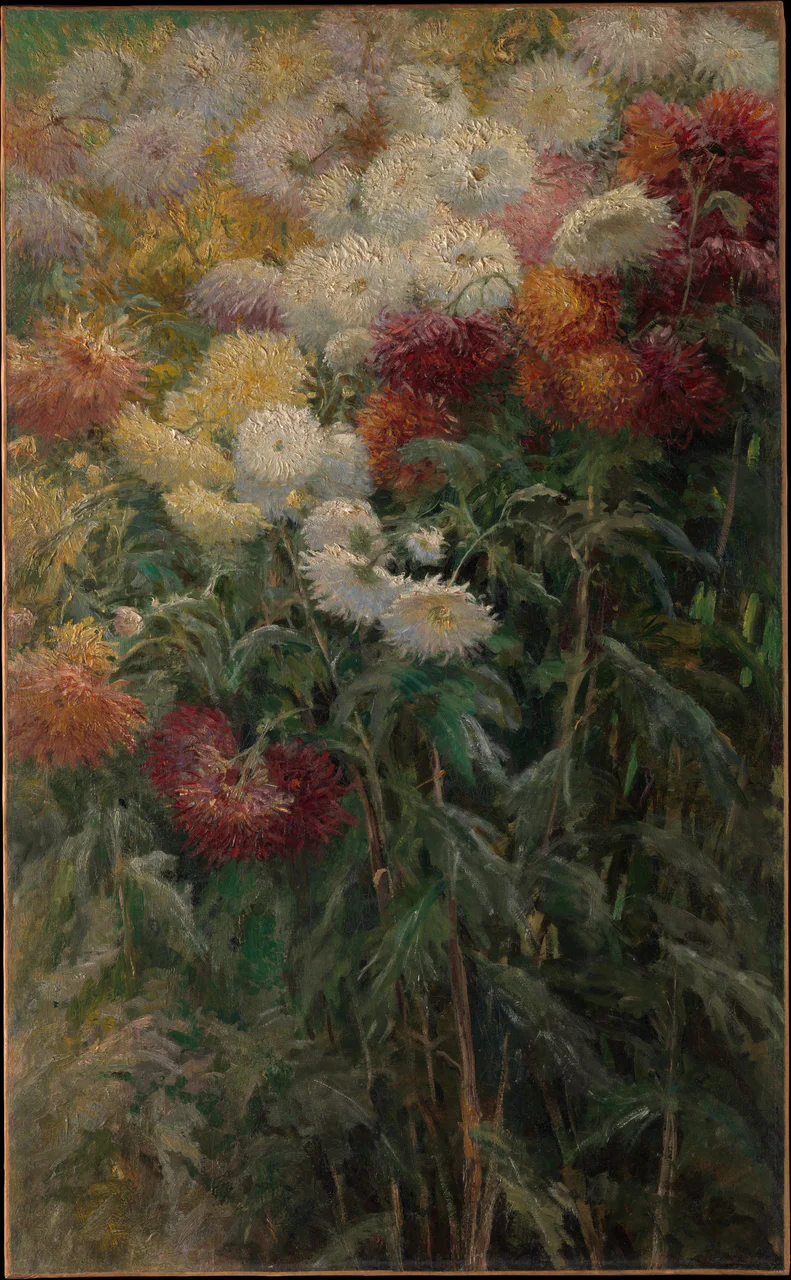
Chrysanthemums in the Garden at Petit-Gennevilliers
Gustave Caillebotte1893Oil on canvas99.4 × 61.6 cm
At a glance
- White, yellow, and deep red chrysanthemums crowd the top of the canvas, while dark stems and leaves tangle below like a small forest.
- The French painter Gustave Caillebotte painted them in 1893, in his own garden at Petit-Gennevilliers, a village on the Seine northwest of Paris.
- There is no sky, no ground, and no pot, only a close-up of the flower bed on a canvas about three feet tall.
Reading the picture
4 places to look closer
Tap a number on the painting to jump to its note, or a close-up to see that spot in the whole picture.
Zoom in on the white blooms near the center. Caillebotte did not paint each petal. He dabbed and dragged thick paint so the petal tips stand up in little ridges. A touch of yellow pools at the heart of each flower. Even the whites hold shadows of lilac and gray.
Look at the deep red chrysanthemum at the lower left. Its heavy head droops toward the ground. Flecks of pink, orange, and gold sit on top of the red, so the flower seems to have depth inside it. A thin stem from above barely holds it up.
Move down to the lower half. The flowers are gone, and only dark green leaves and brown stalks rise in vertical tangles. You cannot see soil or a pot. It feels as if we are crouching inside the bed, looking up at the blooms.
Zoom in on the upper right edge. Orange and dark red chrysanthemums are cut off by the edge of the canvas. A white bloom pushes in front of them, and a green stem runs straight down between. The flower bed seems to keep going beyond the frame.
When it was painted
In 1893 Caillebotte turned forty-five. He had left Paris for his house in Petit-Gennevilliers, on the Seine. Across the river lay Argenteuil, where his friend Claude Monet had once painted. Here Caillebotte designed racing yachts, sailed in regattas, and poured his energy into his garden.
He grew orchids in a greenhouse and painted them onto the doors of his own dining room. The Metropolitan Museum relates this close-up of chrysanthemums to that same project of dining room doors decorated with plants. The decoration was still unfinished when he died.
Monet stands behind the idea. In 1883 Monet had painted panels of flowers and fruit for the doors of the Impressionists' dealer, Paul Durand-Ruel, and Caillebotte had seen them. Monet also built decorative series out of his own garden at Giverny. Both painters were serious gardeners.
Caillebotte died in February 1894, the year after this picture, at forty-five. For years he had bought paintings by his Impressionist friends, and his will left the collection to the French state. The gift set off a long fight. His friend Renoir served as executor, and in the end the state accepted only part of it.
The Honorable John C. Whitehead gave this painting to the Met in 2014. Look again at the dark stems in the lower half. A year before his death, the painter set his eye lower than the flowers and looked up at his own garden.
The painter
Gustave Caillebotte
1848–1894
When painting this, the artist was about 45 years old
All paintings by Gustave Caillebotte →More by the same painter
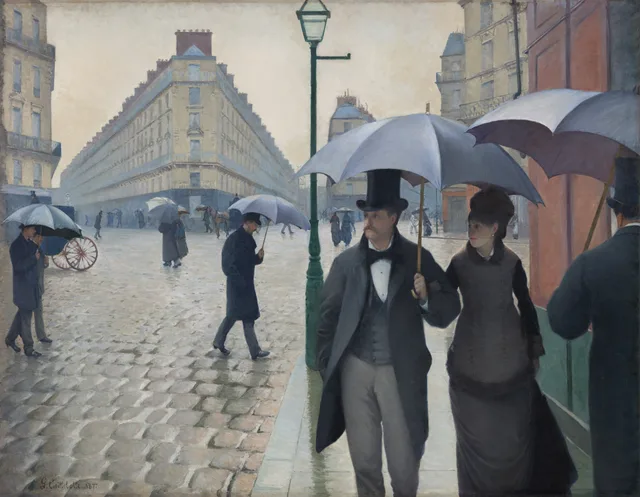
Questions to think about
- Look for itWhich color of chrysanthemum do you see the most of in this picture: white, yellow, or deep red?
- Why?Why do you think Caillebotte left out the sky and the ground and filled the whole canvas with flowers?
- What about you?Caillebotte was wealthy, and he bought his struggling friends' paintings and left them to his country. What are some ways people today can support the artists they care about?
Same period
Painted around the same time,
somewhere else
Too good to keep to yourself
This painting,
for someone who comes to mind
They open it at full size
and see every brushstroke.
About this work
- Artist
- Gustave Caillebotte · 1848–1894
- Date
- 1893
- Medium
- Oil on canvas
- Size
- 99.4 × 61.6 cm
- Collection
- The Metropolitan Museum of Art
- Image
- Original long edge 3876px · shown at 2560px
- Original
- View on the museum's website ↗