Pyeongye

Painters · 19th century
Gustave Caillebotte
1848–1894
A wealthy Parisian who painted rain-slicked new boulevards, sailboats on the Seine and the flowers in his own garden, and who spent his inheritance staging his Impressionist friends' shows and buying their pictures.
Scenes from a life
The life of Gustave Caillebotte,
scene by scene
- 1870Paris
In July 1870 war breaks out between France and Prussia. Gustave Caillebotte has only just qualified to practice law. Instead of opening a practice, he puts on a uniform in the Garde Nationale Mobile de la Seine and serves until March 1871.
His father, Martial, had inherited a family business supplying textiles and bedding to the army, and it had made him rich. He also sat as a judge on the Paris commercial court. But when the son came home from the war, he did not head for a law office. He went to the studio of the painter Léon Bonnat.
- 1875Paris
A large canvas goes before the Salon jury. Three shirtless men kneel on a bare floor, scraping it down by hand. It is The Floor Scrapers, and the jury turns it down.
Caillebotte never sent a picture to the Salon again. His father had died the winter before, leaving him a fortune. The next spring the Impressionists invited him to join them, and he hung The Floor Scrapers in their second exhibition.
- 1876Paris
On 1 November 1876 his younger brother René dies at twenty-five. Two days later, on 3 November, Caillebotte, just twenty-eight, writes his will.
It made two requests. First, money from his estate should pay for an exhibition of the painters called the Impressionists in 1878, and on the most favorable terms possible. Second, his collection of paintings should go to the French state, on condition that the pictures hang in the Musée du Luxembourg and later in the Louvre. He kept on buying his friends' work for years.
- 1877Paris
In April 1877 paintings go up in an empty building at 6 rue Le Peletier. This is the third Impressionist exhibition. Caillebotte rented the rooms and paid the rent and the advertising. He did most of the work of negotiating with the artists and putting the show together.
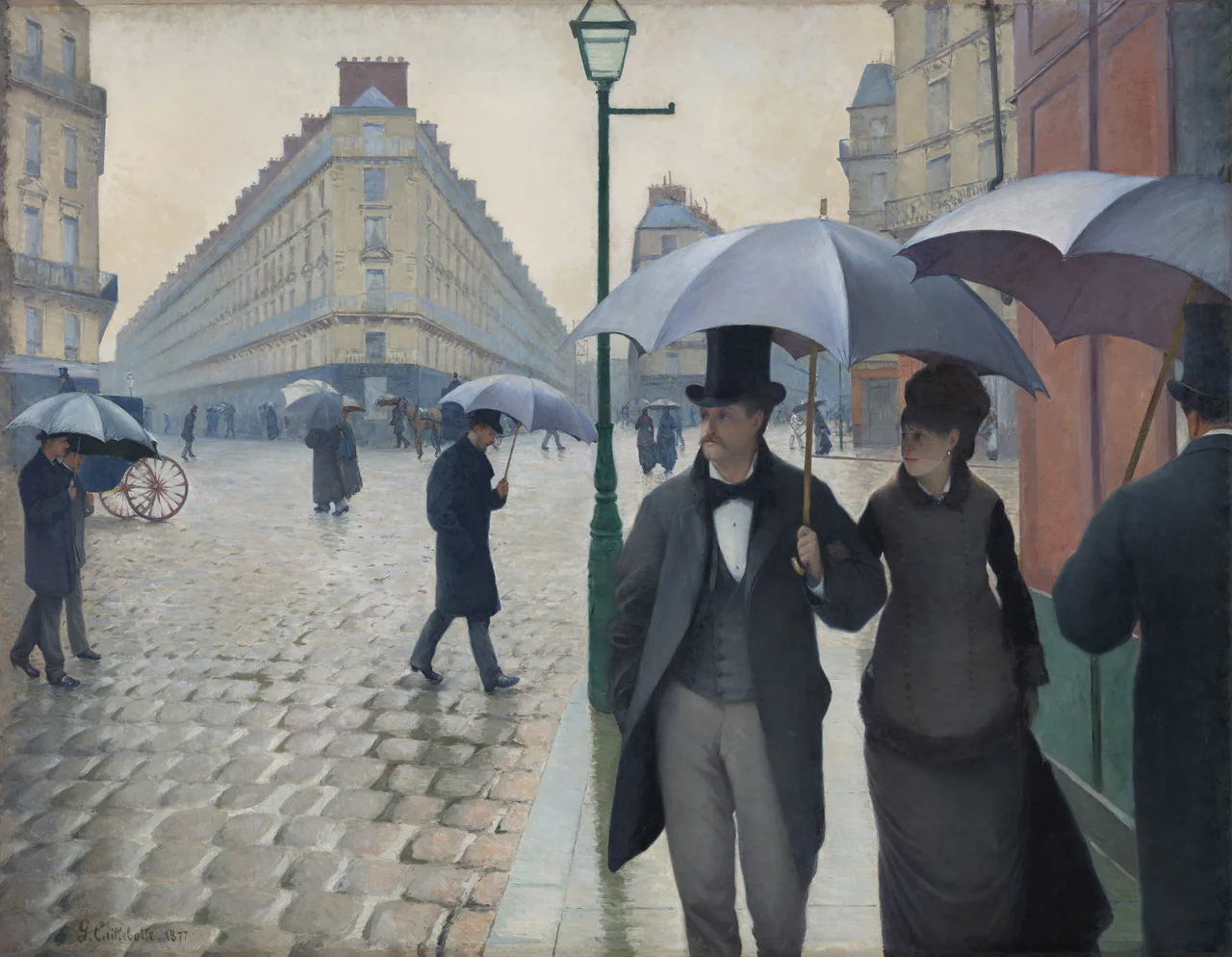
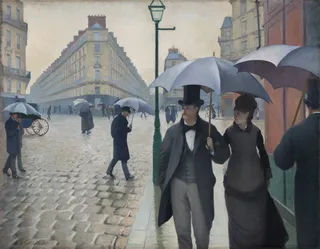
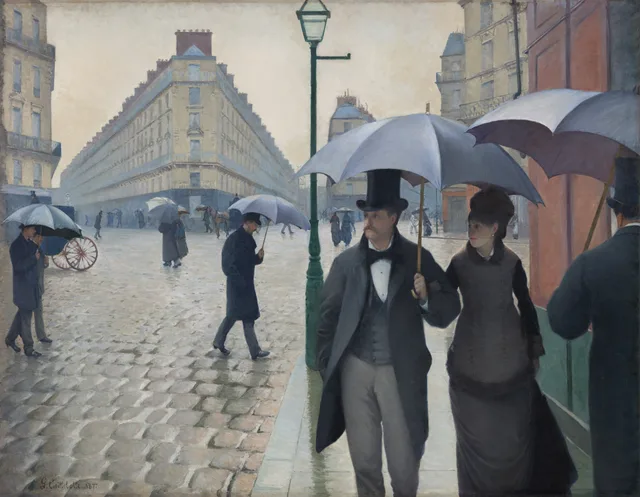
Among his own entries was Paris Street; Rainy Day, a canvas more than two and a half meters wide. Gray umbrellas tilt at almost the same angle. A green lamppost splits the scene in two. Far off on the left, the red spokes of a carriage wheel stand out against the wet paving stones.
 Painted around this timeParis Street; Rainy Day
- 1881Paris
Caillebotte writes a long letter to Camille Pissarro, full of complaints about Edgar Degas. At the center of the quarrel was Jean-François Raffaëlli, a painter Degas insisted on bringing into the show. In the end Caillebotte stayed out of that year's sixth Impressionist exhibition.
Pissarro had not forgotten that Degas had helped him when money was tight. The next year Caillebotte made dropping Raffaëlli a condition of the seventh exhibition. This time it was Degas who stayed away.
- 1881Petit-Gennevilliers
That same year Caillebotte and his youngest brother, Martial, buy a house at Petit-Gennevilliers on the Seine. Across the river lay Argenteuil, where the sailing races were held. A year earlier Caillebotte had become vice president of the Cercle de la Voile de Paris, the city's sailing club.
He designed boats himself. The Roastbeef was one of his designs. His boats won races on the Seine and at Trouville on the Normandy coast. In the late 1880s he gave up his Paris apartment and settled by the river for good, with his companion Charlotte Berthier.
- 1893Petit-Gennevilliers
Caillebotte, a keen gardener, traded letters with his friend Claude Monet. Their letters were packed with questions about which flowers were blooming and how to grow them. Caillebotte built a glass greenhouse and raised orchids in it.
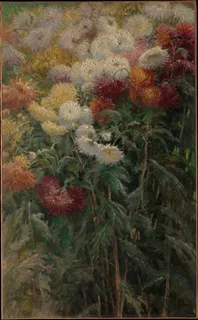
In 1893 he crouched close to his chrysanthemum beds and painted Chrysanthemums in the Garden at Petit-Gennevilliers. White and deep red blooms crowd the top of the canvas. The bottom third is all dark green leaves and stems. There is no sky and no ground.
 Painted around this timeChrysanthemums in the Garden at Petit-Gennevilliers
- 1894Petit-Gennevilliers
On 21 February 1894 Caillebotte dies suddenly at Petit-Gennevilliers, aged forty-five. That year his brother Martial gave Monet one of Gustave's paintings of white and yellow chrysanthemums in his memory. It now hangs in the Musée Marmottan Monet in Paris.
Renoir was the executor. The state did not want all of the sixty-odd Impressionist paintings, and after long talks it took about forty. In 1897 a room of them opened at the Musée du Luxembourg. His rainy street entered the Art Institute of Chicago in 1964, and his chrysanthemums came to the Metropolitan Museum of Art in New York in 2014.
People around them
- Martial Caillebottehis youngest brother, who bought the Petit-Gennevilliers house with him and gave one of his paintings to Monet after his death.
- Pierre-Auguste Renoira fellow Impressionist and the friend he chose as executor of his will.
- Claude Moneta fellow gardener who traded letters with him about flowers.
- Camille Pissarrothe colleague he wrote to at length during the 1881 quarrel with Degas.
- Edgar Degasa colleague he clashed with over who belonged in the Impressionist shows.
- Charlotte Berthierhis companion, who lived with him at Petit-Gennevilliers to the end.
Works
Paintings by
Gustave Caillebotte on Pyeongye
Hidden stories in Gustave Caillebotte's paintings