 Pyeongye
Artwork · 19th century · Pierre Puvis de Chavannes
LeoTurn on Magnifier at the lower right and move slowly across the painting.
Full screen opens it edge to edge.Tap the painting to fill the screen.
Spread two fingers to look closer.
At a glance
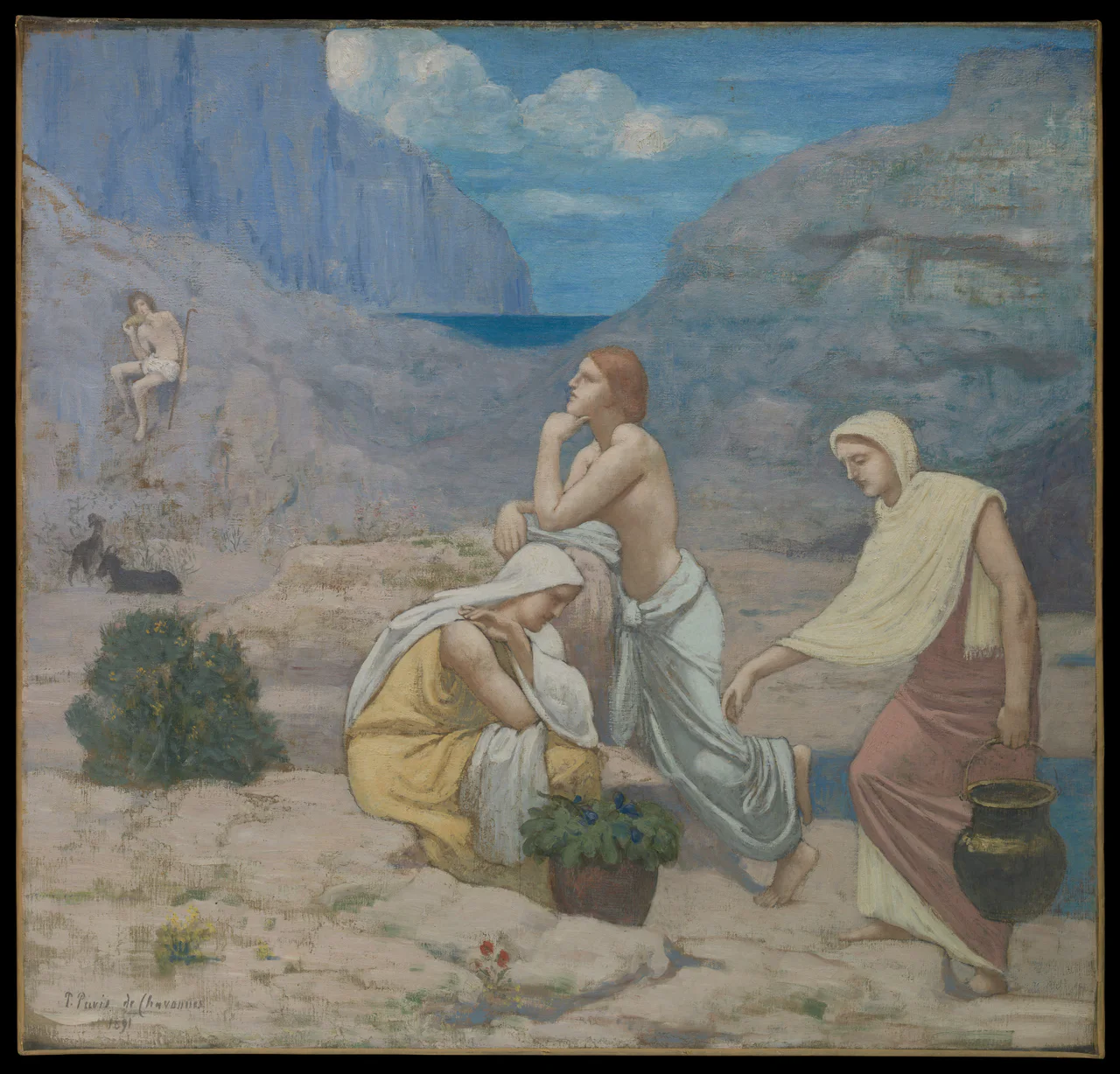
- On a rocky slope above the sea, a distant shepherd plays a pipe while a young man and two women stay still and listen.
- Pierre Puvis de Chavannes painted it in 1891.
- Almost nothing happens, yet soft blues and pinks build a quiet you want to stay inside.
Reading the picture
5 places to look closer
Tap a number on the painting to jump to its note, or a close-up to see that spot in the whole picture.
Zoom in on the upper left slope. A shepherd wearing only a white cloth around his hips sits on a rock and holds a small pipe to his mouth. A staff with a curved top leans beside him. The song in the title comes from this tiny figure.
Now look at the young man in the middle. He leans his elbow on a rock and rests his chin on his hand, gazing into the distance. His mouth is closed and his body is still. This may be what listening looks like.
At his feet a woman crouches, resting her head on her arms. She wears a yellow dress with a white cloth over it. In front of her stands a pot of plants with blue flowers. The paint is so thin here that you can see the weave of the canvas through the folds of her dress.
Look at the woman on the right. She wears a pink robe and a pale yellow shawl, and she carries a dark metal jar by its handle. Her other hand reaches forward lightly. She seems to have stopped on her way to fetch water, caught by the music.
Zoom in on the lower left corner. In gray letters the painter wrote his name, P. Puvis de Chavannes, and the year 1891. Even the signature keeps to the calm colors of the picture.
When it was painted
In 1891 Pierre Puvis de Chavannes was well into his sixties. Born in Lyon, he had made his name in Paris with enormous murals for public buildings such as the Panthéon and the Sorbonne. He painted those murals on canvas and then fixed the canvas to the wall. The same pale, chalky color fills this much smaller picture.
The roots of this painting lie in his home city. In the early 1880s the city of Lyon asked him to decorate the grand new staircase of its art museum. One of the murals he painted there, A Vision of Antiquity, imagines early Greece as a calm, sunlit dream. The Metropolitan Museum explains that The Shepherd's Song adapts its composition from that Lyon mural.
Another mural on the same staircase, The Sacred Grove, Beloved of the Arts and the Muses, caught the eye of younger painters. The Art Institute of Chicago counts it among the inspirations for Georges Seurat's A Sunday on La Grande Jatte. In 1891 Puvis also became president of the Société Nationale des Beaux-Arts, a new exhibiting society in Paris.
The canvas soon went to the dealer Paul Durand-Ruel, the man who had helped bring the Impressionists to American buyers. It was sold in February 1892. In 1906 the Metropolitan Museum bought it.
In the 1890s Puvis took on one more staircase, this time across the ocean, at the Boston Public Library. Now look again at the tiny shepherd at the upper left. His tune began on a museum staircase in Lyon and has traveled a long way to reach you.
The painter
Pierre Puvis de Chavannes
1824–1898
When painting this, the artist was about 67 years old
All paintings by Pierre Puvis de Chavannes →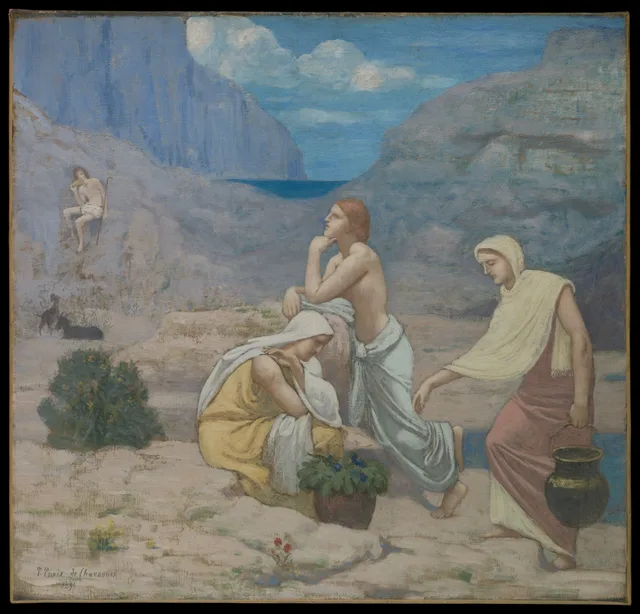
Questions to think about
- Look for itCan you find the dark animals on the left slope, above the green bush?
- Why?Why do you think the painter made the shepherd, the one who is actually singing, the smallest and farthest figure in the picture?
- What about you?Nobody in this picture speaks, yet they all share the same sound. When was the last time you listened to music with someone, without phones, and just stayed quiet together?
Same period
Painted around the same time,
somewhere else
Too good to keep to yourself
This painting,
for someone who comes to mind
They open it at full size
and see every brushstroke.
About this work
- Artist
- Pierre Puvis de Chavannes · 1824–1898
- Date
- 1891
- Medium
- Oil on canvas
- Size
- 104.5 × 109.9 cm
- Collection
- The Metropolitan Museum of Art
- Image
- Original long edge 4000px · shown at 2560px
- Original
- View on the museum's website ↗