 Pyeongye
Artwork · 19th century · Claude Monet
LeoTurn on Magnifier at the lower right and move slowly across the painting.
Full screen opens it edge to edge.Tap the painting to fill the screen.
Spread two fingers to look closer.
At a glance
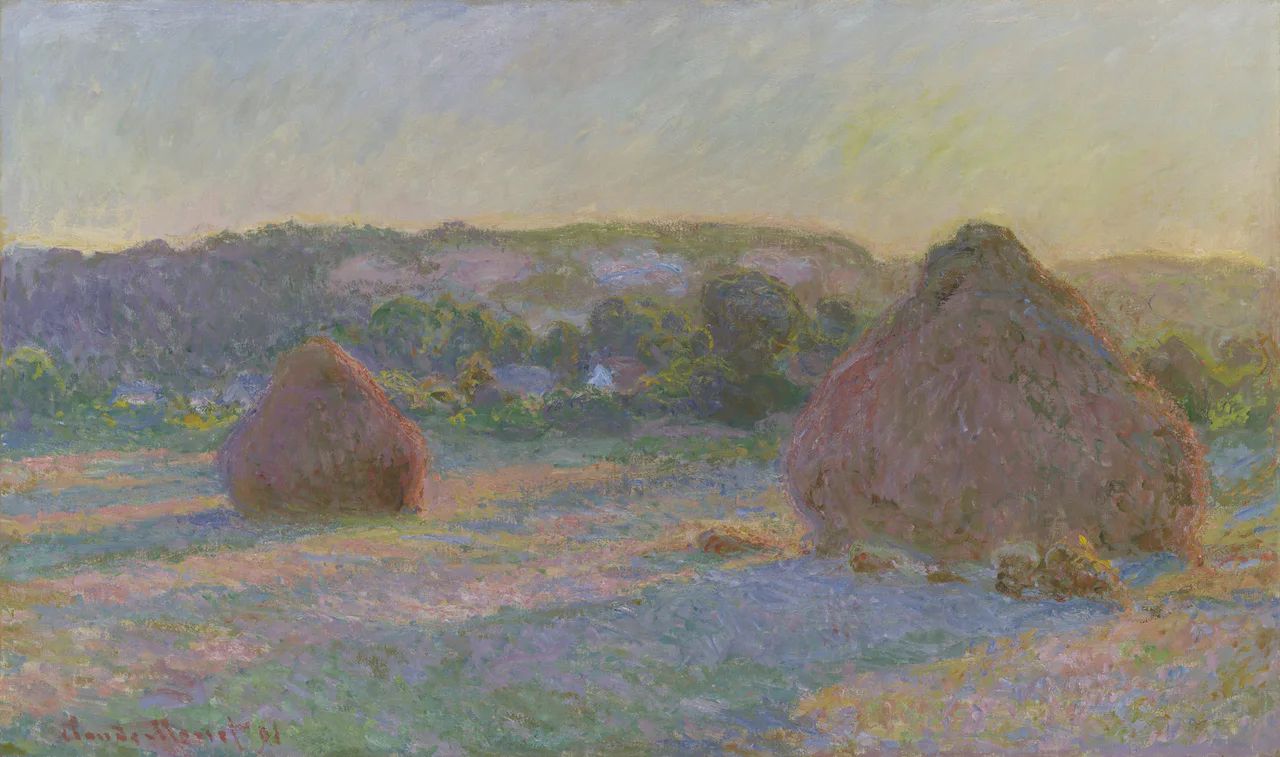
- Two huge stacks of wheat stand in a field at the end of summer, lit from behind.
- Claude Monet painted them in 1890–91 in the field right outside his farmhouse at Giverny, France.
- It belongs to a series of the same stacks in different seasons and hours, so you can watch one ordinary object change as the light changes.
Reading the picture
4 places to look closer
Tap a number on the painting to jump to its note, or a close-up to see that spot in the whole picture.
Start at the top of the big stack on the right. Its pointed cap breaks the line of the hills and pushes up into the sky. A thin thread of orange runs along its upper edge. That glow tells you the sun is behind the stack, not in front of it. The real stacks rose fifteen to twenty feet, several times taller than a person.
Now look at the smaller stack on the left. Its body is not brown at all. It is built from pinks, violets, and greens. Only the right-hand edge flares a warm red-orange. Monet did not paint what color wheat is supposed to be. He painted the color the light made it at that moment.
Zoom in at the foot of the big stack. A few loose bundles of straw lie on the ground. In front of them a long shadow stretches toward you, and it is blue, the blue of the sky, not gray or black. A few quick yellow strokes flicker beside the bundles like stray stalks catching the sun.
Drop down to the bottom left corner. In red paint you can read Claude Monet and the number 91. That is the year he finished the canvas, 1891. Notice that the red of the signature belongs to the same family as the red on the rims of the stacks.
When it was painted
In 1890 Monet turned fifty. Since 1883 he had rented a farmhouse in Giverny, a village northwest of Paris. That November he finally bought it. The stacks stood in the field just outside.
He went after them with a small crowd of canvases. Several easels stood in the field at once, each one waiting for its own kind of light. When the sun moved and the colors shifted, he moved to the next canvas.
In October he wrote to his friend, the critic Gustave Geffroy. He was stubbornly at work on a series of stacks, he said, but at that time of year the sun went down so fast he could not keep up. He kept going into winter anyway, and the snowy views became the heart of the series. Back in the studio he reworked the canvases until their colors held together.
In May 1891 he hung fifteen of them side by side in one small room at the Durand-Ruel gallery in Paris. This painting was number one in the catalogue. The show was an unprecedented success with critics and buyers, and it marked a breakthrough in his career. Next he painted poplar trees and the front of Rouen Cathedral the same way, again and again.
Some of the keenest buyers came from Chicago. Collectors such as Bertha Palmer took several stacks home, and today the Art Institute of Chicago holds the largest group of the series in the world. This canvas hung in a Monet loan show in Boston in 1905. In 1985 Arthur M. Wood Sr. gave it to the Art Institute in memory of Pauline Palmer Wood.
Look once more between the two stacks. A few white rooftops peek through the trees beyond the field. What Monet painted over and over was this ordinary corner of farmland.
More by the same painter
Questions to think about
- Look for itUsing the glowing edges and the direction of the shadows, can you work out where the sun is?
- Why?Why would Monet paint something as plain as a stack of wheat over and over instead of a grand view?
- What about you?Does the street you walk every day look different at 7 a.m. and 7 p.m.? If you photographed the same spot three times a day, what do you think would change?
Same period
Painted around the same time,
somewhere else
Too good to keep to yourself
This painting,
for someone who comes to mind
They open it at full size
and see every brushstroke.
About this work
- Artist
- Claude Monet · 1840–1926
- Date
- 1890–91
- Medium
- Oil on canvas
- Size
- 60 × 100.5 cm
- Culture
- France
- Collection
- The Art Institute of Chicago
- Image
- Original long edge 6884px · shown at 2560px
- Original
- View on the museum's website ↗