 Pyeongye
Artwork · 19th century · Paul Cézanne
LeoTurn on Magnifier at the lower right and move slowly across the painting.
Full screen opens it edge to edge.Tap the painting to fill the screen.
Spread two fingers to look closer.
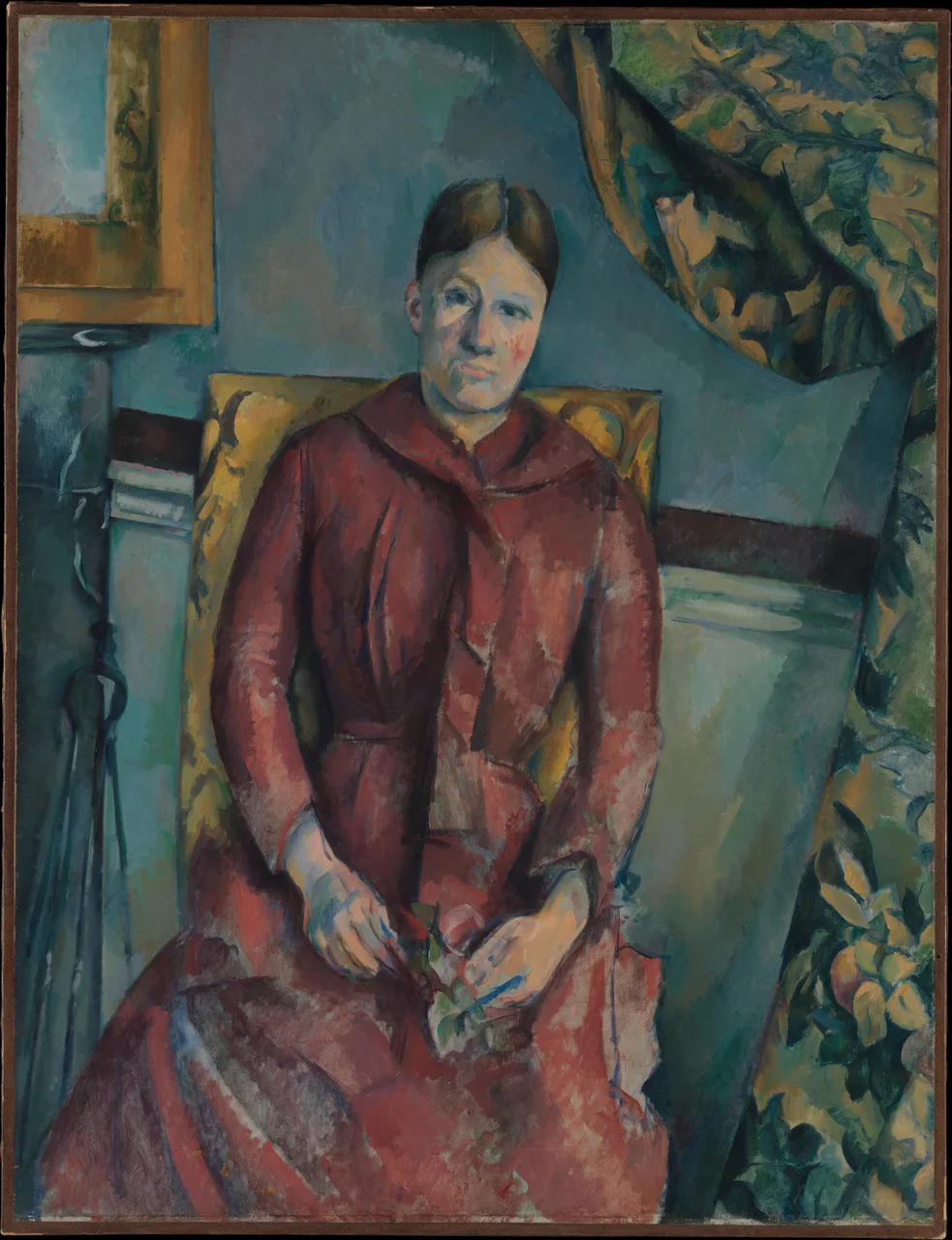
Madame Cézanne (Hortense Fiquet, 1850–1922) in a Red Dress
Paul Cézanne1888–90Oil on canvas116.5 × 89.5 cm
At a glance
- A woman in a red dress sits upright in a yellow armchair, her hands gathered in her lap.
- The French painter Paul Cézanne painted his wife, Hortense Fiquet, in oil on canvas in 1888–90.
- The lines of the wall, the chair, and the curtain don't quite agree with one another. The longer you look, the stranger and more interesting the room becomes.
Reading the picture
4 places to look closer
Tap a number on the painting to jump to its note, or a close-up to see that spot in the whole picture.
Get close to her face. Her hair is parted in the middle, and her face is a long oval. The shadows under her eyes and beside her nose are painted in blues and greens. A few pink strokes sit on her cheeks. She neither smiles nor frowns.
Zoom in on the hands in her lap. Her fingers hold what looks like a small flower, with green leaves and touches of pink. A thick blue stroke runs across the back of one hand. Cézanne didn't outline the hands carefully. He built them from patches of color laid side by side.
Now compare the walls on either side of her, at shoulder height. On the left, a dark band runs level with her shoulder. On the right, the band sits clearly lower. It is one room, yet the lines don't meet. Even the yellow chair behind her seems to tilt a little against her body.
Move up to the right. A large curtain sweeps down at an angle. Big leaf shapes in dark green and blue spread across an ocher ground. Broad strokes all run the same way, so the pattern almost seems to move.
When it was painted
In 1888, Cézanne, then forty-nine, took an apartment on the Île Saint-Louis, the little island in the middle of the Seine in Paris. The address was 15 quai d'Anjou, and he rented it until 1890. The Met identifies the room in this painting as that apartment. The woman in the chair is his wife, Hortense Fiquet.
Their story began long before. Hortense met Cézanne in Paris around 1869, and their son, Paul, was born in 1872. Yet for years Cézanne kept this little family a secret from his strict father. Many biographers believe he was afraid of losing the allowance his father sent him.
The couple finally married in the spring of 1886. That autumn his father died, and Cézanne inherited a fortune that ended his money worries. This portrait came a couple of years after the two had at last become an openly married couple.
In this apartment Cézanne painted Hortense four times in the same red dress. Of those four, this is the only one set in a richly furnished room. The Met bought the painting in 1962.
Twenty-nine painted portraits of Hortense by Cézanne are known. In 2014 the Met gathered more than twenty of them for an exhibition named after her. The model who had long stood in the painter's shadow had a show of her own.
Look again at the room. The gilded frame at the upper left, the big curtain at the upper right, and the yellow chair behind her fill the space around her. And in the middle sits the woman who had been at his side for nearly twenty years.
More by the same painter
Questions to think about
- Look for itCan you find the place on the wall behind her where the heights don't match?
- Why?Why might Cézanne have left the lines of the room out of line instead of straightening them?
- What about you?When someone models for a painting or a photo for a long time, how should their time and feelings be respected?
Same period
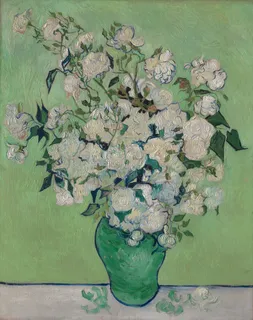
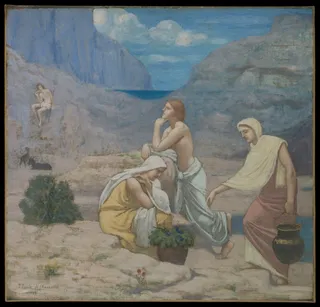
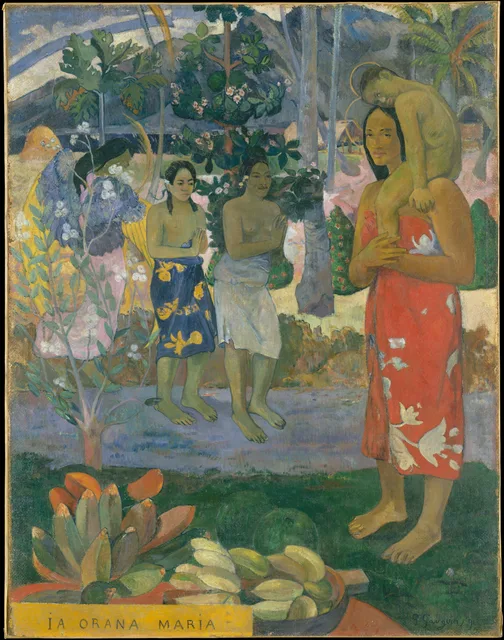
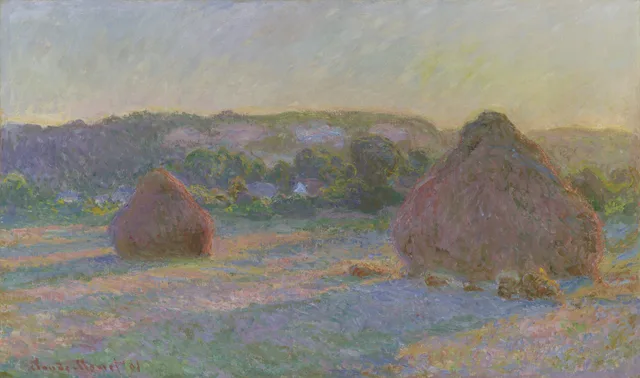
Painted around the same time,
somewhere else
Too good to keep to yourself
This painting,
for someone who comes to mind
They open it at full size
and see every brushstroke.
About this work
- Artist
- Paul Cézanne · 1839–1906
- Date
- 1888–90
- Medium
- Oil on canvas
- Size
- 116.5 × 89.5 cm
- Collection
- The Metropolitan Museum of Art
- Image
- Original long edge 3877px · shown at 2560px
- Original
- View on the museum's website ↗