 Pyeongye
Artwork · 19th century · Frederic Edwin Church
LeoTurn on Magnifier at the lower right and move slowly across the painting.
Full screen opens it edge to edge.Tap the painting to fill the screen.
Spread two fingers to look closer.
At a glance
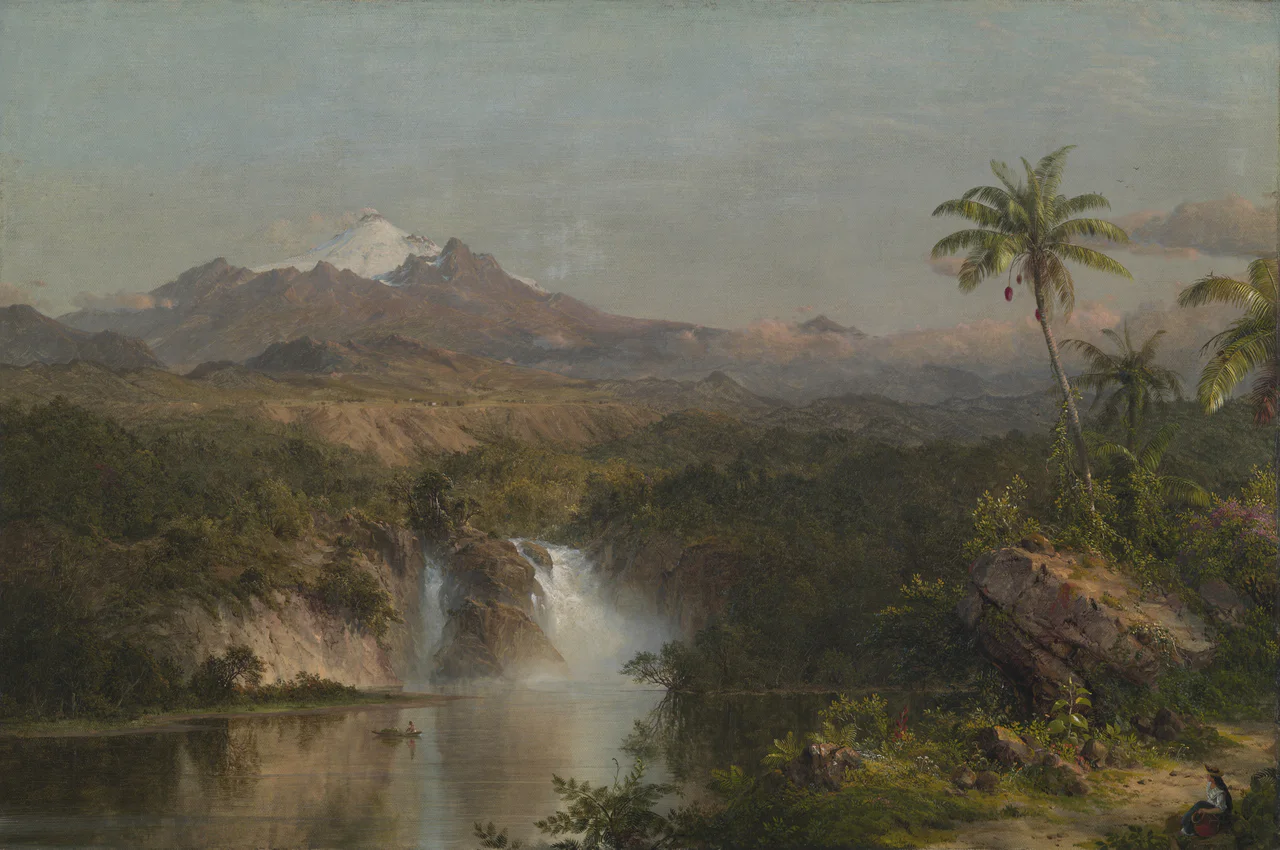
- A snow-capped volcano, Cotopaxi, rises far off above a waterfall, a still lake, and palm trees in tropical Ecuador.
- The American painter Frederic Edwin Church finished it in 1857, just before his second trip to South America.
- Look closely and the picture keeps giving: a thread of smoke on the peak, a tiny boat on the lake, a girl with a red container in the corner.
Reading the picture
5 places to look closer
Tap a number on the painting to jump to its note, or a close-up to see that spot in the whole picture.
Start at the far mountain. A cone of white snow sits above the brown ridges, and from its tip a faint pinkish wisp drifts into the sky. Cotopaxi is an active volcano. Church gives it just a breath of smoke, small but unmistakable.
Now drop down to the waterfall. The water splits around a big boulder and falls in two streams. At the bottom it turns into white mist that swallows the base of the rock. Compare the hard brown planes of the stone with the soft, edgeless spray.
Search the left side of the lake for a very small boat. A figure leans forward in a long, narrow craft piled with something green. The reflection hangs upside down in the calm water. Without this little boat, it would be hard to tell how big the falls really are.
Look up at the palm on the right. Clusters of red fruit dangle below the crown. Each long frond is drawn with a fine central rib and thin, separate leaflets. On his travels in South America, Church filled sheets with pencil and oil sketches of plants like this.
Finish in the bottom right corner. A girl in a straw hat and a white blouse sits on the ground with her hand on a red container. She turns her head left, toward the waterfall. Without noticing, we end up looking at the scene the same way she does.
When it was painted
In 1857 Church was thirty-one. That spring in New York he showed a huge canvas of Niagara Falls, and crowds came to see it. Almost overnight, the young landscape painter was a name people knew.
The person who sent him south was the German naturalist Alexander von Humboldt. Humboldt had explored the Andes and argued that everything in nature is connected, from rocks to plants to weather. Church read him closely, and in 1853 he made his first trip to Colombia and Ecuador.
Back home, he worked from the sketches he had brought with him. According to the Art Institute of Chicago, Church painted at least ten finished pictures of this one volcano. He completed this canvas in his studio shortly before setting out again in 1857, this time with the painter Louis Rémy Mignot.
The painting found its way to Chicago early. A Chicago paper mentioned it in June 1859. In the fall of 1863, in the middle of the Civil War, it hung in the art display of Chicago's Sanitary Fair, a fundraiser for the care of Union soldiers. It entered the Art Institute in 1919, and for a while the museum's guidebooks of the 1920s listed it simply as South America.
The museum also points out something less comfortable. In those years, American officials were eyeing Latin America as land to expand into, and the museum sees that ambition in pictures like this one. With that in mind, look again at the girl in the corner. In front of a mountain and a waterfall built to amaze, the people Church painted are among the smallest things on the canvas.
The painter
Frederic Edwin Church
1826–1900
When painting this, the artist was about 31 years old
All paintings by Frederic Edwin Church →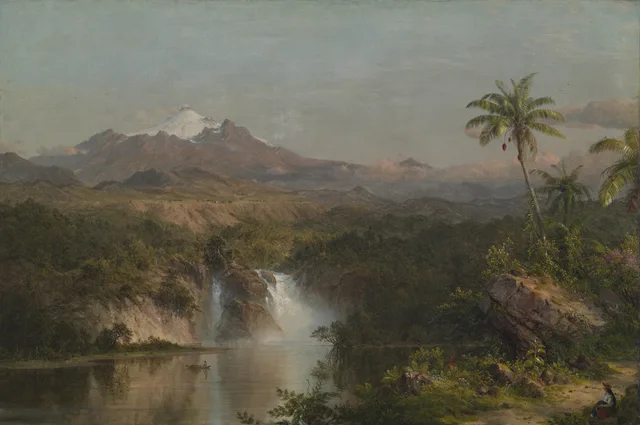
Hidden stories in this painting
Questions to think about
- Look for itHow many people can you find hidden in this landscape?
- Why?Why do you think Church put the volcano, the subject of the title, so small and so far up in the left corner?
- What about you?When we post a beautiful photo from a trip, how much of the lives of the people who live there ends up in the picture?
Same period
Painted around the same time,
somewhere else
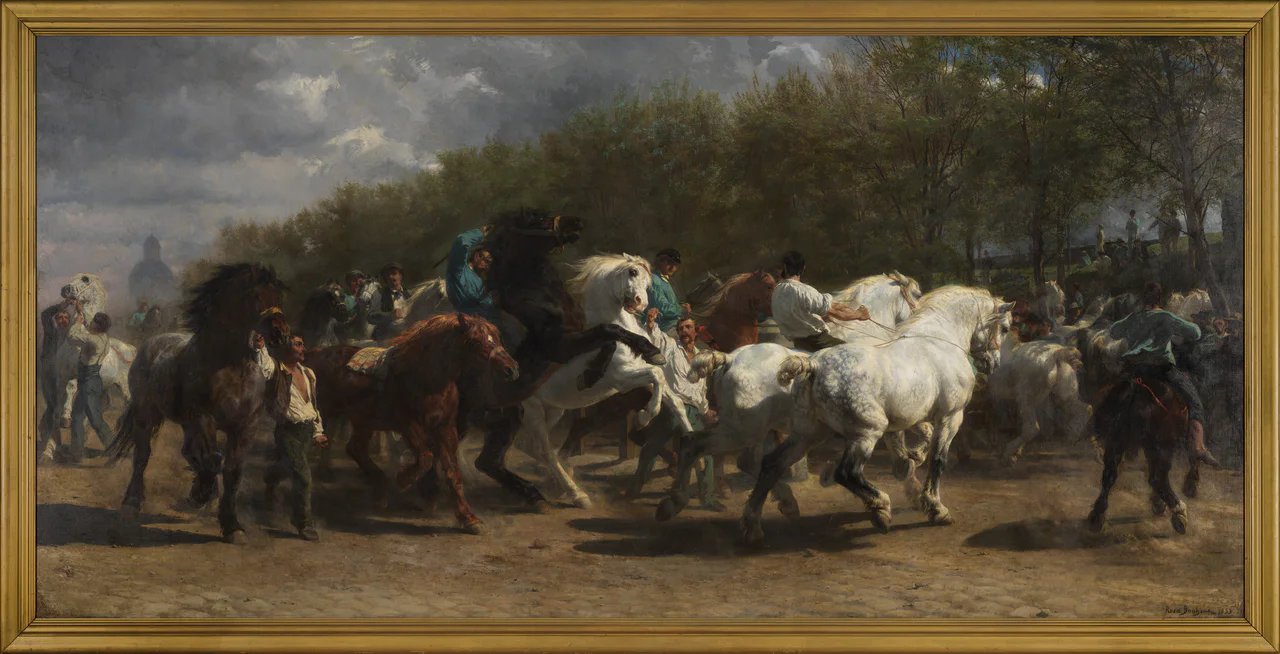 The Horse FairRosa Bonheur1852–55
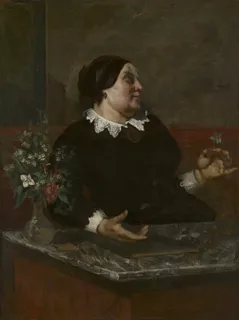 Mère GrégoireGustave Courbet1855, reworked 1857–59
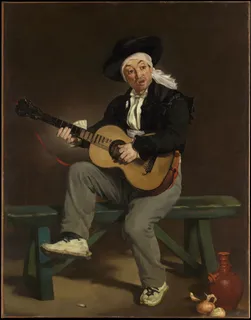 The Spanish SingerEdouard Manet1860
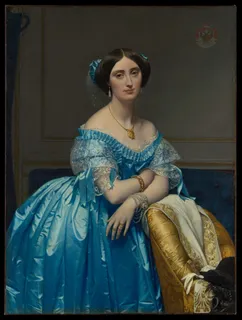 Joséphine-Éléonore-Marie-Pauline de Galard de Brassac de Béarn (1825–1860), Princesse de BroglieJean Auguste Dominique Ingres1851–53
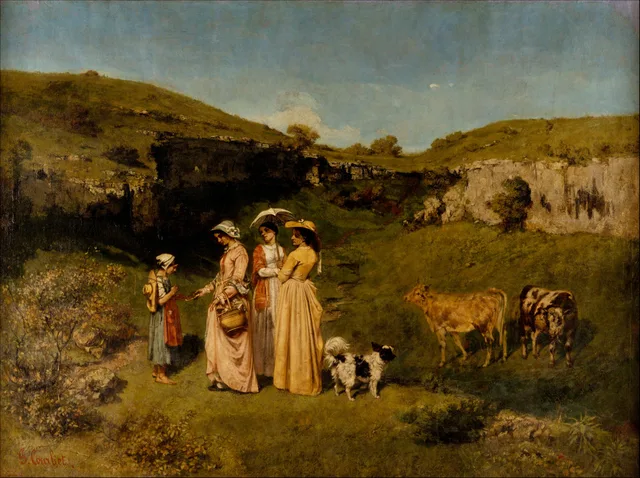 Young Ladies of the VillageGustave Courbet1851–52
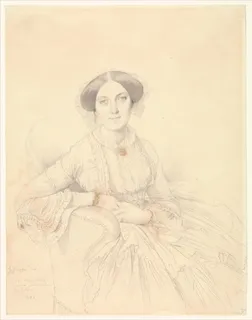 Madame Félix GalloisJean Auguste Dominique Ingres1852
Too good to keep to yourself
This painting,
for someone who comes to mind
They open it at full size
and see every brushstroke.
About this work
- Artist
- Frederic Edwin Church · 1826–1900
- Date
- 1857
- Medium
- Oil on canvas
- Size
- 62.2 × 92.7 cm
- Culture
- United States
- Collection
- The Art Institute of Chicago
- Image
- Original long edge 8511px · shown at 2560px
- Original
- View on the museum's website ↗