 Pyeongye
Artwork · 19th century · Gustave Courbet
LeoTurn on Magnifier at the lower right and move slowly across the painting.
Full screen opens it edge to edge.Tap the painting to fill the screen.
Spread two fingers to look closer.
At a glance
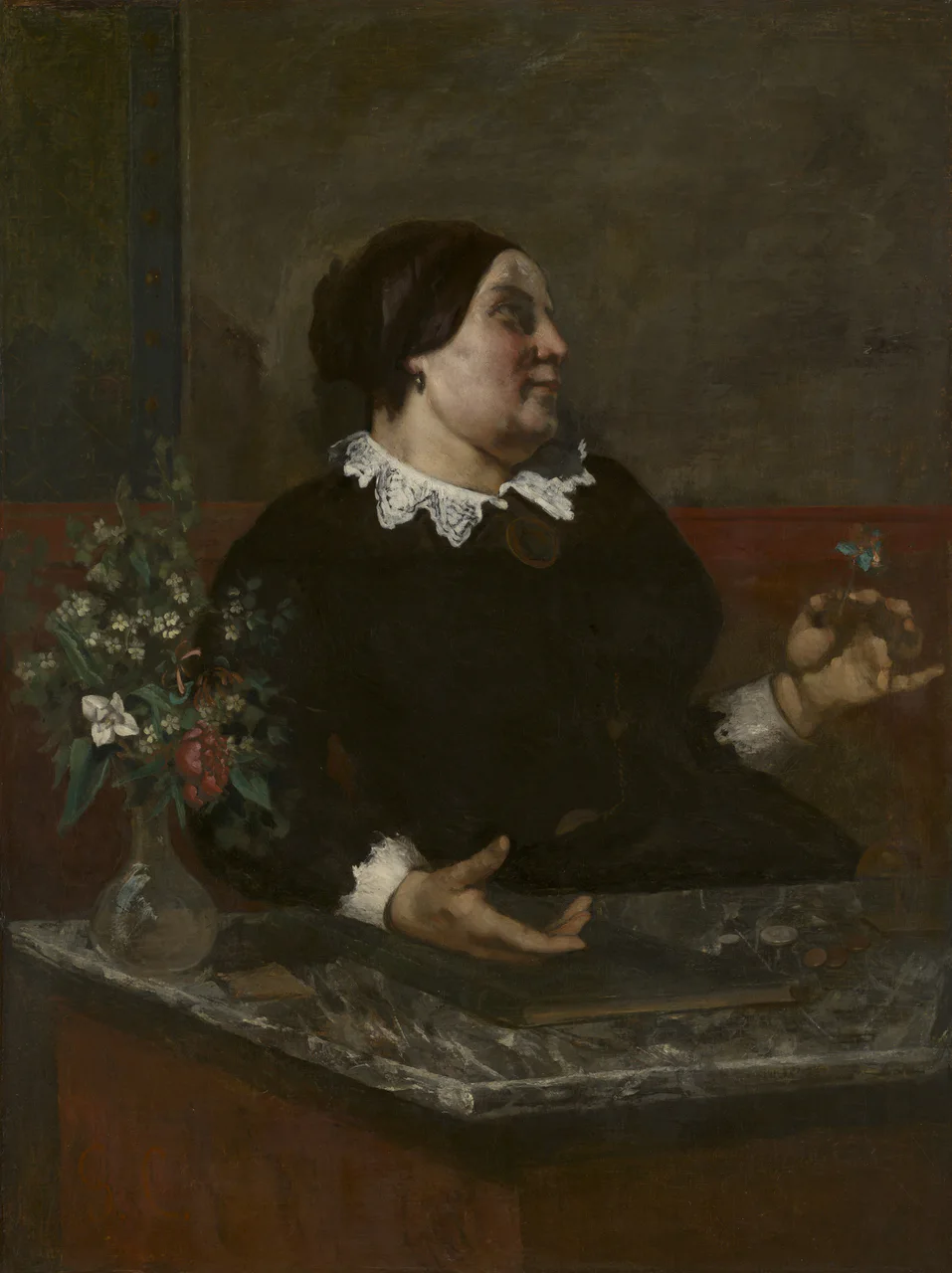
- A large woman in black with a white lace collar sits behind a marble counter, holding up a tiny flower and looking at someone we cannot see.
- Gustave Courbet began it in 1855 as just a head, then enlarged the canvas and turned it into a full scene between 1857 and 1859.
- The heroine comes from a popular song of the 1820s, and the coins, the ledger, and the little flower each carry part of her story.
Reading the picture
5 places to look closer
Tap a number on the painting to jump to its note, or a close-up to see that spot in the whole picture.
Start with her face. She turns to the right and looks past the edge of the picture, with the hint of a smile at her mouth. A small earring catches the light, and her lace collar is built from quick, dabbed strokes of white. Below it sits a round brooch.
Look at the raised hand on the right side of the canvas. Between her fingers she holds a very small flower. Its petals are blue, touched with flecks of red. The Art Institute reads it as carrying the blue, white, and red of the French flag.
Now drop to her right hand on the counter. It lies palm up, as if waiting to receive something, and under it is a thick ledger. The marble below is scraped and streaked with grays and whites so you can feel its veins.
Move to the right end of the counter. A few brown coins are scattered there, next to a round object that shines silver. Money is changing hands right now.
Finish with the bouquet on the left. White flowers, a red bloom, and tiny starry blossoms crowd together. One quick stroke of white makes the round glass vase gleam. Compare this big bunch with the single small flower in her hand.
When it was painted
In 1855 Courbet was thirty-six. Paris was hosting a huge world's fair, and its art exhibition turned down some of his biggest paintings. Instead of backing off, he paid for his own pavilion near the fairgrounds, hung his work there, and put the word Realism over the door.
This picture started that same year. At first it was only the woman's head, on a canvas wider than it was tall. Between 1857 and 1859 he enlarged it to its present size and added the counter, the coins, and the flowers, turning a head study into a scene.
The woman comes from a song. In the 1820s the lyricist Pierre-Jean de Béranger wrote a cheeky number about Madame Grégoire, the keeper of a brothel. Béranger opposed the monarchy, and in the mid-1850s the government came down hard on his songs. He died in 1857, the very year Courbet went back to work on this canvas.
Courbet was a rebel too, an outspoken critic of Napoleon III's Second Empire. Because he painted ordinary people large and without flattery, critics nicknamed him the apostle of ugliness. The Art Institute suggests this painting may have been a quiet protest against censorship and against the regime itself. The museum acquired it in 1930.
Look again at that raised hand. Once you know the tiny flower is blue, white, and red, you start to wonder who on the other side of the counter is about to receive it.
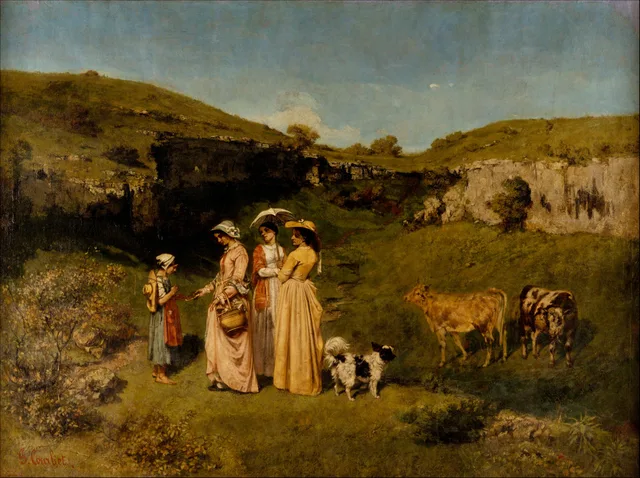
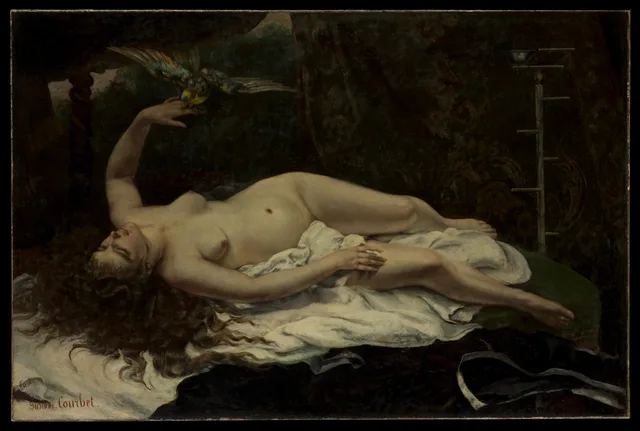
More by the same painter
Questions to think about
- Look for itHow many things connected with money can you find on the counter?
- Why?Why do you think Courbet was not satisfied with his first head study and decided to add the counter and the coins?
- What about you?When the government was attacking songs, a painter may have spoken through a single flower. What are the ways people today say things they cannot say openly?
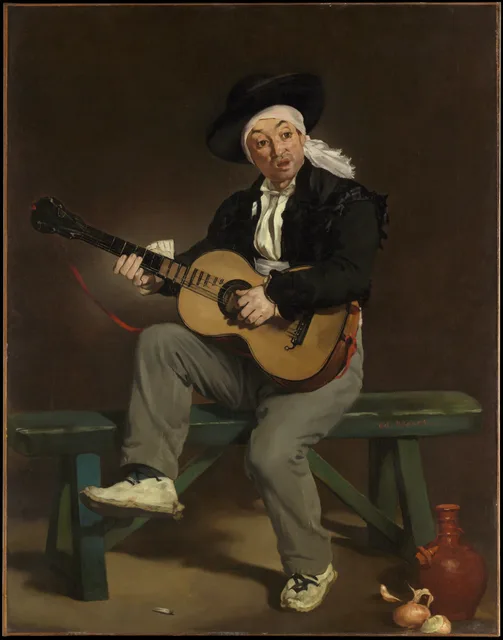
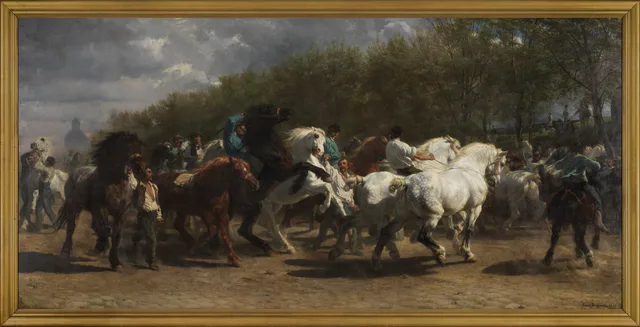
Same period
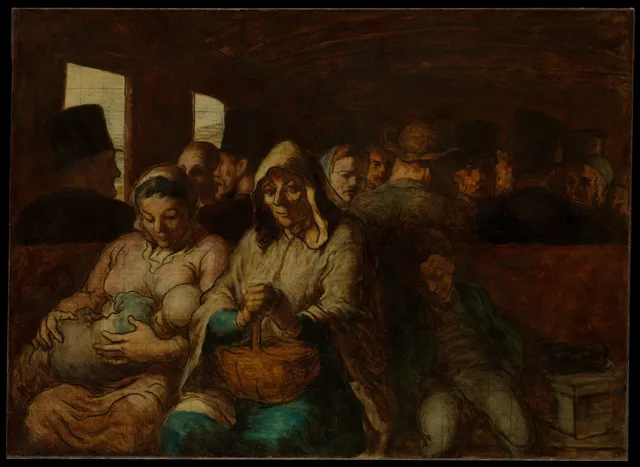
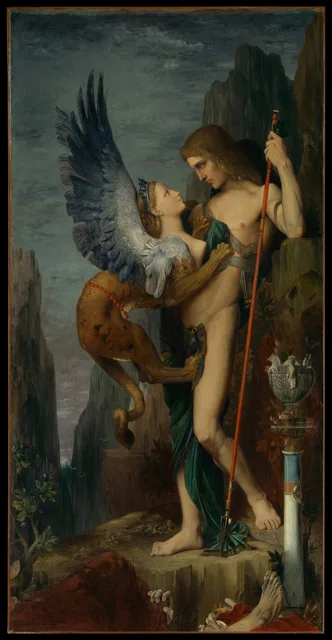
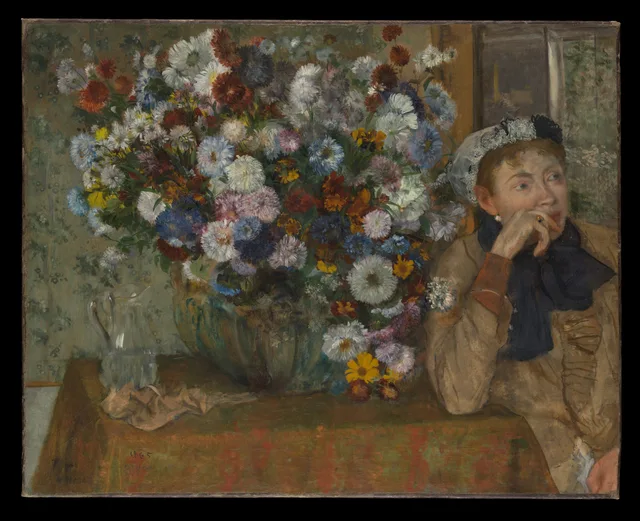
Painted around the same time,
somewhere else

Too good to keep to yourself
This painting,
for someone who comes to mind
They open it at full size
and see every brushstroke.
About this work
- Artist
- Gustave Courbet · 1819–1877
- Date
- 1855, reworked 1857–59
- Medium
- Oil on canvas
- Size
- 129 × 97.5 cm
- Culture
- France
- Collection
- The Art Institute of Chicago
- Image
- Original long edge 9222px · shown at 2560px
- Original
- View on the museum's website ↗