 Pyeongye
Artwork · 16th century · Joos van Cleve
LeoTurn on Magnifier at the lower right and move slowly across the painting.
Full screen opens it edge to edge.Tap the painting to fill the screen.
Spread two fingers to look closer.
At a glance
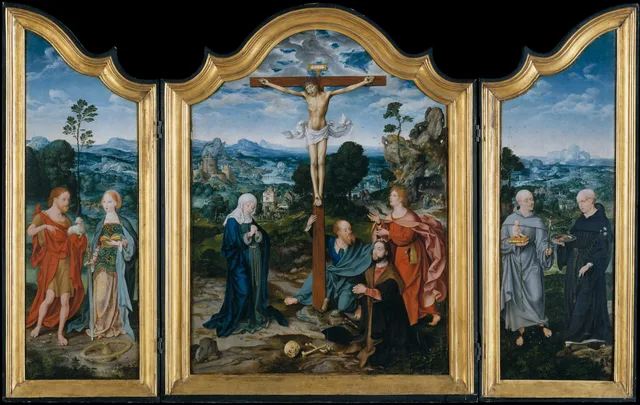
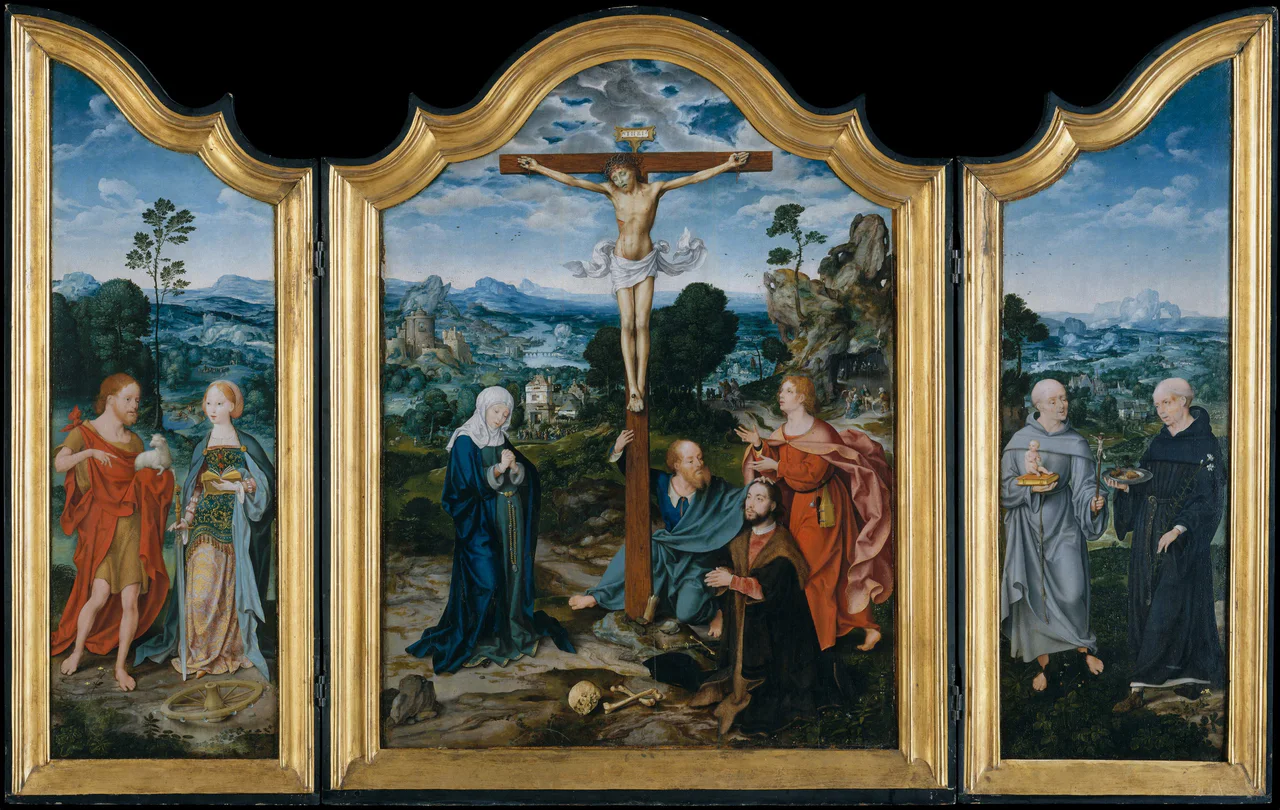
- A three-part altarpiece: Christ on the cross with a kneeling man in the center panel, and two saints standing on each of the side wings.
- Joos van Cleve, a painter working in Antwerp, made it in oil on wood around 1520.
- Behind the sad scene, rivers, castles, and rocky hills stretch far away, and every saint holds a clue to who they are. It is a picture you can search.
Reading the picture
5 places to look closer
Tap a number on the painting to jump to its note, or a close-up to see that spot in the whole picture.
Zoom in on the top of the cross. Christ wears a crown of thorns, his eyes closed and his head dropped. The white cloth around his hips flutters out to both sides as if caught by the wind. The gold sign above him reads INRI, the initials of the Latin words for Jesus of Nazareth, King of the Jews.
Look to the lower right of the cross. A man in a black coat with a fur collar kneels with his hands pressed together. He is the donor, the person who ordered this painting. A young saint in red lays a hand on his head, as if leading him forward to Christ.
Zoom in on the foot of the cross. A skull and two crossed bones lie on the ground. Golgotha, the hill where Jesus died, means "place of the skull," and the skull was often taken to be Adam's, the first man. Just to the right are the donor's black hat and his sword, set down on the ground.
Look at the left wing. John the Baptist, in a rough camel-hair garment, points to a little lamb resting on his arm. The woman beside him holds a sword and a book, and a broken wheel lies at her feet. The wheel is the sign of Saint Catherine of Alexandria.
Zoom in on the two friars on the right wing. The one in gray holds the baby Jesus sitting on a book. That is how painters showed Saint Anthony of Padua. The one in black carries a plate of cooked birds and a white lily.
When it was painted
Around 1520, Joos van Cleve was about thirty-five and running a busy workshop in Antwerp. His name simply means "from Cleves," a region on the Lower Rhine. He had joined the city's painters' guild as a master in 1511, and a few years later he served as one of its deans.
Antwerp was the place to be. Ships and merchants from all over Europe crowded its harbor. In the summer of 1520 the German painter Albrecht Dürer arrived and stayed for most of a year. With so many buyers around, painters sometimes split a job according to what each did best.
This triptych is one of those team efforts. The Met says it joins the figures of Joos van Cleve with the work of a landscape specialist. That is why the sky, the river, and the hills run across all three panels like one wide view.
Kneeling beside the donor is his patron saint, Paul, the bearded man in blue who kneels and holds the cross with one hand. The museum's records do not give the donor's name.
For a long time nobody knew van Cleve's name either. Scholars called him the Master of the Death of the Virgin, after two altarpieces of that subject he painted for patrons in Cologne. Around 1530 he was painting portraits of King Francis I of France. This triptych came to the Metropolitan Museum in 1941 as a bequest of the New York banker George Blumenthal.
Now let your eye travel from the far mountains on the left wing, across the river in the center, to the sky on the right. Somewhere along that line, two painters' brushes meet and become a single landscape.
Questions to think about
- Look for itOn the left of the center panel, who do you think the woman in blue with her hands folded is?
- Why?Why would the painter put the donor right beside Christ and the saints, and at the same size as them?
- What about you?The donor paid to have himself painted into a holy scene. How is that like, or unlike, putting a donor's name on a building or a scholarship today?
Same period
Painted around the same time,
somewhere else
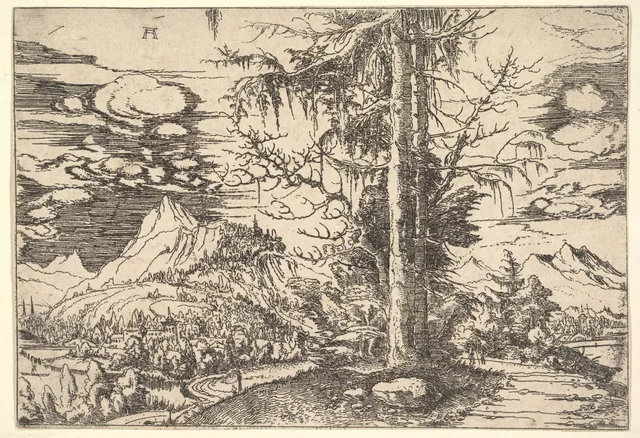 Landscape with a Double SpruceAlbrecht Altdorferca. 1521–22
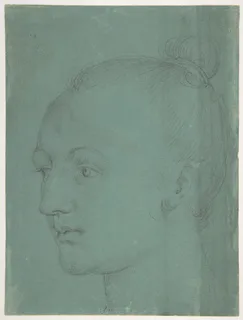 Head of a Young WomanAlbrecht Dürer1522
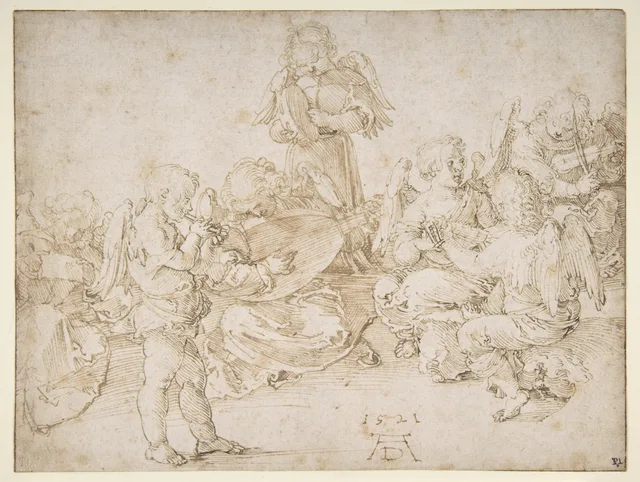 Music-Making AngelsAlbrecht Dürer1521
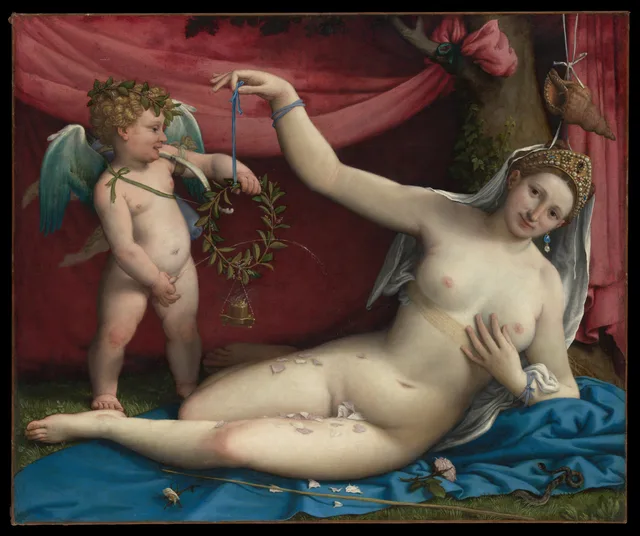 Venus and CupidLorenzo Lotto1520s
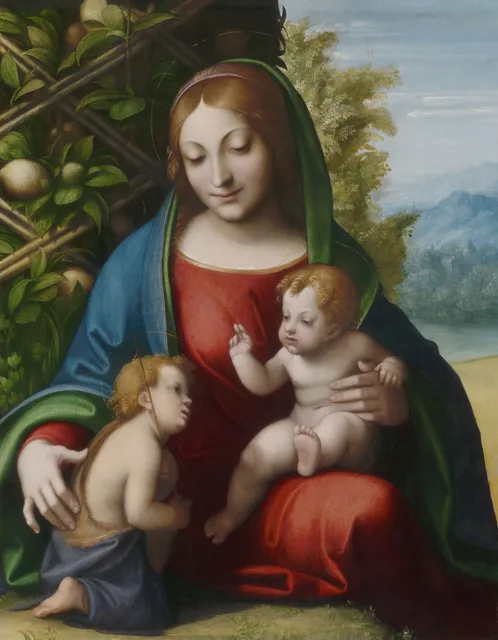 Virgin and Child with the Young Saint John the BaptistAntonio da Correggioc. 1515
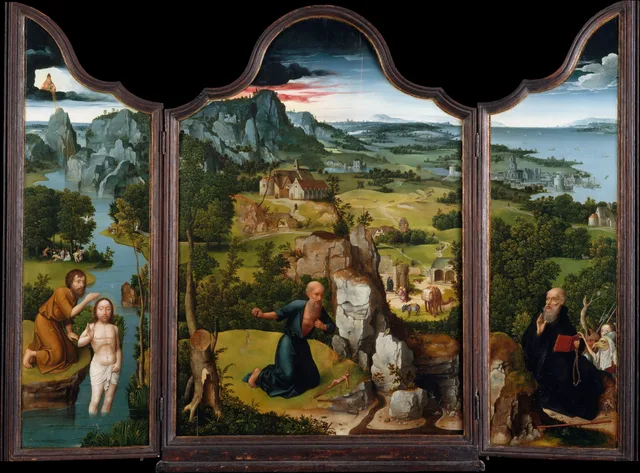 The Penitence of Saint JeromeJoachim Patinirca. 1515
Too good to keep to yourself
This painting,
for someone who comes to mind
They open it at full size
and see every brushstroke.
About this work
- Artist
- Joos van Cleve · 1485–1541
- Date
- ca. 1520
- Medium
- Oil on wood
- Size
- 98.4 × 74.3 cm
- Collection
- The Metropolitan Museum of Art
- Image
- Original long edge 3811px · shown at 2560px
- Original
- View on the museum's website ↗