 Pyeongye
Artwork · 15th century · Piero di Cosimo
LeoTurn on Magnifier at the lower right and move slowly across the painting.
Full screen opens it edge to edge.Tap the painting to fill the screen.
Spread two fingers to look closer.
At a glance
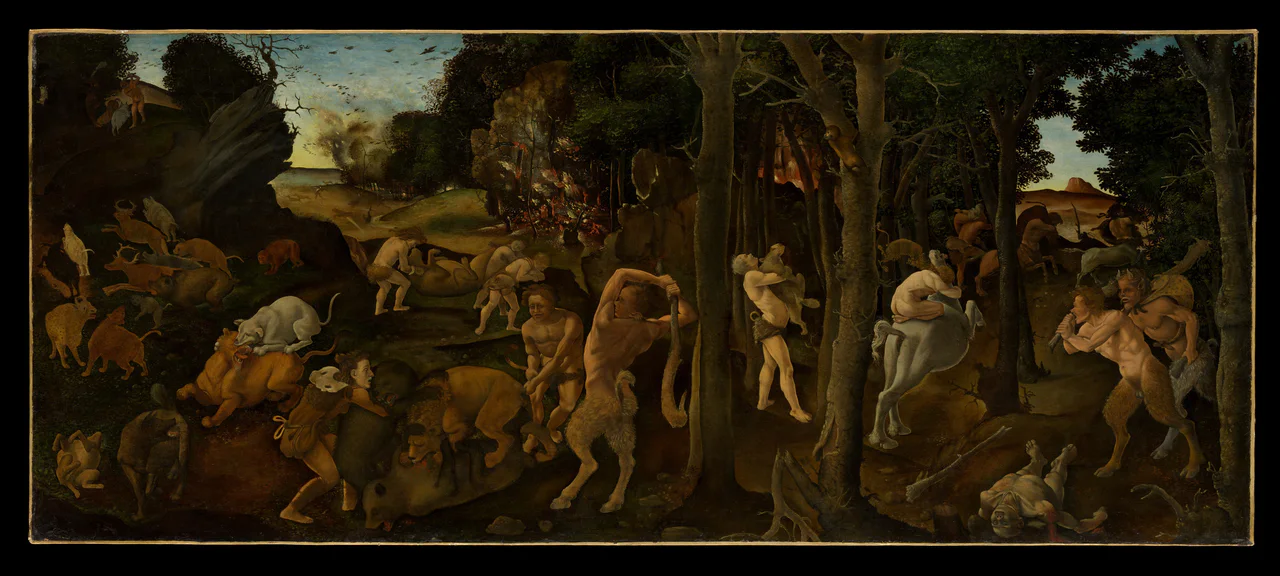
- In a dark forest, naked people and goat-legged satyrs swing clubs and grapple with lions, bears, and horses.
- The Florentine painter Piero di Cosimo made it around 1494 to 1500.
- The panel is about five and a half feet wide, and as you follow it from left to right, one fight leads straight into the next.
Reading the picture
5 places to look closer
Tap a number on the painting to jump to its note, or a close-up to see that spot in the whole picture.
Zoom in on the sky at the upper left. Smoke billows up beyond the trees, and flocks of birds stream into the air. Below, animals that look like deer are running across a field. It seems the forest has caught fire and driven everything out.
Drop down to the lower left. A white animal has climbed onto a lion's back and bitten into its head, and the lion bares its teeth with its mouth wide open. A man nearby carries what looks like an animal skull over his shoulder. Above them, a bear and fox-like creatures chase one another.
Move to the center. A man seen from behind raises a huge club over his head. Now look below his waist: he has shaggy goat legs and a tail. He is a satyr from ancient myth. The man beside him grips a club with both hands too.
Zoom in between the trees on the right. A naked man has jumped onto a white horse and hugs its neck tightly. The horse twists its body and braces on its hind legs. There is no saddle and no bridle. This is a horse that has never been tamed.
Look at the far right. Two satyrs hurry past, the one behind carrying a sack on his shoulder. At their feet a man lies on his back, bleeding. Piero does not hide the fact that hunting could cost people their lives.
When it was painted
In 1494 Piero di Cosimo was a thirty-two-year-old painter in Florence. The di Cosimo in his name did not come from his father. He took it from his teacher, Cosimo Rosselli. That same year the Medici family was driven out of the city.
This long panel was made during those restless years. The sixteenth-century biographer Giorgio Vasari wrote that a room in the house of Francesco del Pugliese, a rich wool merchant, was decorated with Piero's stories of small figures. Many scholars believe this picture was one of them. The Met suggests that its long shape and learned subject point to a panel set into the wall of a room meant for study and reflection.
Vasari's Piero is a strange character. He wrote that the painter kept to himself, avoided company, and lived on eggs that he boiled fifty at a time while he was heating his glue. Vasari also said Piero would stare at stained walls and clouds and find fighting horses and odd cities in them.
Centuries later, in 1937, the art historian Erwin Panofsky identified this painting and its companion at the Met, The Return from the Hunt, as part of the Pugliese pictures Vasari described. He read the two as a series about the very earliest days of humankind. By then the panel had long been in New York: Robert Gordon gave it to the Metropolitan Museum in 1875.
Now look at the picture again. People, animals, and satyrs are tangled together between the trees. Try looking with the eyes of a man who could find a horse fight in a stained wall, and count the creatures hiding in the woods one by one.
Questions to think about
- Look for itHow many goat-legged satyrs can you find in the picture?
- Why?Why do you think Piero mixed people, animals, and satyrs together so it is hard to tell who is chasing whom?
- What about you?The people here fight animals with bare hands just to survive. What do we struggle against today to make a living, and who gets hurt in that struggle?
Same period
Painted around the same time,
somewhere else
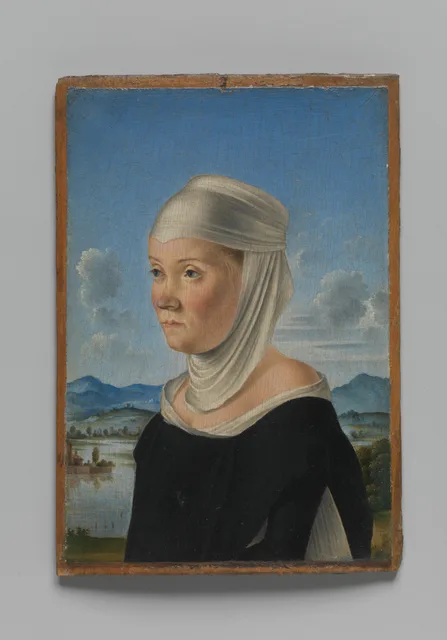 Portrait of a Woman, Possibly a Nun of San Secondo; (verso) Scene in GrisailleJacomettoca. 1485–95
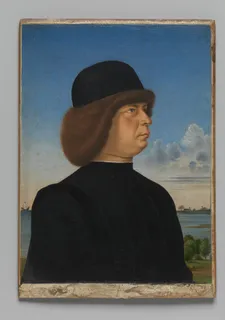 Portrait of Alvise Contarini(?); (verso) A Tethered RoebuckJacomettoca. 1485–95
 Approach to a Mountain Village with Horsemen on the RoadFra Bartolomeoca. 1501
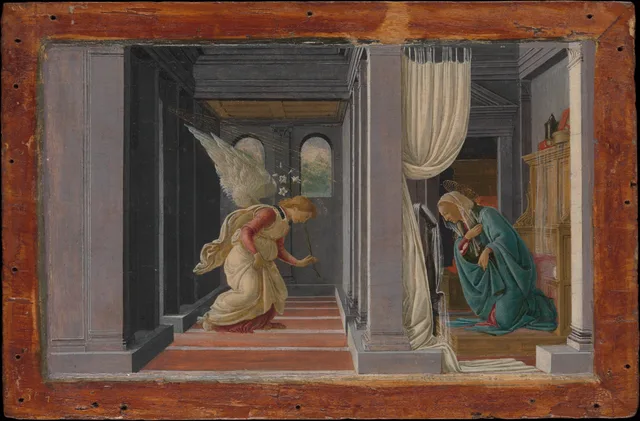 The AnnunciationBotticellica. 1490
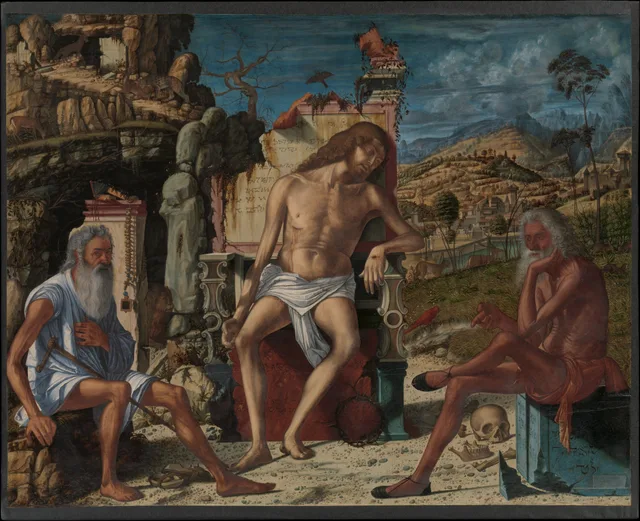 The Meditation on the PassionVittore Carpaccioca. 1490
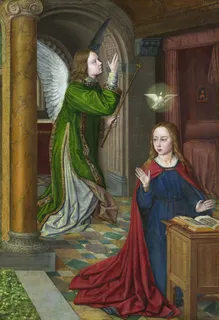 The AnnunciationJean Hey1490–95
Too good to keep to yourself
This painting,
for someone who comes to mind
They open it at full size
and see every brushstroke.
About this work
- Artist
- Piero di Cosimo · 1462–1522
- Date
- ca. 1494–1500
- Medium
- Tempera and oil transferred to Masonite
- Size
- 70.5 × 169.5 cm
- Collection
- The Metropolitan Museum of Art
- Image
- Original long edge 4000px · shown at 2560px
- Original
- View on the museum's website ↗