 Pyeongye
Artwork · 15th century · Jacometto
LeoTurn on Magnifier at the lower right and move slowly across the painting.
Full screen opens it edge to edge.Tap the painting to fill the screen.
Spread two fingers to look closer.
Portrait of Alvise Contarini(?); (verso) A Tethered Roebuck
Jacomettoca. 1485–95Oil on wood; verso: oil and gold on wood
At a glance
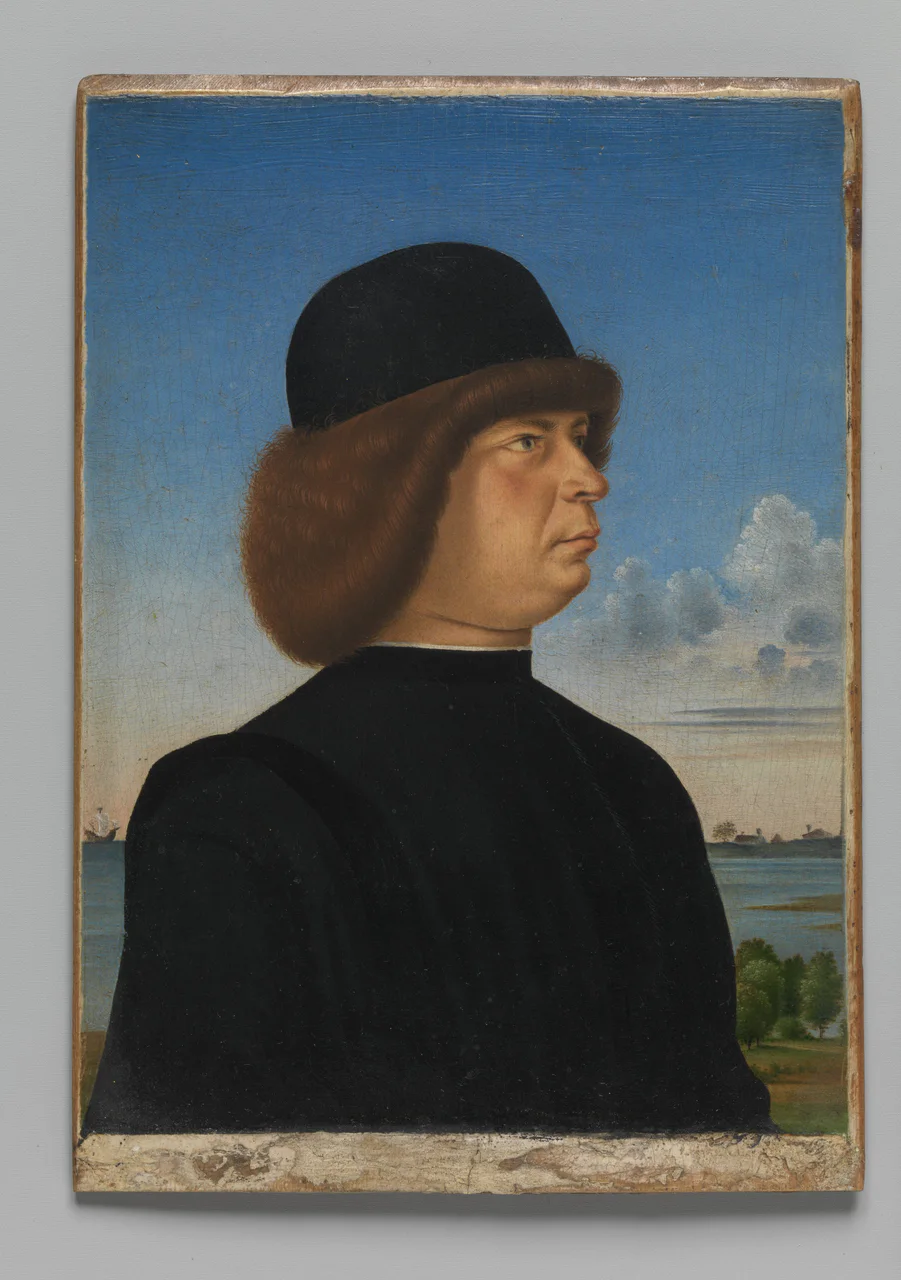
- A man in a black cap and black robe turns his head to the right, set against a wide sky and open water.
- The Venetian painter Jacometto made it in oil on wood around 1485 to 1495. The sitter is thought to be Alvise Contarini, a Venetian nobleman.
- The whole panel is under 12 cm tall. Even so, it holds single curls of hair and a sailing ship on the horizon.
Reading the picture
4 places to look closer
Tap a number on the painting to jump to its note, or a close-up to see that spot in the whole picture.
Zoom in on the face. The nose is long with a rounded tip, and the flesh under his chin folds softly. His cheeks and nostrils are flushed with red, and his eyes look ahead into the distance. The painter did not make him handsome. He painted what he saw.
Look at the hair spilling out from under the cap. It is cut in a rounded bob that covers his ears, and it curls in small loops. Each curl is a short stroke from the tip of the brush, lighter brown where the light hits and darker underneath. You can even see stray wisps poking out from under the cap's rim.
Now find the far left edge of the horizon. Right beside his black shoulder floats a ship with white sails. It is smaller than a grain of rice, yet you can make out the mast and the curve of the hull. For people in a sea-trading city, ships on the horizon were part of everyday life.
Go down to the landscape on the right. Low strips of land lie flat on the calm water. On the far shore stand a single tree and a few low-roofed houses, and leafy trees fill the foreground. Water, land and sky are spread across a space no bigger than a fingernail.
When it was painted
Turn this little panel over and you find a different picture. A roebuck is chained up, and with it is a single Greek word that means forever. The painter worked gold into the paint on this side too.
In 1543 a Venetian art lover named Marcantonio Michiel was cataloguing a patrician family's collection. He noted a small portrait of Alvise Contarini by Jacometto, and next to it a portrait of a nun of San Secondo. This panel and Portrait of a Woman, Possibly a Nun of San Secondo, also on this site, are thought to be those two. The question mark in the title is there because the identification is still not certain.
Venice was a republic that grew rich through trade by sea, and the Contarini were among its oldest noble families. Several doges, the elected heads of the state, came from this one house.
Jacometto worked in Venice from the 1470s into the 1490s, as a painter and an illuminator of books. Only a handful of pictures are now given to him, among them a portrait of a man in the National Gallery in London. That is what makes this pair so precious.
The chained roebuck and its promise of forever suggest a vow of faithfulness. That is why scholars still argue about the woman in the companion panel. Was she really a nun, and what was she to this man? Both panels came to the Metropolitan Museum together with the Robert Lehman Collection in 1975.
Now turn back to the front and look at his profile. His eyes are fixed on the far shore to the right. Think about what kind of promise might link that steady gaze to the word forever on the other side.
More by the same painter
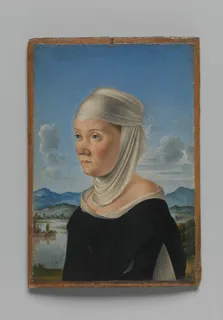
Questions to think about
- Look for itDid you find the little ship on the left horizon, almost hidden by his shoulder?
- Why?Why do you think the painter showed the man's face turned to the side rather than straight on?
- What about you?This portrait shows even the soft fold under his chin. Now that editing our photos feels normal, how would you want your own face remembered?
Same period
Painted around the same time,
somewhere else
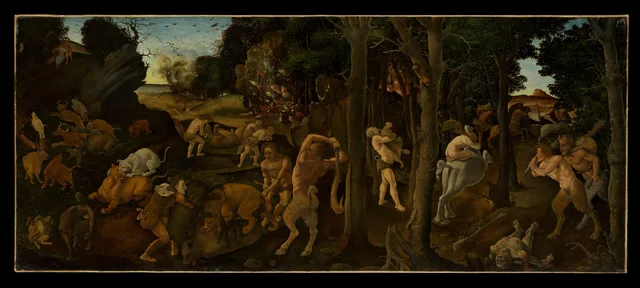 A Hunting ScenePiero di Cosimoca. 1494–1500
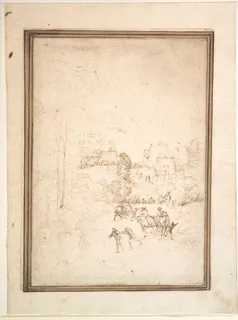 Approach to a Mountain Village with Horsemen on the RoadFra Bartolomeoca. 1501
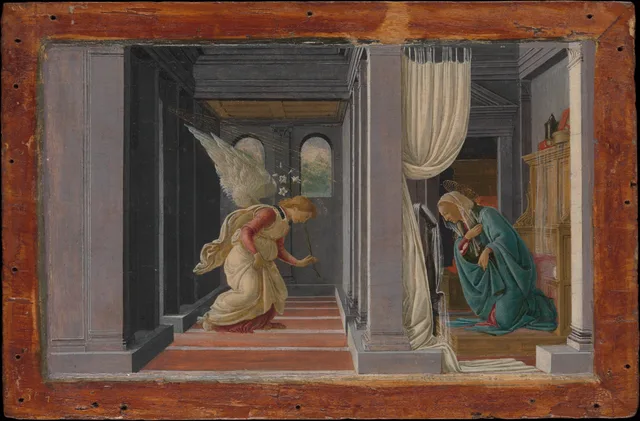 The AnnunciationBotticellica. 1490
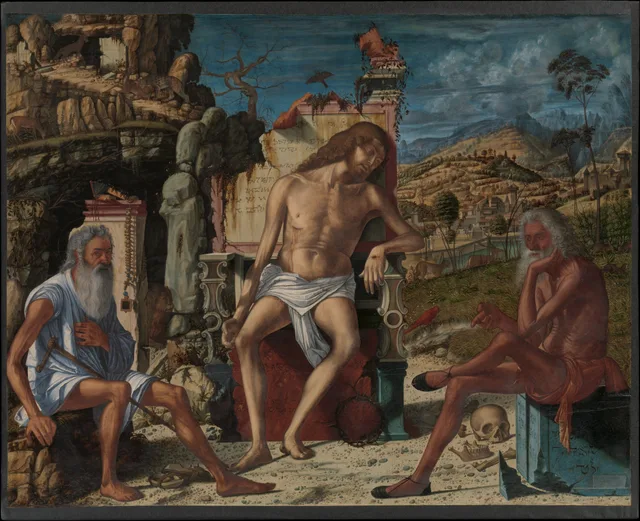 The Meditation on the PassionVittore Carpaccioca. 1490
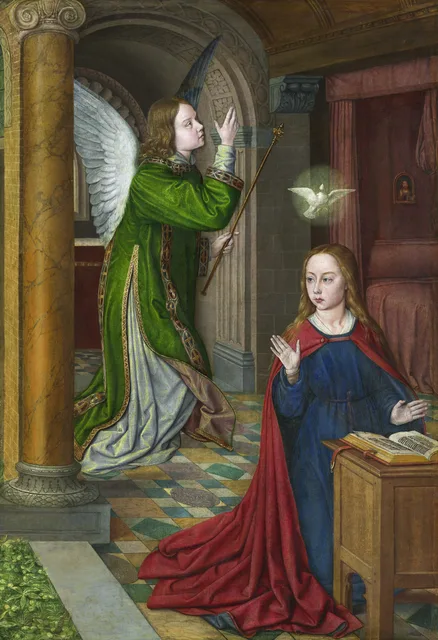 The AnnunciationJean Hey1490–95
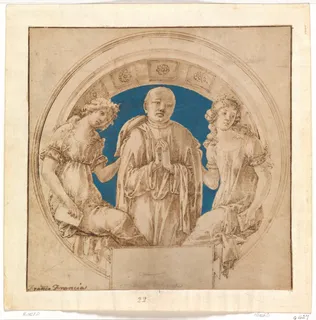 Design for a Wall MonumentFrancesco di Giorgio Martinica. 1490
Too good to keep to yourself
This painting,
for someone who comes to mind
They open it at full size
and see every brushstroke.
About this work
- Artist
- Jacometto · 1472–1498
- Date
- ca. 1485–95
- Medium
- Oil on wood; verso: oil and gold on wood
- Collection
- The Metropolitan Museum of Art
- Image
- Original long edge 4000px · shown at 2560px
- Original
- View on the museum's website ↗