 Pyeongye
Artwork · 15th century · Vittore Carpaccio
LeoTurn on Magnifier at the lower right and move slowly across the painting.
Full screen opens it edge to edge.Tap the painting to fill the screen.
Spread two fingers to look closer.
At a glance
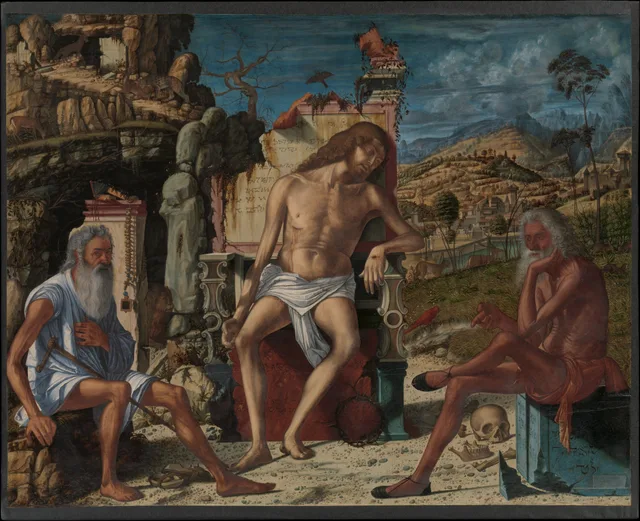
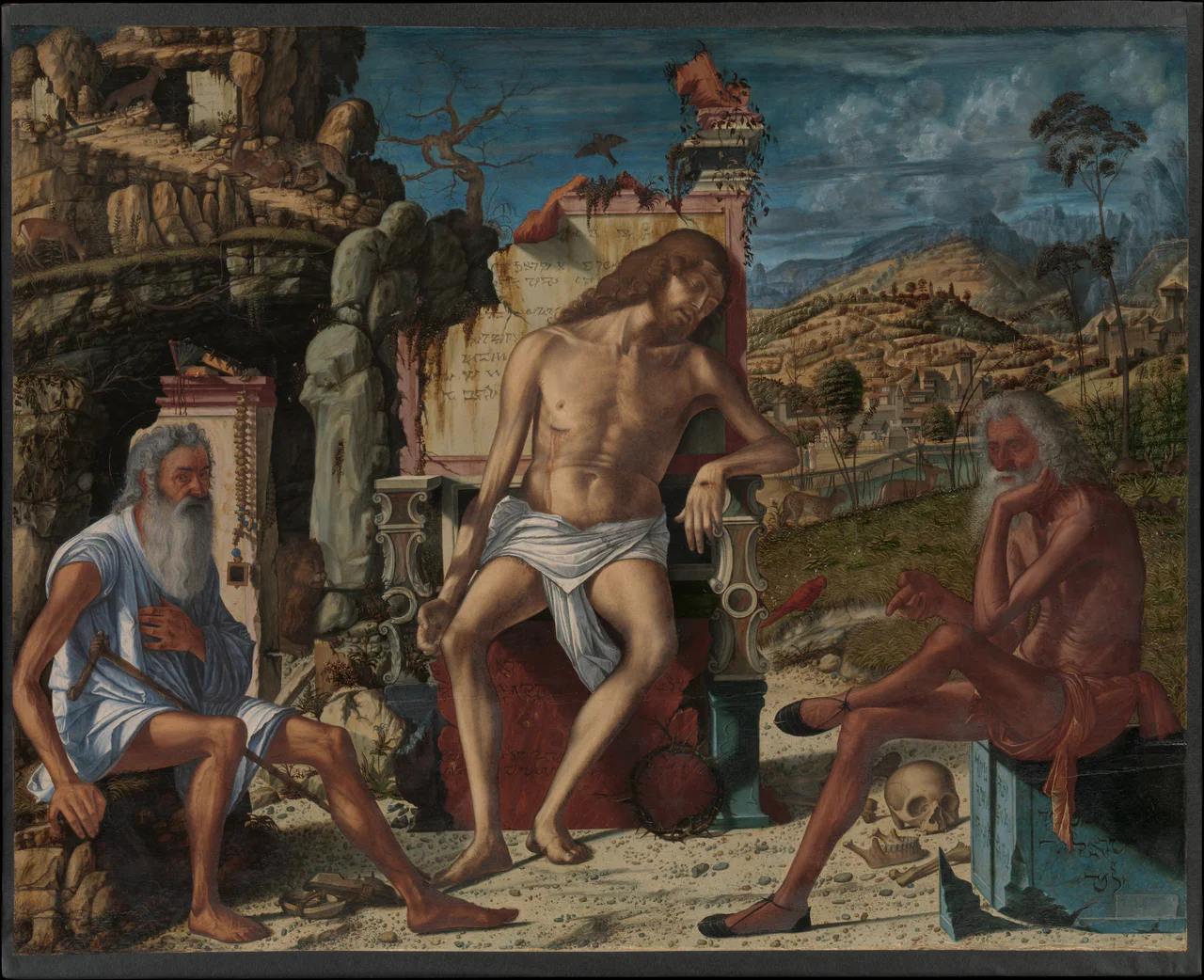
- The dead Christ sits slumped on a broken stone throne, while two white-bearded old men sit on either side, lost in thought.
- Vittore Carpaccio, a painter in Venice, made it around 1490 in oil and tempera on a wooden panel.
- A crown of thorns, a skull, a lion, and a leopard taking down a deer are all tucked into the scene, waiting to be found.
Reading the picture
5 places to look closer
Tap a number on the painting to jump to its note, or a close-up to see that spot in the whole picture.
Zoom in on Christ's face in the center. His eyes are closed, and his head has dropped to one side. Long hair falls over his shoulders. On the wall behind him, faint marks that look like letters are carved into the stone, and weeds hang down from the top, as if the place has been abandoned for years.
Look into the dark gap in the rocks behind the old man on the left. A lion lies there, calm and still. The old scholar with the lion is Saint Jerome, who translated the Bible into Latin. Painters often gave him a lion as his companion.
Now zoom in on the blue stone block at the lower right, where the other old man sits. Letters that look like Hebrew are carved into its side. In the sand in front of it lie a skull and scattered bones. This old man is Job, the figure in the Old Testament who suffered terrible losses and kept his faith.
Look at the ground near Christ's feet. A ring woven from thorny branches rests there, leaning against the red stone. It is the crown of thorns Christ wore before he was crucified. Around it, every little pebble in the sand is painted one by one.
Climb up to the rocky hill in the upper left. A spotted leopard has pounced on a deer and has it by the neck. A little farther left, another deer keeps grazing as if nothing is happening. A quiet meditation in front, a hunt behind: Carpaccio put both in the same picture.
When it was painted
Around 1490, Vittore Carpaccio, then about thirty, landed a big job in Venice. The confraternity of Saint Ursula asked him to fill the walls of its meeting hall with the story of the saint. Over several years he covered huge canvases with ships, palaces, and crowded harbors. That series now hangs in the Gallerie dell'Accademia in Venice.
His family name was Scarpazza. On his paintings, though, he often signed a Latin-sounding version of his name, Carpathius. This panel is the opposite of those busy canvases. It is small and still, and instead of telling a story, it invites you to sit, like Jerome and Job, and think about Christ's death.
For a long time, the panel carried a fake signature with the name of Andrea Mantegna, a painter with a much bigger reputation in northern Italy at the time. In 1945 the false signature was removed, and Carpaccio's own signature came to light underneath.
The picture has traveled far. In the 1600s it belonged to the Canonici family in Italy, and it stayed with them until about 1850. Later it passed through the hands of the English collector Sir William Neville Abdy. In 1911 it entered The Met.
Look at it again. All those years it carried someone else's name, but the broken stone throne, the lion in the rocks, and every pebble in the sand were Carpaccio's work from the start. Do the strange letters carved in the stone look a little different now?
Questions to think about
- Look for itCan you find the bird flying in the sky above Christ, and the red bird hiding in the grass to the right of the throne?
- Why?Why do you think Carpaccio put a leopard hunting a deer behind such a still, quiet scene?
- What about you?The two old men sit without speaking, thinking hard about death and suffering. In our busy days, how often do we give ourselves time to sit alone with something heavy?
Same period
Painted around the same time,
somewhere else
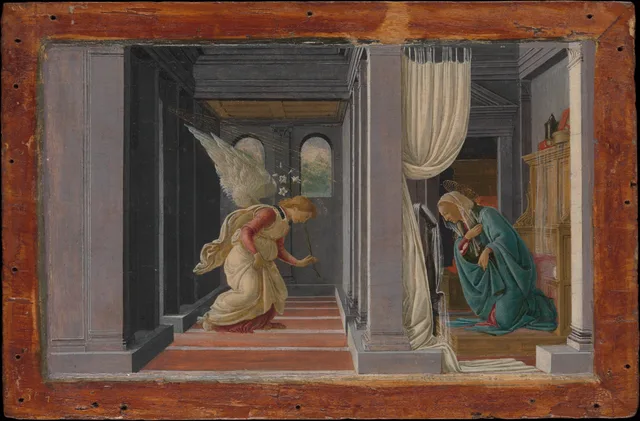 The AnnunciationBotticellica. 1490
 The AnnunciationJean Hey1490–95
 Design for a Wall MonumentFrancesco di Giorgio Martinica. 1490
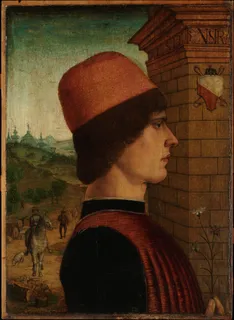 Portrait of a Man, possibly Matteo di Sebastiano di Bernardino GozzadiniMaestro delle Storie del Pane1494(?)
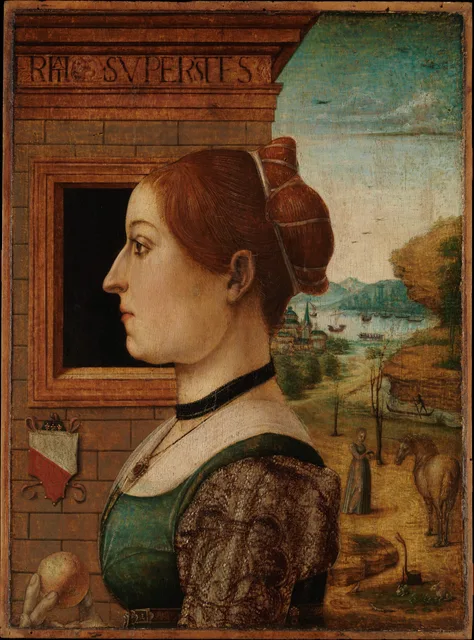 Portrait of a Woman, possibly Ginevra d'Antonio Lupari GozzadiniMaestro delle Storie del Pane1494?
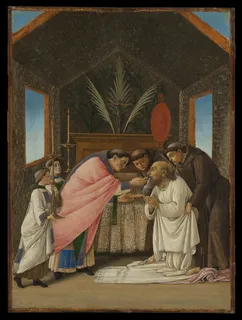 The Last Communion of Saint JeromeBotticelliearly 1490s
Too good to keep to yourself
This painting,
for someone who comes to mind
They open it at full size
and see every brushstroke.
About this work
- Artist
- Vittore Carpaccio · 1460–1526
- Date
- ca. 1490
- Medium
- Oil and tempera on wood
- Size
- 70.5 × 86.7 cm
- Collection
- The Metropolitan Museum of Art
- Image
- Original long edge 3911px · shown at 2560px
- Original
- View on the museum's website ↗