 Pyeongye
Artwork · 15th century · Botticelli
LeoTurn on Magnifier at the lower right and move slowly across the painting.
Full screen opens it edge to edge.Tap the painting to fill the screen.
Spread two fingers to look closer.
At a glance
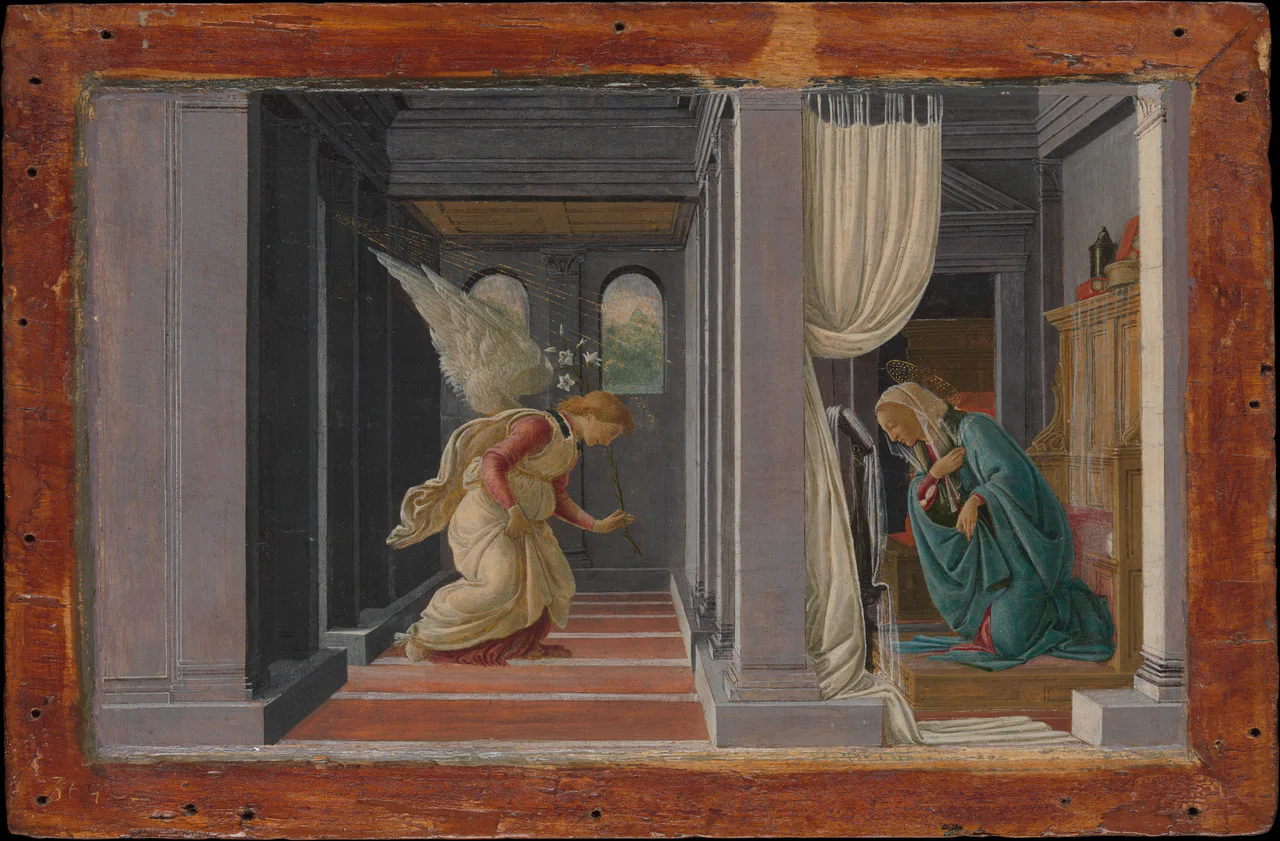
- The angel Gabriel kneels to tell Mary that she will bear the child Jesus.
- Sandro Botticelli painted it in Florence around 1490, in tempera and gold on a wooden panel.
- The whole picture is only about 7.5 by 12.4 inches, yet columns and a striped floor build two deep rooms inside it.
Reading the picture
5 places to look closer
Tap a number on the painting to jump to its note, or a close-up to see that spot in the whole picture.
Start with the angel on the left. He has just landed, one knee down, his pale cloak still swinging out behind him. In his hand is a white lily. The lily stands for Mary's purity, which is why it turns up in so many paintings of this scene.
Now look at the dark wall above the angel's wings. Fine dotted lines of gold slant down across it. They enter from the upper left and run past the wings toward the lower right. It reads as a sign that a message from heaven is reaching this house right now.
Just right of the central column hangs a white curtain. A row of rings holds it at the top, and its lower edge has been gathered and tied to one side. With the curtain pulled back, Mary's room opens up for us.
Here is Mary. She wears a blue-green mantle and bows her head, one hand pressed to her chest. Her other hand lightly holds a fold of her cloak. Look closely at her halo: it is made of tiny dots of gold.
On top of the wooden cabinet at the upper right sit two red books, a dark jar, and a round box. Each is smaller than a fingernail, yet the corners of the books and the rim of the box are all there. These everyday things make it feel like an ordinary home that has suddenly received extraordinary news.
When it was painted
Around 1490 Botticelli was in his mid-forties and running a busy workshop in Florence. About ten years earlier, Pope Sixtus IV had called him to Rome to help paint the walls of the Sistine Chapel. Back home, in 1489 and 1490, he painted a large altarpiece of the Annunciation for the church of Cestello.
This little panel had a different job. The Met believes it was almost certainly made as a private devotional picture, something a person could keep close at home and pray before, rather than a piece of a bigger altarpiece. Who ordered it is not known.
Small as it is, Botticelli built the space with care. The museum points to the one-point perspective that pulls the floor and columns toward a single spot. It also notes the incised lines you can see on the surface as evidence of how he worked. Think of them as a blueprint scratched into the panel.
Florence was about to be shaken. Lorenzo de' Medici, who had steered the city, died in 1492. Crowds packed in to hear the friar Girolamo Savonarola preach, and in 1494 the Medici were driven out of Florence.
The panel went on to travel. It was once in the Barberini collection in Rome, and later passed through Florence. In July 1905 it left Italy, and the customs stamp is still on the back. It belonged to the Berlin collector Oscar Huldschinsky, was bought at a Berlin auction in 1928 for Robert Lehman, and came to the Met in 1975.
Now look again at the red stripes of the floor. After more than four centuries of moving between homes and countries, they still run straight toward the one point Botticelli set for them.
More by the same painter
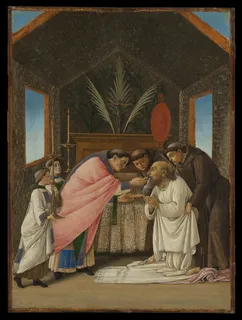
Questions to think about
- Look for itHow many columns and door frames can you count standing between the angel and Mary?
- Why?Why do you think Botticelli split the scene into two rooms with a column between them, instead of putting both figures in one space?
- What about you?If you suddenly heard news that would change your whole life, would you bow your head and accept it like Mary, or would you ask questions first?
Same period
Painted around the same time,
somewhere else
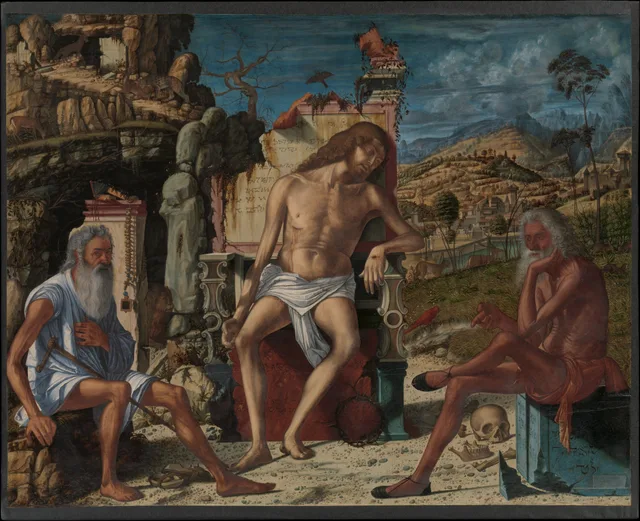 The Meditation on the PassionVittore Carpaccioca. 1490
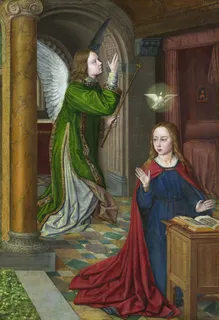 The AnnunciationJean Hey1490–95
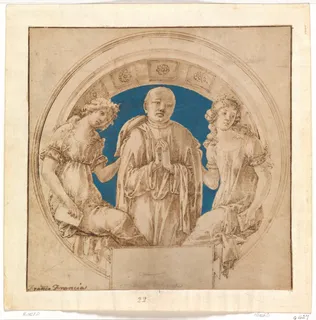 Design for a Wall MonumentFrancesco di Giorgio Martinica. 1490
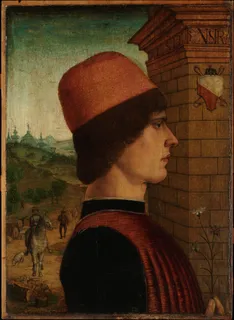 Portrait of a Man, possibly Matteo di Sebastiano di Bernardino GozzadiniMaestro delle Storie del Pane1494(?)
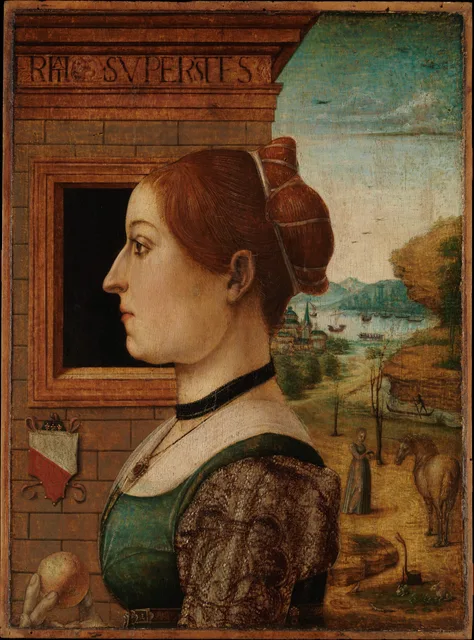 Portrait of a Woman, possibly Ginevra d'Antonio Lupari GozzadiniMaestro delle Storie del Pane1494?
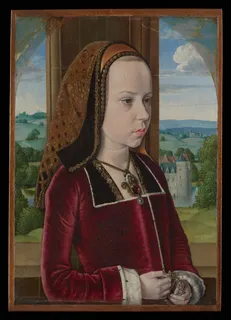 Margaret of AustriaJean Heyca. 1490
Too good to keep to yourself
This painting,
for someone who comes to mind
They open it at full size
and see every brushstroke.
About this work
- Artist
- Botticelli · 1444–1510
- Date
- ca. 1490
- Medium
- Tempera and gold on wood
- Size
- 19.1 × 31.4 cm
- Collection
- The Metropolitan Museum of Art
- Image
- Original long edge 3913px · shown at 2560px
- Original
- View on the museum's website ↗