 Pyeongye
Artwork · 20th century · Odilon Redon
LeoTurn on Magnifier at the lower right and move slowly across the painting.
Full screen opens it edge to edge.Tap the painting to fill the screen.
Spread two fingers to look closer.
At a glance
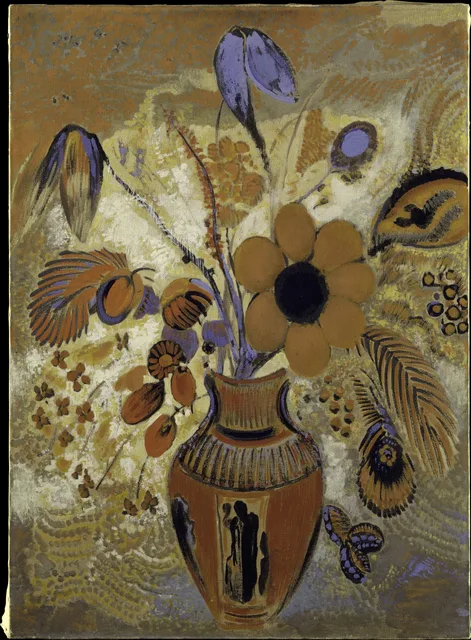
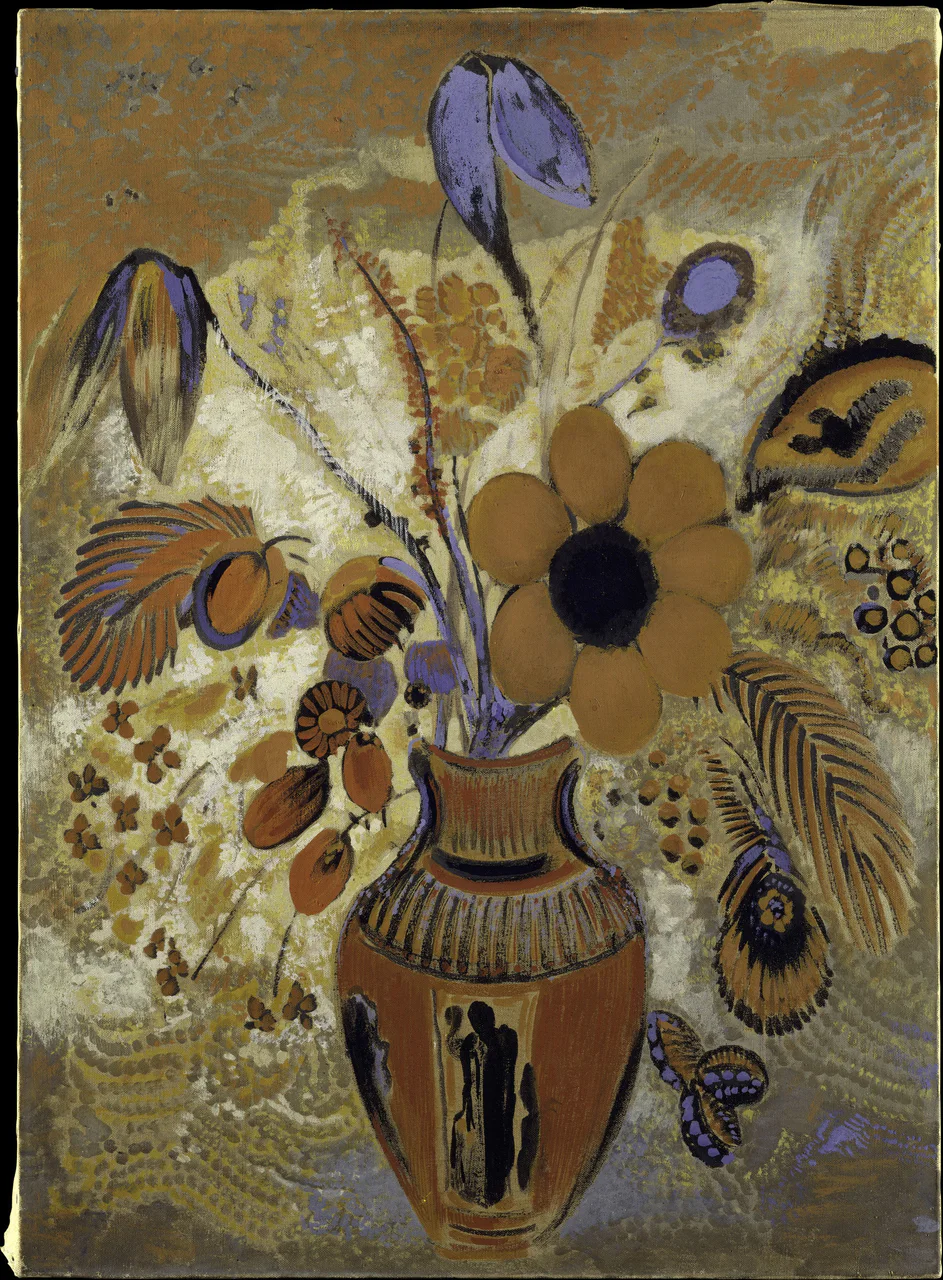
- A reddish-brown ancient-style vase, painted with dark human figures, holds violet buds, feathery leaves, and one big brown flower.
- The French artist Odilon Redon painted it in tempera on canvas sometime between 1900 and 1910.
- These flowers look little like the ones you could buy at a market, so even a vase of flowers starts to feel like a dream.
Reading the picture
5 places to look closer
Tap a number on the painting to jump to its note, or a close-up to see that spot in the whole picture.
Zoom in on the big flower in the middle. Round brown petals circle a black center. Along the edges of the petals you can see the weave of the canvas showing through. Redon brushed the paint on thin and dry, so the texture of the cloth became part of the picture.
Now look at the body of the vase. In a pale panel stands a black human figure, with another shadowy shape beside it. Around the shoulder of the vase runs a band of vertical stripes. The Etruscans of the title were a people who lived in central Italy before Rome rose to power. Redon set fresh flowers in a very old kind of vessel.
Zoom in on the violet bud at the very top. Its two petals curve downward like a bowed head. Rough black strokes cross the violet and give the petals shadows and creases. That same violet turns up again and again across the canvas, tying the picture together.
Look at the lower right, beside the vase. Black wings dotted with violet spread open. It looks just like a butterfly. Did it land after flying among the flowers? In Redon's flower pictures, petals and wings often blur into each other.
Zoom in on the background at the lower left. Little round dabs of paint line up in rows like ripples. Redon painted no table and no wall. Dots and smudges alone fill the air around the flowers.
When it was painted
In 1900, Odilon Redon turned sixty. Born in Bordeaux, he had built his name almost entirely in black: charcoal drawings and lithographs that he himself called his noirs, his black works.
Those black works were full of strange dreams. An eye rises into the sky like a balloon. A spider grins on its spread legs. Then, from about 1890, Redon began working in color, in pastel and paint. By around 1900 he had nearly given up the noirs, and flowers became one of his favorite subjects.
The new path brought new commissions. In 1900 and 1901, Baron Robert de Domecy asked him to decorate the dining room of his château in Burgundy. Redon filled the walls with large panels of drifting flowers and leaves. Those panels now hang in the Musée d'Orsay in Paris.
In 1913, when Redon was in his seventies, a large group of his works crossed the ocean to the Armory Show in New York. The collector Lillie P. Bliss, a quiet financial backer of that exhibition, bought several of his pictures there. Redon died in Paris three years later, in 1916.
Bliss went on to help found the Museum of Modern Art in New York in 1929. After her death in 1931, her collection went to that museum, and this vase of flowers was part of it. The Met later bought the painting from the Museum of Modern Art with a purchase fund and added it to its collection in 1953.
Look again at the black figure on the body of the vase. Then find the black center of the big brown flower. Even after Redon became a painter of color, black stayed at the heart of his pictures.
Questions to think about
- Look for itHow many places can you find where Redon used violet?
- Why?Why do you think Redon changed real flowers into shapes that look like feathers and wings?
- What about you?Redon switched to color at about fifty, after decades of black. What do you think when you see someone take a new path later in life?
Same period
Painted around the same time,
somewhere else
Too good to keep to yourself
This painting,
for someone who comes to mind
They open it at full size
and see every brushstroke.
About this work
- Artist
- Odilon Redon · 1840–1916
- Date
- 1900–1910
- Medium
- Tempera on canvas
- Size
- 81.3 × 59.1 cm
- Collection
- The Metropolitan Museum of Art
- Image
- Original long edge 3722px · shown at 2560px
- Original
- View on the museum's website ↗