 Pyeongye
Artwork · 16th century · Raphael
LeoTurn on Magnifier at the lower right and move slowly across the painting.
Full screen opens it edge to edge.Tap the painting to fill the screen.
Spread two fingers to look closer.
At a glance
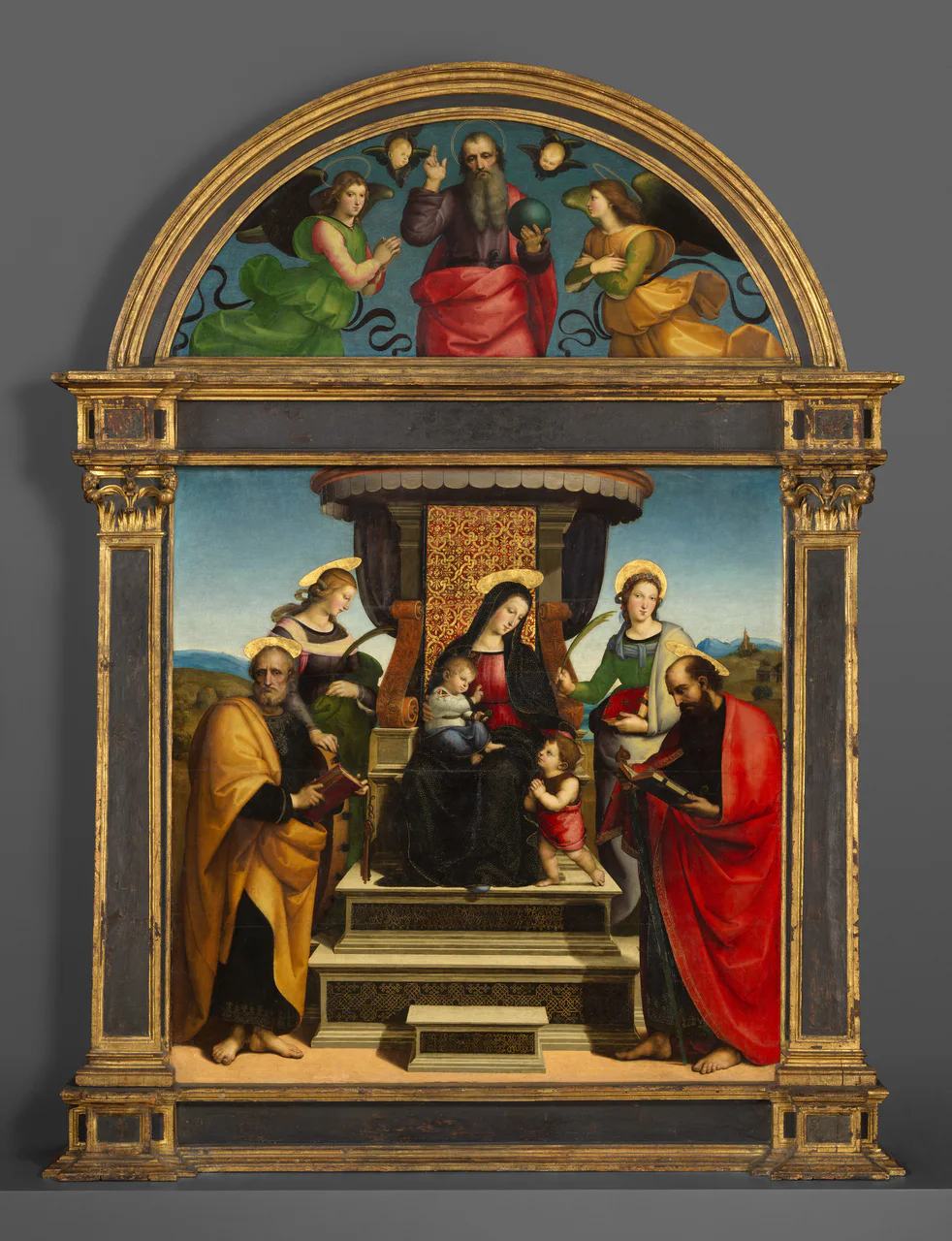
- The Virgin and Child sit on a high throne surrounded by saints, while God the Father blesses them from the half-moon panel above.
- Raphael painted this altarpiece around 1504, when he was about twenty, for a convent of nuns in Perugia, Italy.
- The main panel and the half-moon panel above it survive together, so you can picture how it once stood over an altar.
Reading the picture
4 places to look closer
Tap a number on the painting to jump to its note, or a close-up to see that spot in the whole picture.
Zoom in on the half-moon panel at the top. God the Father, with a long gray beard, raises two fingers of his right hand in blessing. In his left hand he holds a dark green ball, which stands for the world he made. Small winged heads of baby angels float on either side.
Now look at the center of the throne. The Christ Child sits on his mother's lap in a white shirt with a blue cloth around his legs. Below him, the young John the Baptist, with a thin gold ring above his head, presses his hands together and looks up at him. Notice Mary's black cloak: it is sprinkled with tiny gold dots that catch the light.
Zoom in on the saint in the yellow cloak on the left. Under the red book in his hands hangs a large key. That key tells you he is Peter, who was given the keys of heaven. The woman just behind him rests her hand on a wheel, the sign of Saint Catherine of Alexandria.
Now look at the saint in red on the right. He reads an open book, and beside his hand a long sword reaches down to the floor. The sword is the sign of Paul. Peter and Paul stand at the two edges like doorkeepers guarding Mary.
When it was painted
Around 1504 Raphael was just over twenty. His father, Giovanni Santi, a painter at the court of Urbino, had died when the boy was eleven, and his mother had died even earlier. Working in and around Perugia, the young painter absorbed the calm, balanced style of the leading local master, Perugino.
In 1504 he signed and dated another altarpiece, The Marriage of the Virgin. Soon after, he moved to Florence. There Michelangelo's David had just been set up in front of the city hall, and Leonardo and Michelangelo had both been hired to paint huge battle scenes on the walls of its great council chamber.
This altarpiece was painted for Sant'Antonio, a small Franciscan convent in Perugia, and it hung in the part of the church set aside for the nuns. The sixteenth-century biographer Giorgio Vasari wrote that the Christ Child was painted fully clothed because those devout nuns wanted it that way.
Over the next centuries the altarpiece came apart. The main panel passed to the Colonna family in Rome, which is why it is still called the Colonna Altarpiece, and later to the king of Naples. Those little base scenes are now divided among museums in New York, London, and Boston.
In 1901 the American banker J. Pierpont Morgan bought the altarpiece for two million francs. After his death it was given to the Metropolitan Museum in 1916. Look again at the Christ Child's white shirt. More than five hundred years later, the nuns' wish is still right there in the paint.
More by the same painter
Questions to think about
- Look for itCan you find the small object the Christ Child is holding in his hand?
- Why?Why do you think Raphael gave each saint one object to hold, like a key, a wheel, or a sword?
- What about you?If Vasari is right, the nuns who paid for this picture shaped how the babies look. When the people who pay for a work want something different from what the maker wants, what do you think today's artists and designers should do?
Same period
Painted around the same time,
somewhere else
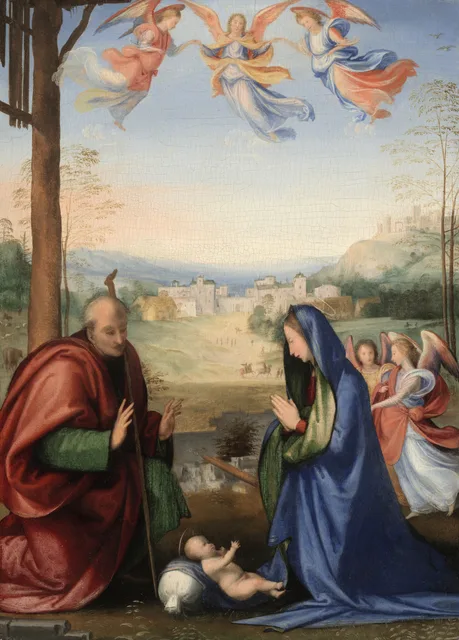 The NativityFra Bartolomeo1504–7
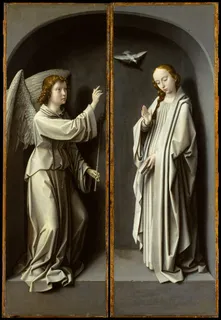 Archangel Gabriel; The Virgin AnnunciateGerard Davidca. 1510
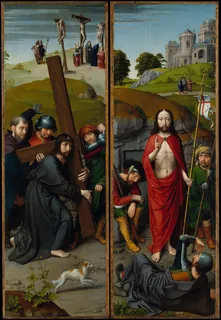 Christ Carrying the Cross, with the Crucifixion; The Resurrection, with the Pilgrims of EmmausGerard Davidca. 1510
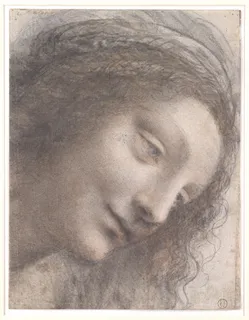 The Head of the Virgin in Three-Quarter View Facing RightLeonardo da Vinci1510–13
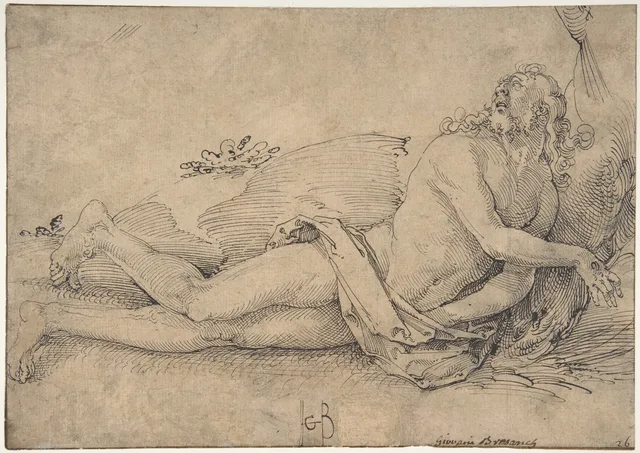 Ecstatic ChristHans Baldungca. 1510–11
 Approach to a Mountain Village with Horsemen on the RoadFra Bartolomeoca. 1501
Too good to keep to yourself
This painting,
for someone who comes to mind
They open it at full size
and see every brushstroke.
About this work
- Artist
- Raphael · 1483–1520
- Date
- ca. 1504
- Medium
- Oil and gold on wood
- Size
- 172.4 × 172.4 cm
- Collection
- The Metropolitan Museum of Art
- Image
- Original long edge 4000px · shown at 2560px
- Original
- View on the museum's website ↗