Pyeongye
Painters · 16th century
Gerard David
1455–1523
A painter from a small Dutch town who served Bruges for nearly forty years with altarpieces and pictures for its town hall, then was forgotten until his name turned up again in the city archives.
Scenes from a life
The life of Gerard David,
scene by scene
- 1484Bruges
In January 1484 a new master's name is entered in the register of the Bruges painters' guild: Gerard David. He came from Oudewater, a small town in Holland, in today's Netherlands. Only as a guild master could he open his own workshop in the city and sell pictures under his own name.
Bruges was then a great trading city, full of merchants and bankers. It already had a famous painter, Hans Memling. After Memling died in 1494, David became one of the leading painters in town.
- 1496–97Bruges
David marries Cornelia Cnoop. Her father, Jacob Cnoop, was the head of the goldsmiths' guild of Bruges. The painter had married into a family of craftsmen who worked in gold and jewels.
The marriage tied him even more firmly to the city. In 1501 he became dean of the painters' guild.
- 1498Bruges
In Bruges town hall, two large panels go up in the room where the city's judges sit. They are David's Justice of Cambyses, and the year 1498 is painted on them.
The story comes from the ancient Greek historian Herodotus. Cambyses, king of Persia, had a judge named Sisamnes arrested for taking bribes and flayed. Then he had the skin stretched over the judge's chair and made Sisamnes's son the new judge, seated on it. The judges of Bruges did their work every day with this picture in front of them.
- 1509Bruges
David gives a large altarpiece to the Carmelite convent of Sion in Bruges. It shows the Virgin and Child surrounded by many female saints. At the far edges are two faces taken to be David himself and his wife Cornelia. The painting is now in the museum in Rouen, France.
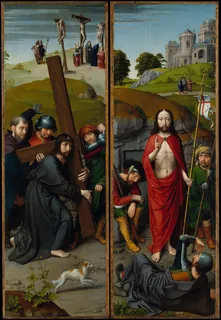
Around this time he also painted a pair of wings, full of color when open and gray when closed. Look at the bottom of the left inner wing. Beside Christ's bare feet as he carries the cross, a little white dog with orange patches runs past.
Painted around this timeChrist Carrying the Cross, with the Crucifixion; The Resurrection, with the Pilgrims of Emmaus - 1515Antwerp
This time David's name goes into the register of the Antwerp painters' guild. The channel that linked Bruges to the sea was silting up, and ships and merchants were moving north to Antwerp. Antwerp was also growing into a big market for paintings.
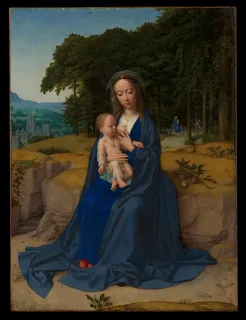
The Rest on the Flight into Egypt dates from about this time. The Virgin, in a deep blue mantle, sits on a rock and nurses the child. Look down the forest path on the right: there the family appears again, tiny, still on the road, with Mary riding the donkey. Because several versions of this scene survive, the picture is thought to come from a pattern David worked out for paintings sold on the open market.
Painted around this timeThe Rest on the Flight into Egypt - 1519Bruges
A quarrel breaks out between David and his assistant Ambrosius Benson. David had seized two of Benson's chests, packed with patterns, drawings and a few paintings. Benson owed him a good deal of money.
Benson took David to court. The ruling came in January 1520, and according to the records David was sent to prison. A dispute between an aging master and his young assistant was written into the city's files.
- 1523Bruges
On 13 August 1523 David died in Bruges and was buried in the Church of Our Lady. After that his name faded for centuries, and some of his paintings were given to other artists.
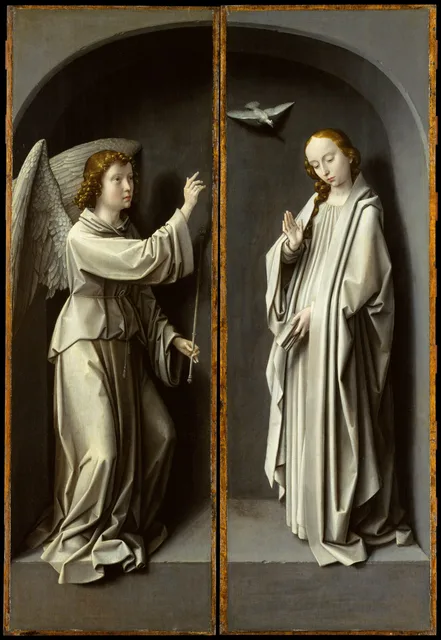
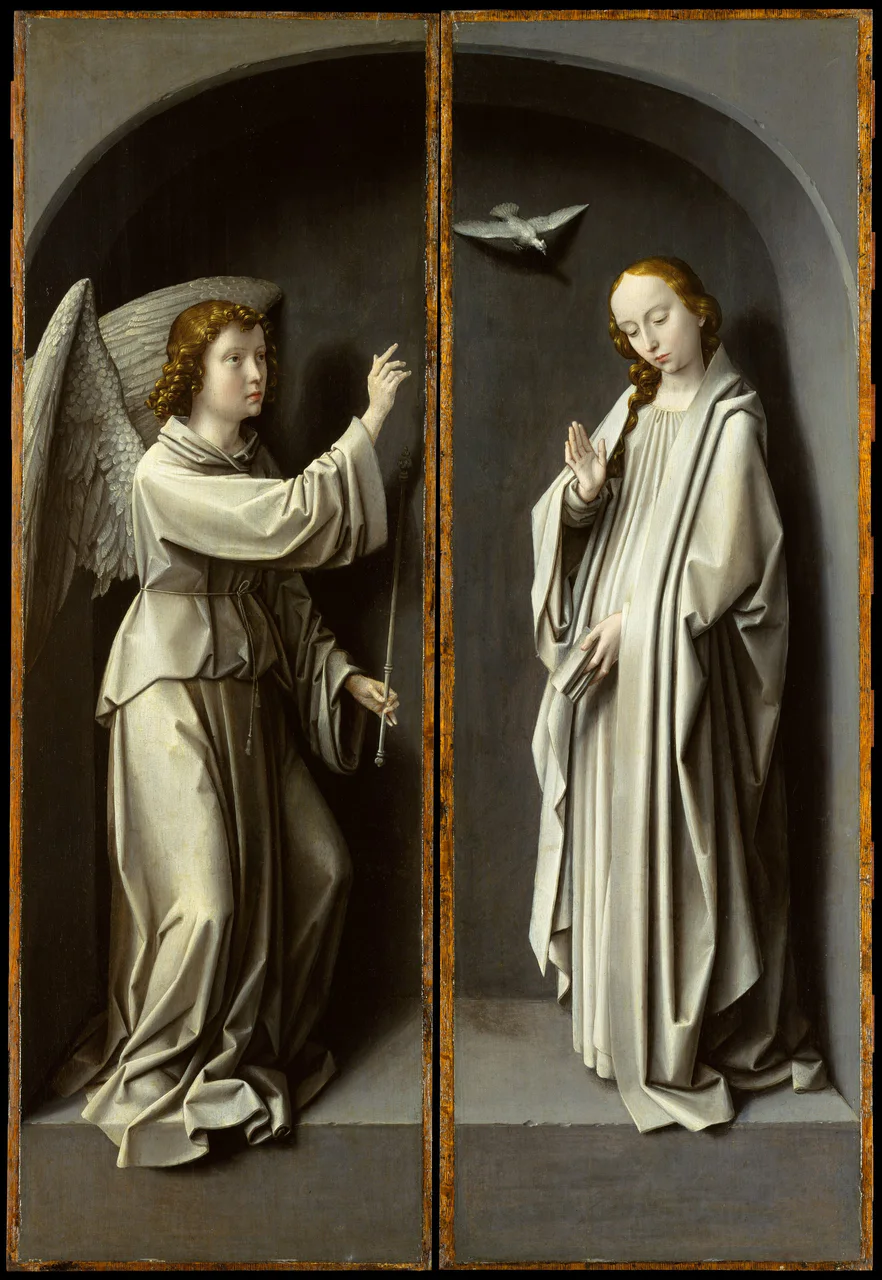
In the nineteenth century the English scholar James Weale searched the Bruges archives and found the records of David's life. Only then were his name and his pictures joined up again. Look at his gray wings: Gabriel, as if carved in stone, raises a hand in greeting, and the Virgin lifts her hand to receive his words.
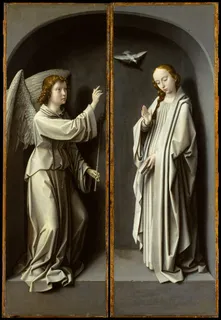 Painted around this timeArchangel Gabriel; The Virgin Annunciate
People around them
- Cornelia Cnoophis wife from about 1496, daughter of the head of the goldsmiths' guild.
- Hans Memlingthe famous Bruges painter before him; after Memling's death David became one of the city's leading painters.
- Ambrosius Bensonhis assistant, who took him to court in 1519 over two chests of patterns.
- James Wealethe nineteenth-century English scholar who found David's records in the Bruges archives.