 Pyeongye
Artwork · 17th century · Pieter de Hooch
LeoTurn on Magnifier at the lower right and move slowly across the painting.
Full screen opens it edge to edge.Tap the painting to fill the screen.
Spread two fingers to look closer.
At a glance
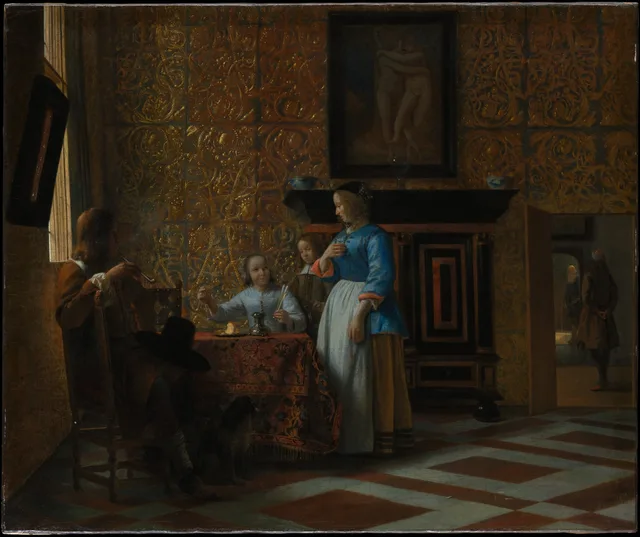
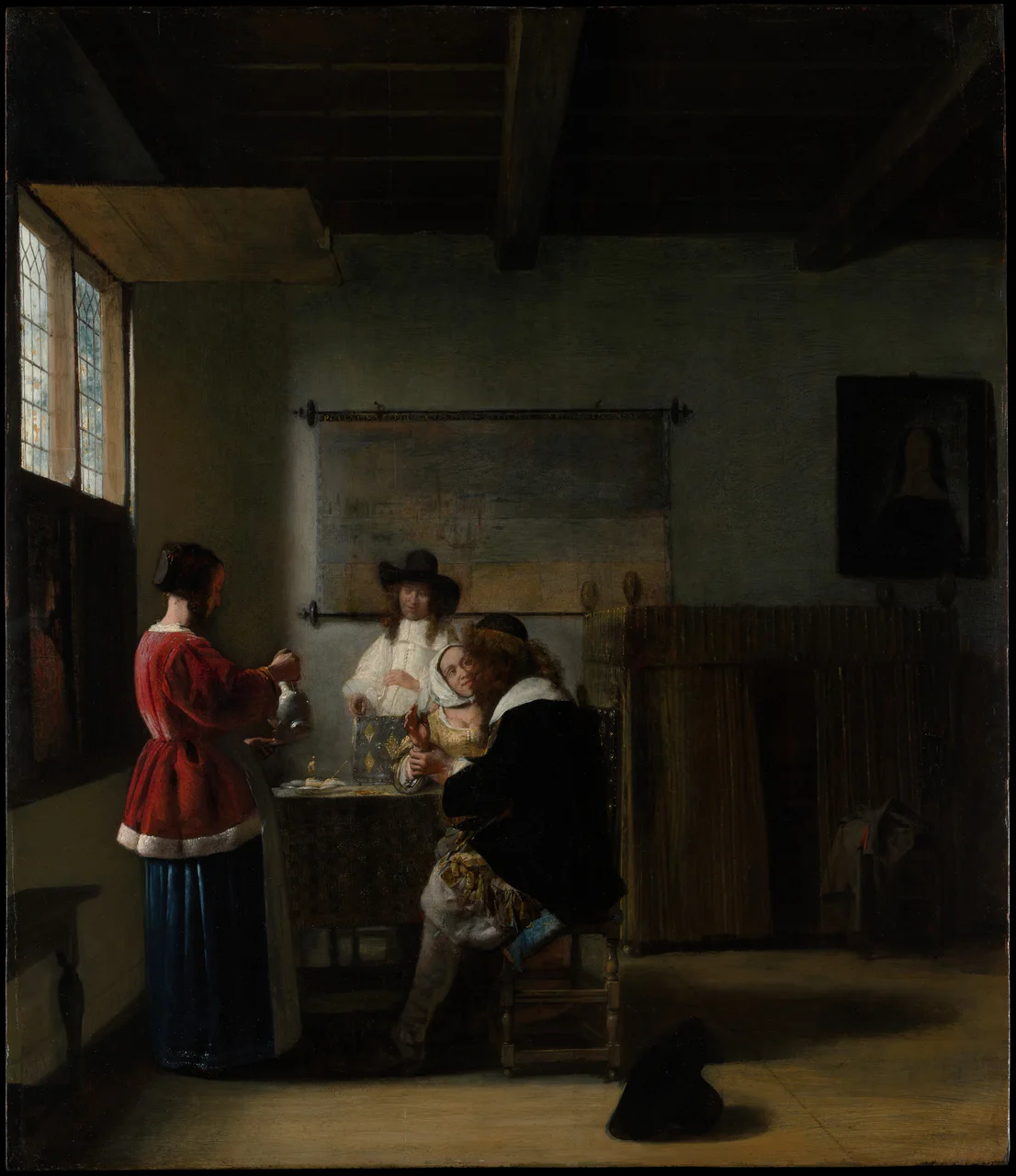
- Two men and two women drink and flirt in the sunlit front room of a Dutch house.
- The Dutch painter Pieter de Hooch painted it in oil on a wooden panel around 1657, while he was working in Delft.
- At first it looks like a friendly visit, but a plate of oysters on the table and a curtained bed hint at another story.
Reading the picture
5 places to look closer
Tap a number on the painting to jump to its note, or a close-up to see that spot in the whole picture.
Zoom in on the window at the upper left. Small panes of glass sit in lead strips, set in diamonds at the top and squares lower down. Each pane catches a patch of blue and white from the sky outside. Light from this one window falls on everyone in the room.
Look at the hands of the woman in the red jacket. With her right hand she tips a silvery jug, pouring into a slender glass she holds in her left. A white highlight from the window sits on the belly of the jug. Her back is to us, so we never see her face.
Zoom in on the pair in the middle. The man in black has hold of the wrist of the woman in yellow. She looks up at him from under her headscarf and smiles. Behind them, the man in white holds something thin and white, perhaps a clay pipe, as he stands facing the couple.
Look at the white plate on the table. A few opened oysters lie on it, with a thin blade resting across them at an angle. In Dutch paintings of this time, oysters were a food that called to mind seduction.
Zoom in on the dark wall at the right. A curtain with long vertical folds hangs all the way to the floor. It closes off a bed. On the chair beside it, a piece of clothing, maybe a coat, has been tossed over the back.
When it was painted
When he painted this, de Hooch was about twenty-seven or twenty-eight. Born in the port city of Rotterdam, he had come to Delft in the early 1650s. A record from 1653 describes him as both servant and painter to Justus de la Grange, a linen merchant. By 1655 that merchant owned eleven of his paintings.
In 1654 de Hooch married Jannetje van der Burch. The next year he joined the city's painters' guild, the Guild of Saint Luke. Johannes Vermeer was working in the same town at the same time, and many scholars think the two painters learned from each other's pictures.
The setting here is the front room facing the street. In a narrow Dutch house, that was the room that got the most daylight. Even so, the Metropolitan Museum of Art points to the oysters and the curtained bed and concludes that de Hooch most likely meant this to be a brothel, not a respectable home. Scenes of people carousing together were painted in great numbers in the Netherlands in these years.
Around 1660 de Hooch left Delft for Amsterdam. He died in 1684 in an asylum in Amsterdam. This painting came to the Metropolitan Museum in 1929 through the bequest of the New York collector Louisine Havemeyer.
Look again at the window at the upper left. Only one source of light enters this room full of laughter and wine. Follow it, and the objects the painter tucked into the scene start to show themselves one by one.
More by the same painter
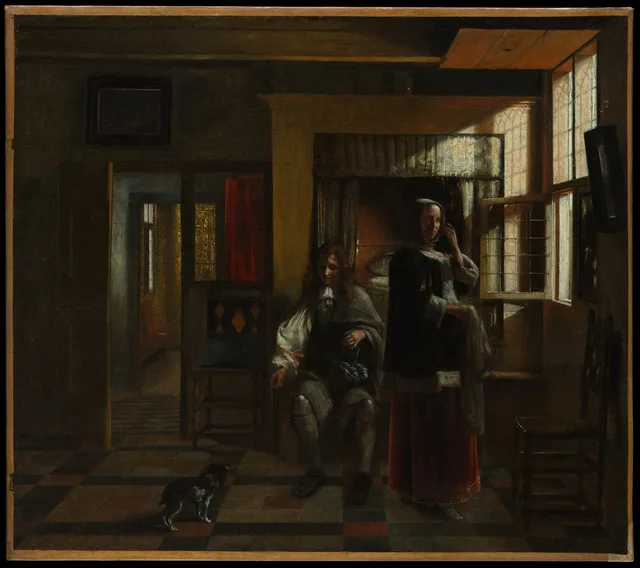
Questions to think about
- Look for itWhat does the dark object lying on the floor at the lower right look like to you?
- Why?Why do you think de Hooch painted this scene to look like an ordinary front room instead of a tavern?
- What about you?A single object in a picture can change the meaning of the whole scene. What quiet stories might the small props in the photos we post today be telling the people who see them?
Same period
Painted around the same time,
somewhere else
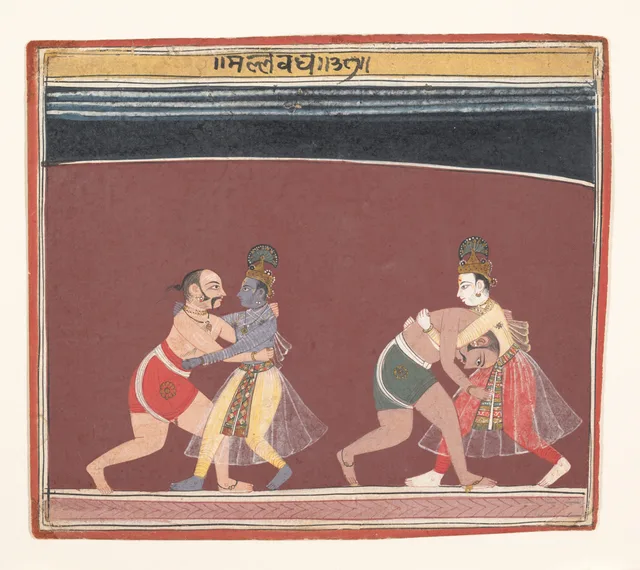 Krishna and Balarama Fight the Evil King Kamsa’s Wrestlers: Page from a Dispersed Bhagavata PuranaUnknown artist · India (Madhya Pradesh, Malwa)ca. 1650
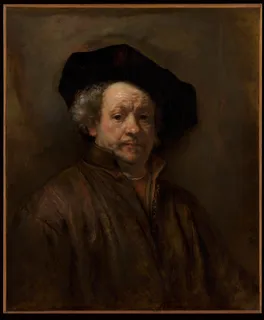 Self-PortraitRembrandt1660
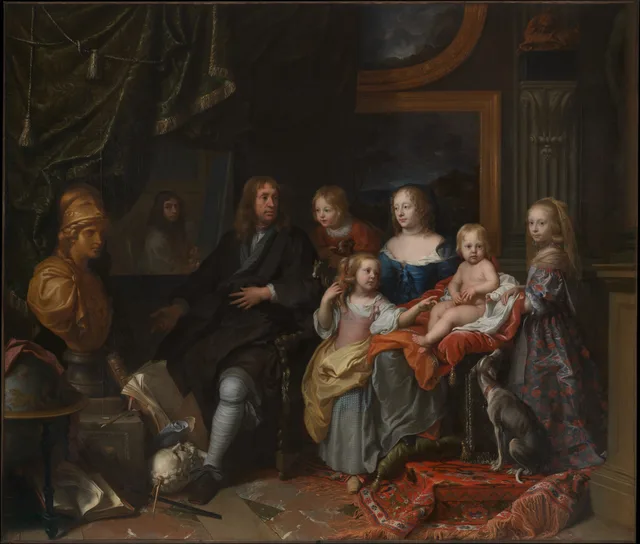 The Jabach FamilyCharles Le Brunca. 1660
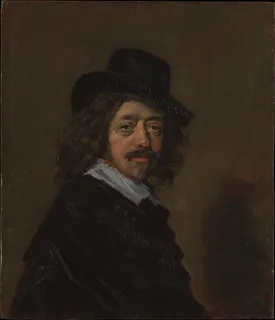 Frans Hals (1582/83–1666)Frans Halsprobably 1650s
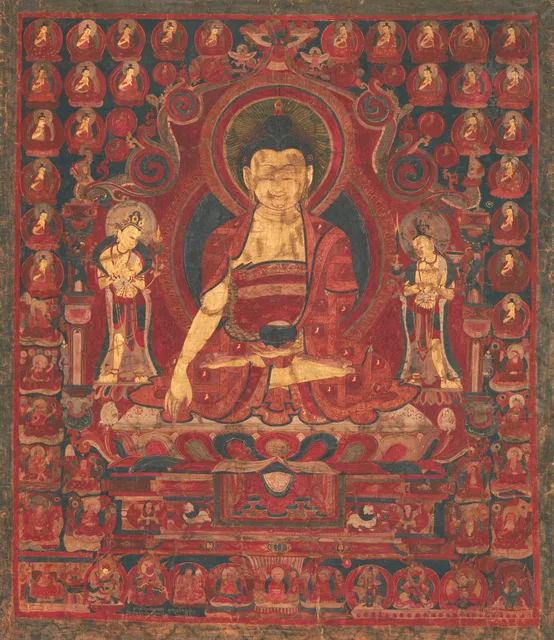 Buddha Shakyamuni as "Lord of the Munis"Unknown artist · Western Tibet, Gugemid-17th century
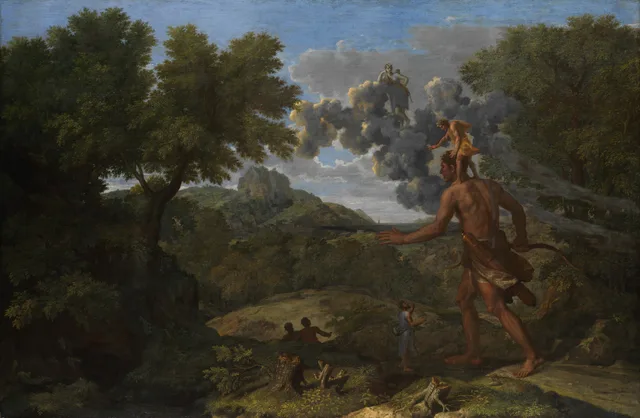 Blind Orion Searching for the Rising SunNicolas Poussin1658
Too good to keep to yourself
This painting,
for someone who comes to mind
They open it at full size
and see every brushstroke.
About this work
- Artist
- Pieter de Hooch · 1629–1684
- Date
- ca. 1657
- Medium
- Oil on wood
- Size
- 67.9 × 58.4 cm
- Collection
- The Metropolitan Museum of Art
- Image
- Original long edge 3701px · shown at 2560px
- Original
- View on the museum's website ↗