Pyeongye

Painters · 20th century
Gustav Klimt
1862–1918
A Vienna painter, the son of a gold engraver, who started out decorating theater ceilings, broke away from the old art establishment, and filled his portraits with gold leaf and pattern.
Scenes from a life
The life of Gustav Klimt,
scene by scene
- 1876Vienna
Gustav was born in 1862 just outside Vienna. His father was a gold engraver, and money at home was tight. At fourteen Gustav entered Vienna's School of Applied Arts. His younger brother Ernst soon followed him there.
- 1886Vienna
After their studies, the Klimt brothers teamed up with their friend Franz Matsch to form a small company of painters. The three took on ceilings and walls in theaters and palaces. From 1886 they painted the staircase ceilings of the new Burgtheater, Vienna's court theater, and the job made young Klimt's name known in the city.
- 1892Vienna
That year Klimt lost his father and then his brother Ernst. Ernst had been married only a short time, and Gustav became guardian of the baby daughter he left behind. Ernst's wife Helene had a younger sister, Emilie Flöge. From then until his death, Emilie remained the person closest to Klimt.
- 1897Vienna
Klimt and a group of young painters and architects walked out of the old artists' association and founded a new one: the Vienna Secession. He became its first president. The following year the Secession put up its own exhibition building, crowned with a dome of golden laurel leaves.
- 1900Vienna
Klimt had been commissioned to paint three large pictures for the ceiling of the University of Vienna's great hall. When the first, Philosophy, was shown in 1900, professors signed a protest. Instead of celebrating learning as a shining light, it showed a column of naked people drifting through darkness. The quarrel dragged on for years, and in 1905 Klimt returned the fee and took the paintings back.
- 1907Vienna
The gold engraver's son brought gold onto the canvas. In these years Klimt painted one picture after another with real gold leaf. In 1907 he finished his portrait of Adele Bloch-Bauer, and The Kiss was bought by the Austrian state at an exhibition the following year. This stretch is often called his golden phase.
- 1912Vienna
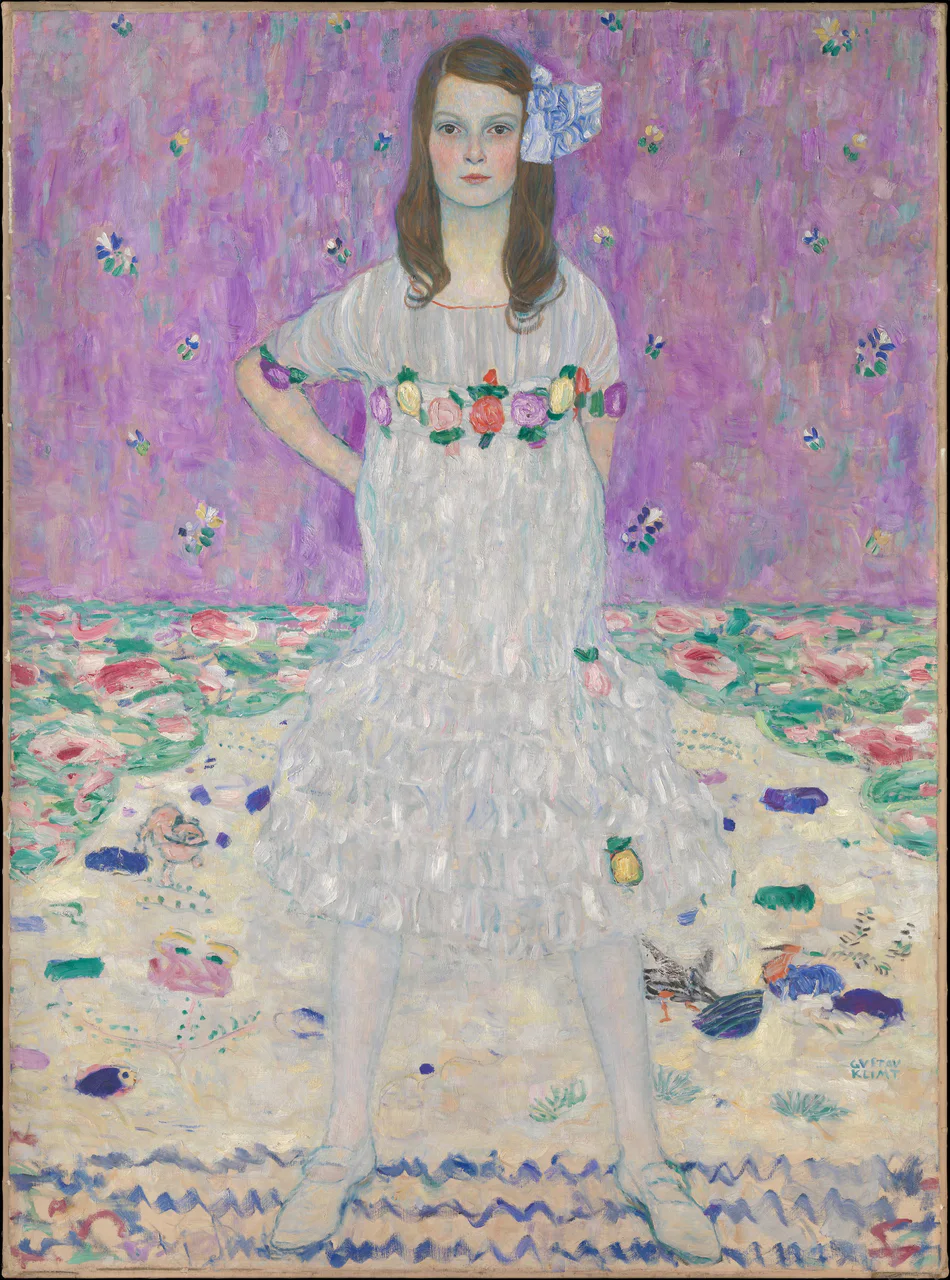
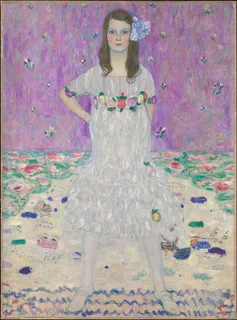
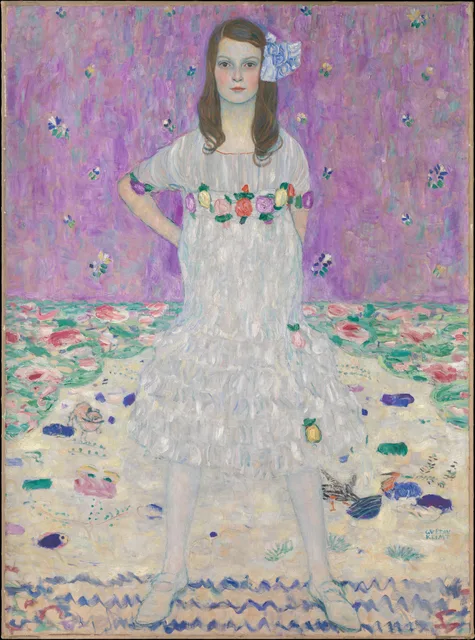
The banker Otto Primavesi asked Klimt to paint his nine-year-old daughter, Mäda. In Mäda Primavesi, the girl plants her feet apart, puts one hand on her hip, and looks straight at us. A garland of flowers runs across the front of her white dress, and a blue bow sits in her hair. Small flowers are scattered over the lilac background, and down by her feet on the right stands a bird with orange legs. There is no gold here, but the whole canvas is alive with pattern and color.
 Painted around this timeMäda Primavesi (1903–2000)
- 1918Vienna
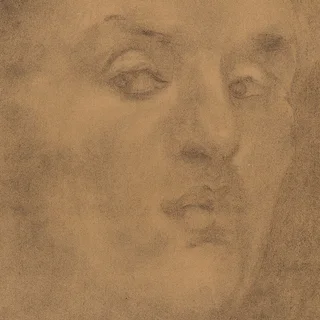
In January 1918 Klimt suffered a stroke, and in February he died at fifty-five. Unfinished paintings were still standing on the easels in his studio. The young painter Egon Schiele, who admired him, drew Klimt's face after his death. Schiele himself died that fall in the influenza epidemic.
People around them
- Ernst Klimthis younger brother and partner in the painting company, who died young in 1892.
- Franz Matscha friend from the School of Applied Arts who painted theater and palace ceilings with the Klimt brothers.
- Emilie Flögea Vienna fashion designer who ran her own salon, and the person closest to Klimt for the rest of his life.
- Josef Hoffmannan architect and fellow founder of the Secession, who worked with Klimt on buildings and exhibitions.
- Egon Schielea young painter whom Klimt encouraged and helped.
- Otto Primavesia banker and patron who commissioned portraits of his family from Klimt.
Works
Paintings by
Gustav Klimt on Pyeongye
More paintings by this artist will be added.
Contemporaries