 Pyeongye
Artwork · 19th century · Edgar Degas
LeoTurn on Magnifier at the lower right and move slowly across the painting.
Full screen opens it edge to edge.Tap the painting to fill the screen.
Spread two fingers to look closer.
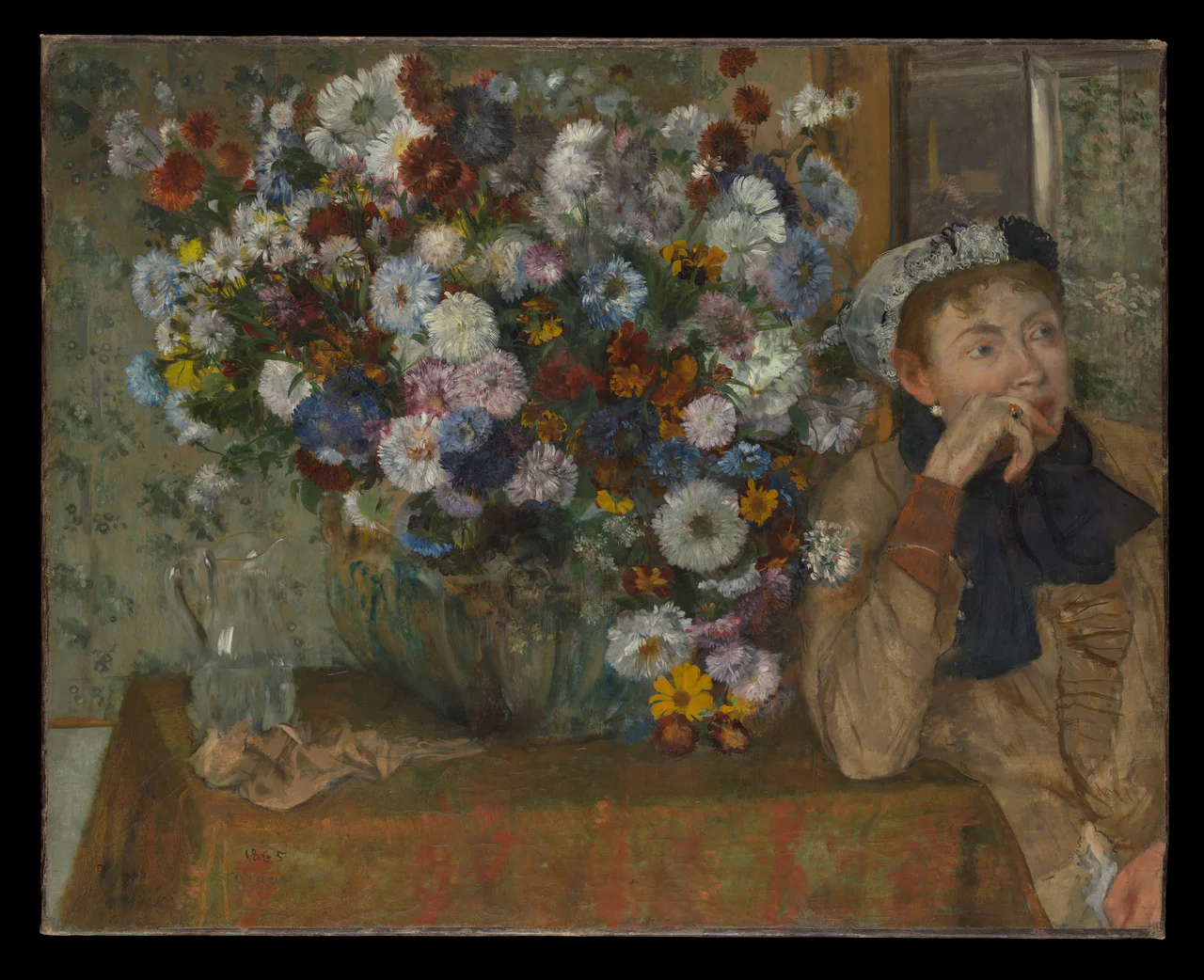
A Woman Seated beside a Vase of Flowers (Madame Paul Valpinçon?)
Edgar Degas1865Oil on canvas73.7 × 92.7 cm
At a glance
- A huge bunch of flowers fills the middle of the canvas, while a woman at the right edge presses her hand to her mouth and looks away.
- Edgar Degas painted it in oil on canvas in 1865.
- The flowers hold the center and the person sits at the edge, so your eye keeps traveling back and forth between them.
Reading the picture
5 places to look closer
Tap a number on the painting to jump to its note, or a close-up to see that spot in the whole picture.
Start with the bouquet. White, lilac, blue, and rust-red blooms crowd together in one round mass. Each petal is a short, quick stroke, and up close the brush marks are still plain to see.
Now slide over to the right edge. A woman in a lace cap rests her chin on her hand, fingers pressed to her mouth. A ring with a reddish stone sits on one finger, and a small white earring hangs from her ear. Her eyes are fixed on something outside the picture, and Degas never shows us what it is.
Look at the left end of the table. A glass pitcher of water stands there, with a crumpled, light-brown cloth below it. Degas paints the glass with only a few white flicks for the shine. It looks like a table someone has just left after arranging flowers.
Zoom in at the front of the vase, low down. One yellow flower and a few dark red ones spill over the rim toward the table. Each yellow petal is a single press of the brush. Against the dark brown table, that yellow jumps right out.
At the lower left, on the tablecloth, you can find the numbers 1865. Below them, faint and easy to miss, is the name Degas. This is the painter's signature and the year.
When it was painted
In 1865 Degas turned thirty-one. He was the son of a Parisian banking family, and a few years earlier he had come home from Italy, where he spent years copying the old masters. That year he showed at the Paris Salon for the first time. His entry was a history painting of a medieval war scene. This canvas has no hero and no big event, just flowers and a woman lost in thought.
The question mark in the title means no one is sure who sat for it. The museum suggests she may be Madame Paul Valpinçon. Paul Valpinçon was a school friend of Degas. The painter often stayed at the family's country house, Ménil-Hubert, in Normandy, and he later painted the Valpinçons' young daughter, Hortense.
The friendship came with a well-known story. Paul's father, Édouard, was a collector who owned Ingres's Valpinçon Bather. In 1855 the young Degas talked him into lending it to the World's Fair, and through that favor he got to meet Ingres, the painter he revered. For the rest of his life Degas told how Ingres advised him to draw lines, many lines.
This picture has also gone by the name Woman with Chrysanthemums. Its layout is so unusual, with the sitter pushed to one edge, that many writers have suggested Degas added her to a flower painting he had already made. The canvas later joined the Havemeyer collection in New York and came to the Met with Louisine Havemeyer's bequest in 1929.
Nine years after this painting, in 1874, Degas helped organize the first Impressionist exhibition. Take your eyes off the bouquet and look at the right edge once more. Her off-center seat is a taste of the lopsided, edge-cut compositions Degas would keep using for years.
The painter
Edgar Degas
1834–1917
When painting this, the artist was about 31 years old
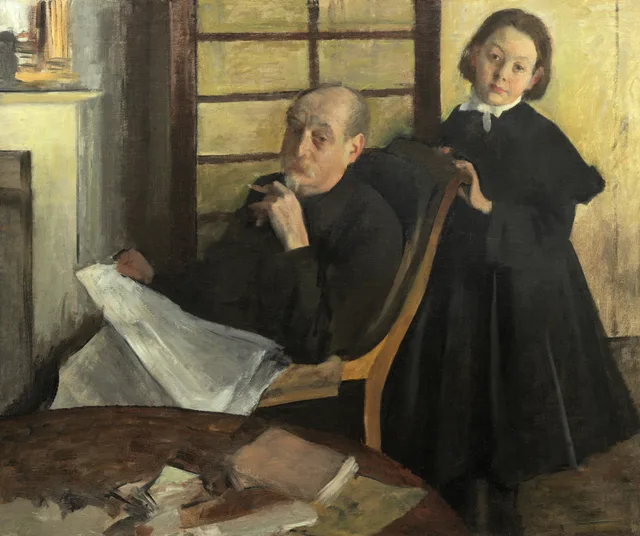
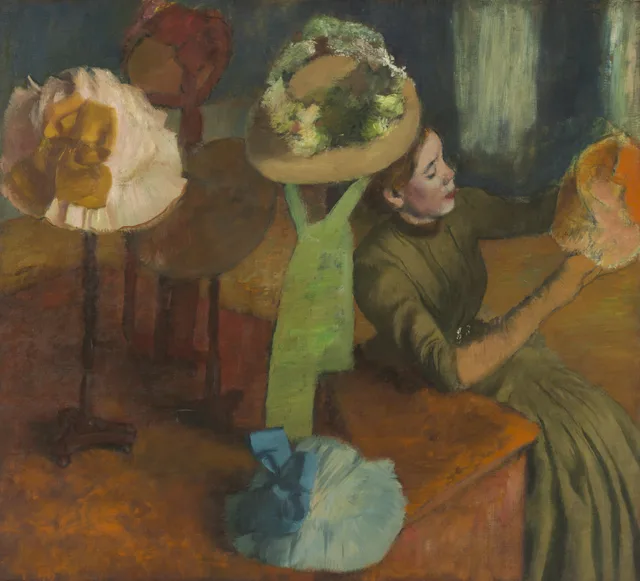
All paintings by Edgar Degas →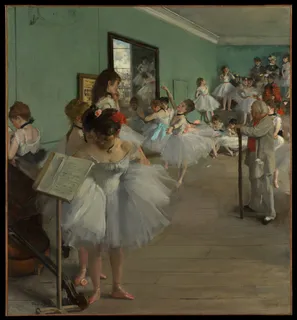
Questions to think about
- Look for itCan you find the woman's ring and her earring? What colors are they?
- Why?Why do you think Degas placed the woman at the edge instead of in the middle?
- What about you?In photos today, the flashiest thing often takes the center while people drift to the side. When we scroll past pictures like that, do we notice how the people in them actually feel?

Too good to keep to yourself
This painting,
for someone who comes to mind
They open it at full size
and see every brushstroke.
About this work
- Artist
- Edgar Degas · 1834–1917
- Date
- 1865
- Medium
- Oil on canvas
- Size
- 73.7 × 92.7 cm
- Collection
- The Metropolitan Museum of Art
- Image
- Original long edge 4000px · shown at 2560px
- Original
- View on the museum's website ↗